
Pulp Fiction, 1917 · page 69 of 192
The Argosy, Vol. 84 No. 2 — page 69: what you’re looking at
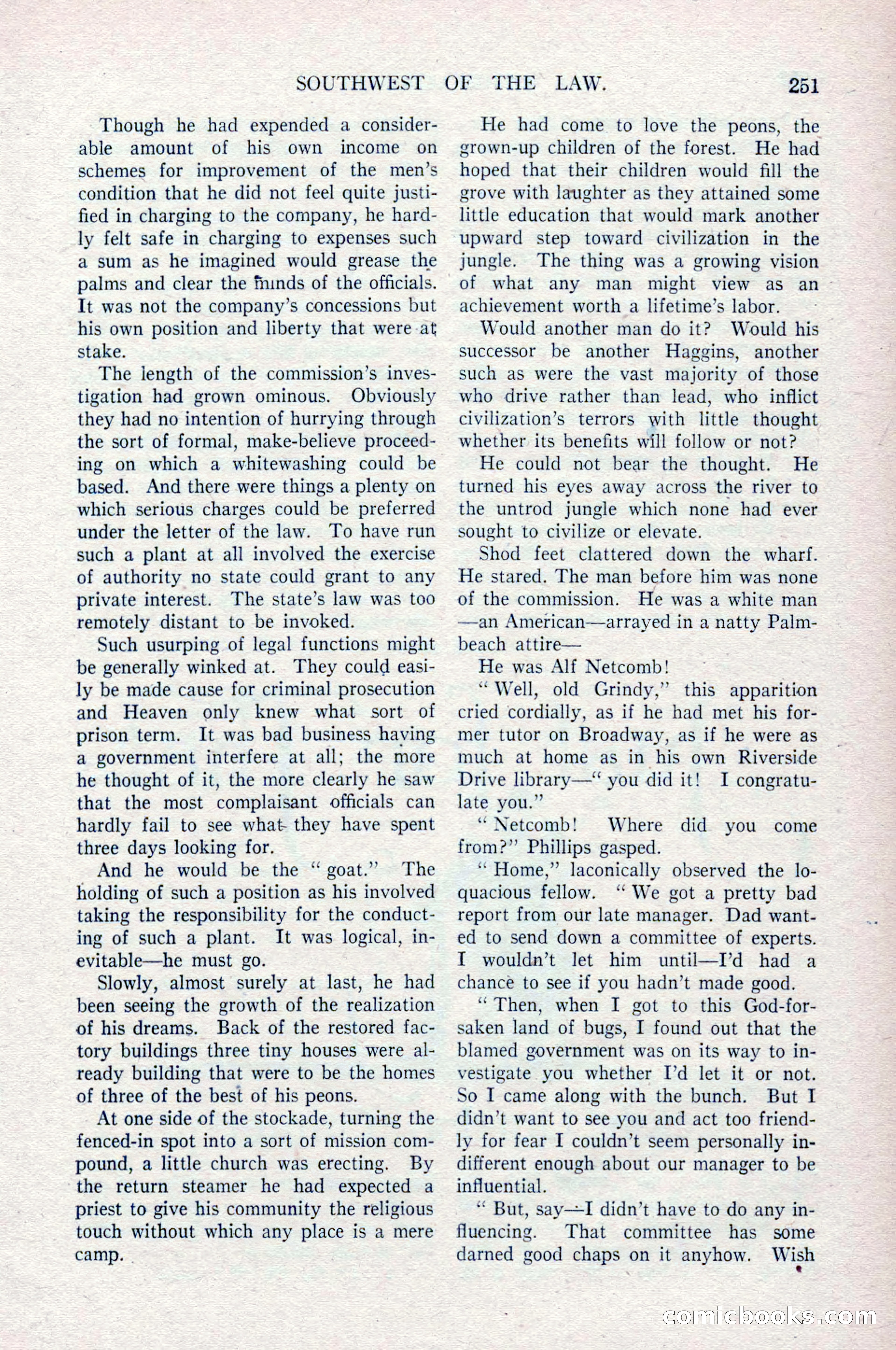
A restored page from Pulp Fiction, 1917. Page through the whole issue in the reader above.
📄 Transcribed text from this page (OCR, searchable)
Machine-transcribed from the original scan — historical spelling and the odd misread are preserved.
SOUTHWEST OF Though he had expended a consider- able amount of his own income on schemes for improvement of the men’s condition that he did not feel quite justi- fied in charging to the company, he hard- ly felt safe in charging to expenses such a sum as he imagined would grease the palms and clear the finds of the officials. It was not the company’s concessions but his own position and liberty that were-at stake. The length of the commission’s inves- tigation had grown ominous. Obviously they had no intention of hurrying through the sort of formal, make-believe proceed- ing on which a whitewashing could be based. And there were things a plenty on which serious charges could be preferred under the letter of the law. To have run such a plant at all involved the exercise of authority no state could grant to any private interest. The state’s law was too remotely distant to be invoked. Such usurping of legal functions might be generally winked at. They could easi- ly be made cause for criminal prosecution and Heaven only knew what sort of prison term. It was bad business having a government interfere at all; the more he thought of it, the more clearly he saw that the most complaisant officials can hardly fail to see what they have spent three days looking for. And he would be the ‘“ goat.’ The holding of such a position as his involved taking the responsibility for the conduct- ing of such a plant. It was logical, in- evitable—he must go. Slowly, almost surely at last, he had been seeing the growth of the realization of his dreams. Back of the restored fac- tory buildings three tiny houses were al- ready building that were to be the homes of three of the best of his peons. At one side of the stockade, turning the fenced-in spot into a sort of mission com- pound, a little church was erecting. By the return steamer he had expected a priest to give his community the religious touch without which any place is a mere camp. . THE LAW. 251 He had come to love the peons, the grown-up children of the forest. He had hoped that their children would fill the grove with laughter as they attained some little education that would mark another upward step toward civilization in the jungle. The thing was a growing vision of what any man might view as an - achievement worth a lifetime’s labor. Would another man do it? Would his successor be another Haggins, another such as were the vast majority of those who drive rather than lead, who inflict civilization’s terrors with little thought whether its benefits will follow or not? He could not bear the thought. He turned his eyes away across the river to the untrod jungle which none had ever sought to civilize or elevate. Shod feet clattered down the wharf. He stared. The man before him was none of the commission. He was a white man —an American—arrayed in a natty Palm- beach attire— He was Alf Netcomb! “Well, old Grindy,” this apparition cried cordially, as if he had met his for- mer tutor on Broadway, as if he were as much at home as in his own Riverside Drive library—‘ you did it! I congratu- late you.” “Netcomb! Where did you come from?” Phillips gasped. ‘“ Home,” laconically observed the lo- quacious fellow. ‘‘ We got a pretty bad report from our late manager. Dad want- ed to send down a committee of experts. I wouldn’t let him until—I’d had a chance to see if you hadn’t made good. “Then, when I got to this God-for- saken land of bugs, I found out that the blamed government was on its way to in- vestigate you whether Id let it or not. So I came along with the bunch. But I didn’t want to see you and act too friend- ly for fear I couldn’t seem personally in- different enough about our manager to be influential. ‘* But, say—TI didn’t have to do any in- fluencing. That committee has some darned good chaps on it anyhow. Wish COMMUC VOOKS (C@