
Pulp Fiction, 1917 · page 66 of 192
The Argosy, Vol. 84 No. 2 — page 66: what you’re looking at
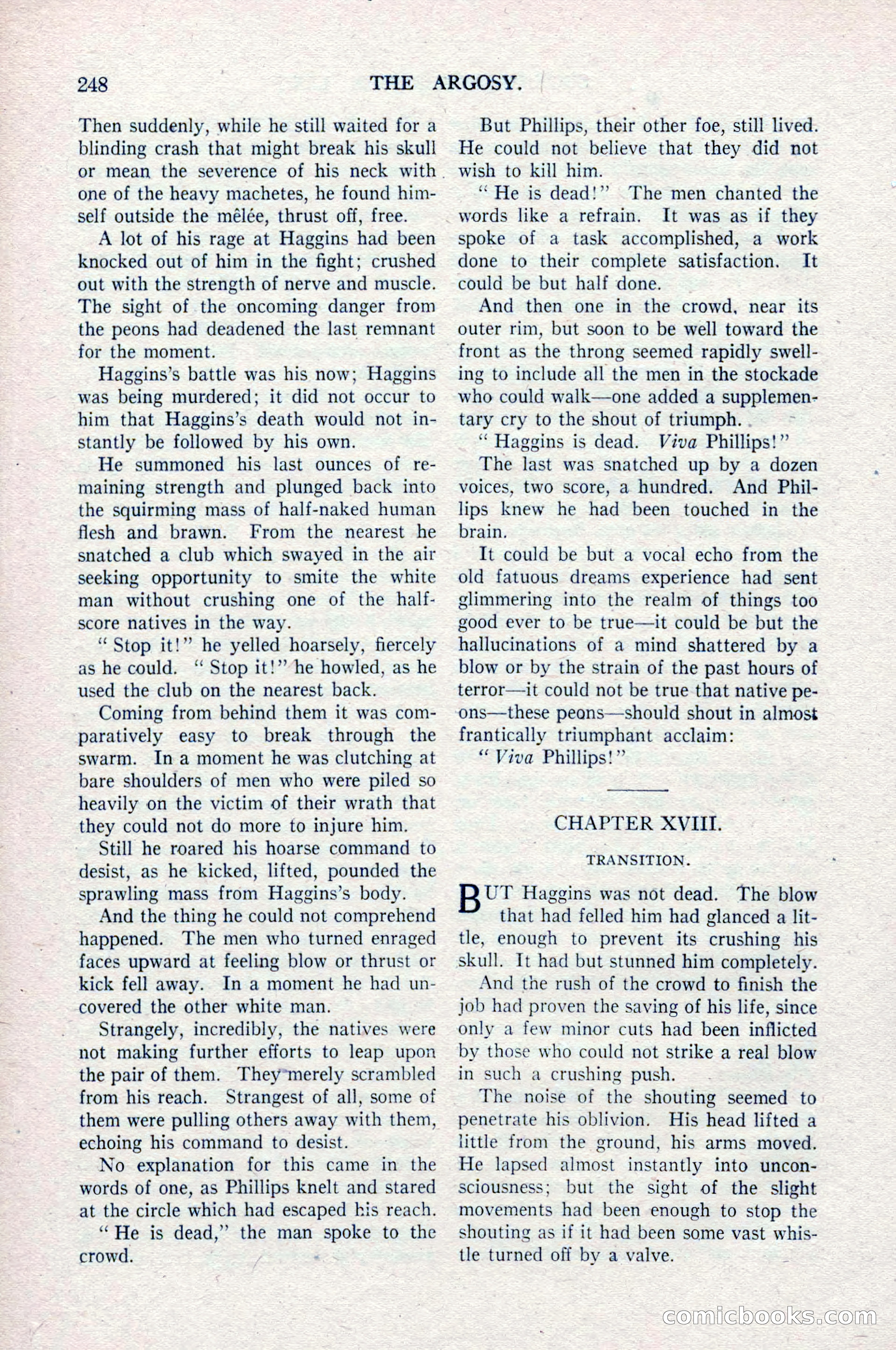
A restored page from Pulp Fiction, 1917. Page through the whole issue in the reader above.
📄 Transcribed text from this page (OCR, searchable)
Machine-transcribed from the original scan — historical spelling and the odd misread are preserved.
248 Then suddenly, while he still waited for a blinding crash that might break his skull or mean the severence of his neck with. one of the heavy machetes, he found him- self outside the mélée, thrust off, free. A lot of his rage at Haggins had been knocked out of him in the fight; crushed out with the strength of nerve and muscle. The sight of the oncoming danger from the peons had deadened the last remnant for the moment. Haggins’s battle was his now; Haggins was being murdered; it did not occur to him that Haggins’s death would not in- stantly be followed by his own. He summoned his last ounces of re- maining strength and plunged back into the squirming mass of half-naked human flesh and brawn. From the nearest he snatched a club which swayed in the air seeking opportunity to smite the white man without crushing one of the half- score natives in the way. ‘Stop it!” he yelled hoarsely, fiercely as he could. ‘‘ Stop it!” he howled, as he used the club on the nearest back. Coming from behind them it was com- paratively easy to break through the swarm. In a moment he was clutching at bare shoulders of men who were piled so heavily on the victim of their wrath that they could not do more to injure him. Still he roared his hoarse command to desist, as he kicked, lifted, pounded the sprawling mass from Haggins’s body. And the thing he could not comprehend happened. The men who turned enraged faces upward at feeling blow or thrust or kick fell away. In a moment he had un- covered the other white man. Strangely, incredibly, the natives were not making further efforts to leap upon the pair of them. They*merely scrambled from his reach. Strangest of all, some of them were pulling others away with them, echoing his command to desist. No explanation for this came in the words of one, as Phillips knelt and stared at the circle which had escaped kis reach. ‘He is dead,” the man spoke to the crowd. , THE ARGOSY. But Phillips, their other foe, still lived. He could not believe that they did not wish to kill him. ‘He is dead!”” The men chanted the words like a refrain. It was as if they spoke of a task accomplished, a work done to their complete satisfaction. It could be but half done. And then one in the crowd, near its outer rim, but soon to be well toward the front as the throng seemed rapidly swell- ing to include all the men in the stockade who could walk—one added a supplemen- tary cry to the shout of triumph. . ‘ Haggins is dead. Viva Phillips!” The last was snatched up by a dozen voices, two score, a hundred. And Phil- lips knew he had been touched in the brain. It could be but a vocal echo from the old fatuous dreams experience had sent glimmering into the realm of things too good ever to be true—it could be but the hallucinations of a mind shattered by a blow or by the strain of the past hours of terror—it could not be true that native pe- ons—these peans—should shout in almost frantically triumphant acclaim: “Viva Phillips!” CHAPTER XVIII. TRANSITION. But Haggins was not dead. The blow that had felled him had glanced a lit- tle, enough to prevent its crushing his skull. It had but stunned him completely. And the rush of the crowd to finish the job had proven the saving of his life, since only a few minor cuts had been inflicted by those who could not strike a real blow in such a crushing push. The noise of the shouting seemed to penetrate his oblivion. His head lifted a little from the ground, his arms moved. He lapsed almost instantly into uncon- sciousness; but the sight of the slight movements had been enough to stop the shouting as if it had been some vast whis- tle turned off by a valve. COMIC OOOKS (C@