
Pulp Fiction, 1917 · page 151 of 192
The Argosy, Vol. 84 No. 2 — page 151: what you’re looking at
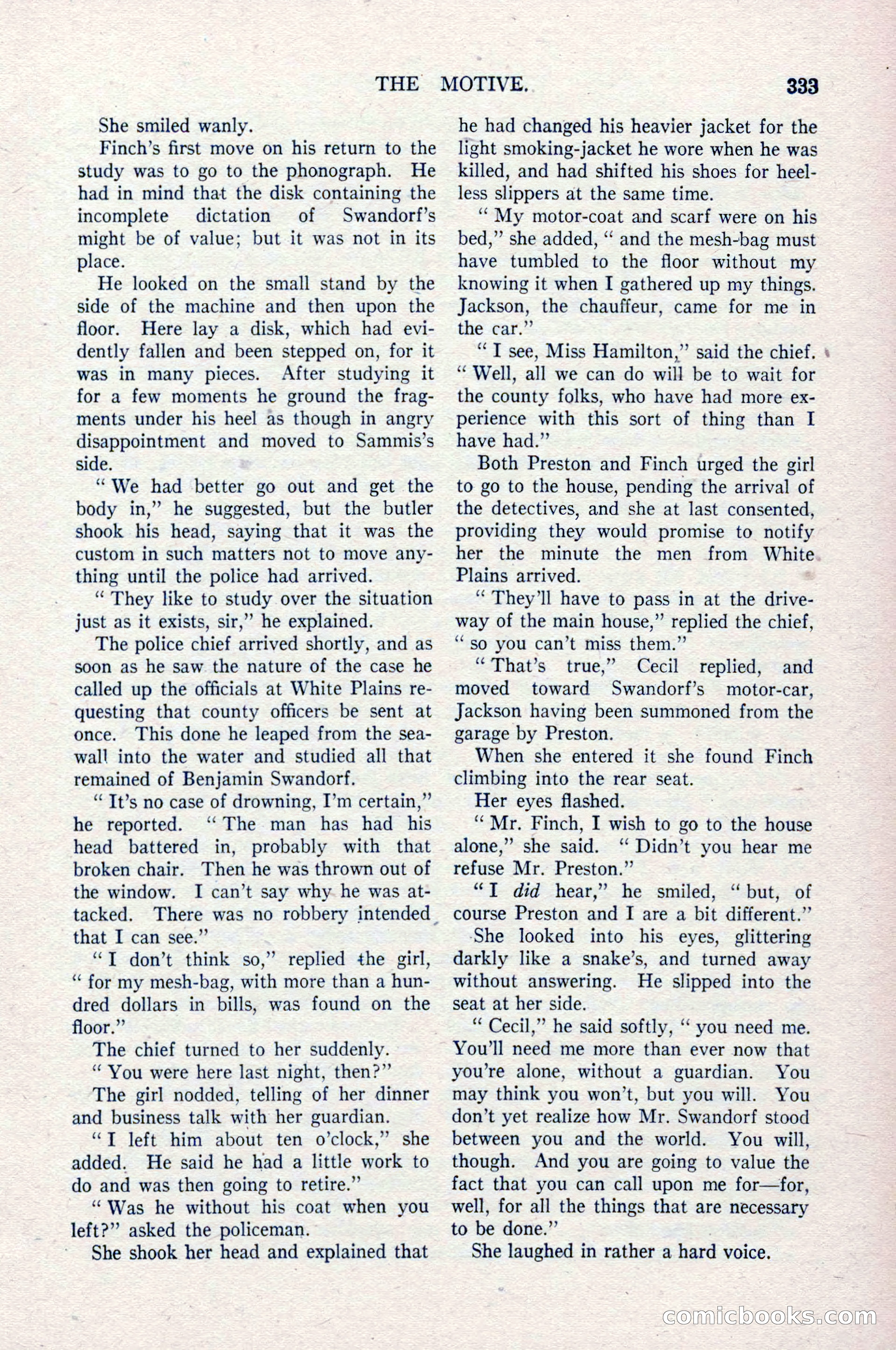
A restored page from Pulp Fiction, 1917. Page through the whole issue in the reader above.
📄 Transcribed text from this page (OCR, searchable)
Machine-transcribed from the original scan — historical spelling and the odd misread are preserved.
THE MOTIVE. She smiled wanly. Finch’s first move on his return to the study was to go to the phonograph. He had in mind that the disk containing the incomplete dictation of Swandorf’s might be of value; but it was not in its place. He looked on the small stand by the side of the machine and then upon the floor. Here lay a disk, which had evi- dently fallen and been stepped on, for it was in many pieces. After studying it for a few moments he ground the frag- ments under his heel as though in angry disappointment and moved to Sammis’s side. “We had better go out and get the body in,” he suggested, but the butler shook his head, saying that it was the custom in such matters not to move any- thing until the police had arrived. “They like to study over the situation just as it exists, sir,” he explained. The police chief arrived shortly, and as soon as he saw the nature of the case he called up the officials at White Plains re- questing that county officers be sent at once. This done he leaped from the sea- wall into the water and studied all that remained of Benjamin Swandorf. “ Tt’s no case of drowning, I’m certain,” he reported. “The man has had his head battered in, probably with that broken chair. Then he was thrown out of the window. I can’t say why he was at- tacked. There was no robbery intended. that I can see.” “T don’t think so,” replied the girl, ‘“‘ for my mesh-bag, with more than a hun- dred dollars in bills, was found on the floor.” The chief turned to her suddenly. “You were here last night, then?”’ The girl nodded, telling of her dinner and business talk with her guardian. “T Jeft him about ten o’clock,” she added. He said he had a little work to do and was then going to retire.” “Was he without his coat when you left?”’ asked the policeman. She shook her head and explained that 333 he had changed his heavier jacket for the light smoking-jacket he wore when he was killed, and had shifted his shoes for heel- less slippers at the same time. ‘“My motor-coat and scarf were on his bed,” she added, “ and the mesh-bag must have tumbled to the floor without my knowing it when I gathered up my things. Jackson, the chauffeur, came for me in the car.” ‘““T see, Miss Hamilton,” said the chief. “Well, all we can do will be to wait for the county folks, who have had more ex- perience with this sort of thing than I have had.” Both Preston and Finch urged the girl to go to the house, pending the arrival of the detectives, and she at last consented, providing they would promise to notify her the minute the men from White Plains arrived. ‘* They’ll have to pass in at the drive- way of the main house,” replied the chief, “so you can’t miss them.” ‘“That’s true,” Cecil replied, and moved toward Swandorf’s motor-car, Jackson having been summoned from the garage by Preston. When she entered it a found Finch climbing into the rear seat. Her eyes flashed. ‘Mr. Finch, I wish to go to the house alone,” she said. ‘ Didn’t you hear me refuse Mr. Preston.” “IT did hear,” he smiled, “ but, of course Preston and I are a bit different.” ‘She looked into his eyes, glittering darkly like a snake’s, and turned away without answering. He slipped into the seat at her side. ‘ Cecil,” he said softly, ‘‘ you need me. You'll need me more than ever now that you're alone, without a guardian. You may think you won’t, but you will. You don’t yet realize how Mr. Swandorf stood between you and the world. You will, though. And you are going to value the fact that you can call upon me for—for, well, for all the things that are necessary to be done.”’ She laughed in rather a hard voice. ECOMMICLOOOK a (C@)