
Pulp Fiction, 1917 · page 140 of 192
The Argosy, Vol. 84 No. 2 — page 140: what you’re looking at
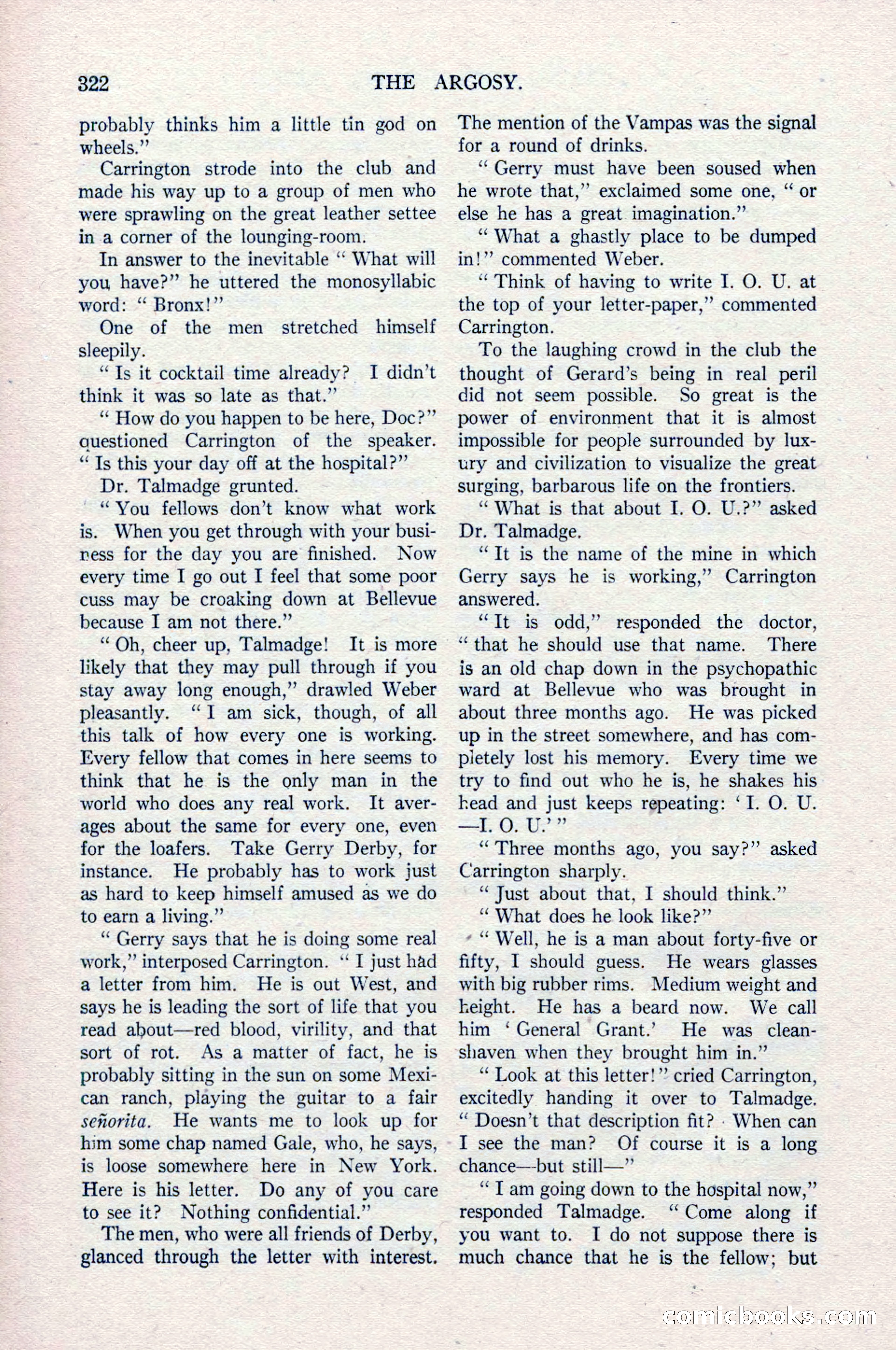
A restored page from Pulp Fiction, 1917. Page through the whole issue in the reader above.
📄 Transcribed text from this page (OCR, searchable)
Machine-transcribed from the original scan — historical spelling and the odd misread are preserved.
322 probably thinks him a little tin god on wheels.” Carrington strode into the club and made his way up to a group of men who were sprawling on the great leather settee in a corner of the lounging-room. In answer to the inevitable ‘‘ What will you have?” he uttered the monosyllabic word: “ Bronx!”’ One of the men_ stretched himself sleepily. “Ts it cocktail time already? think it was so late as that.” ‘‘ How do you happen to be here, Doc?”’ questioned Carrington of the speaker. “Ts this your day off at the hospital?”’ Dr. Talmadge grunted. “You fellows don’t know what work is. When you get through with your busi- ress for the day you are finished. Now every time I go out I feel that some poor cuss may be croaking down at Bellevue because I am not there.” “Oh, cheer up, Talmadge! It is more likely that they may pull through if you stay away long enough,” drawled Weber pleasantly. “I am sick, though, of all this talk of how every one is working. Every fellow that comes in here seems to think that he is the only man in the world who does any real work. It aver- ages about the same for every one, even for the loafers. Take Gerry Derby, for instance. He probably has to work just as hard to keep himself amused as we do to earn a living.” “ Gerry says that he is doing some real work,” interposed Carrington. “‘ I just had a letter from him. He is out West, and says he is leading the sort of life that you read ahbout—red blood, virility, and that sort of rot. As a matter of fact, he is probably sitting in the sun on some Mexi- can ranch, playing the guitar to a fair senorita, He wants me to look up for him some chap named Gale, who, he says, is loose somewhere here in New York. Here is his letter. Do any of you care to see it? Nothing confidential.” The men, who were all friends of Derby, glanced through the letter with interest. I didn’t THE ARGOSY. The mention of the Vampas was the signal for a round of drinks. “Gerry must have been soused when he wrote that,”’ exclaimed some one, “ or else he has a great imagination.” “What a ghastly place to be dumped in!’? commented Weber. “Think of having to write I. O. U. at the top of your letter-paper,”’ commented Carrington. To the laughing crowd in the club the thought of Gerard’s being in real peril did not seem possible. So great is the power of environment that it is almost impossible for people surrounded by lux- ury and civilization to visualize the great surging, barbarous life on the frontiers. ‘What is that about I. O. U.?” asked Dr. Talmadge. “Tt is the name of the mine in which Gerry says he is working,” Carrington answered. “It is odd,” responded the doctor, “that he should use that name. There is an old chap down in the psychopathic ward at Bellevue who was brought in about three months ago. He was picked up in the street somewhere, and has com- pletely lost his memory. Every time we try to find out who he is, he shakes his head and just keeps repeating: ‘I. O. U. —I. 0. UW” “Three months ago, you say?” asked Carrington sharply. “Just about that, I should think.” “What does he look like?” *“ Well, he is a man about forty-five or fifty, I should guess. He wears glasses with big rubber rims. Medium weight and height. He has a beard now. We call him ‘General Grant.’ He was clean- shaven when they brought him in.” “Look at this letter!’ cried Carrington, excitedly handing it over to Talmadge. “ Doesn’t that description fit? - When can I see the man? Of course it is a long chance—-but still—”’ “Tam going down to the hospital now,” responded Talmadge. ‘‘ Come along if you want to. I do not suppose there is much chance that he is the fellow; but CONMUC S TOO (C@