
Pulp Fiction, 1917 · page 112 of 192
The Argosy, Vol. 84 No. 2 — page 112: what you’re looking at
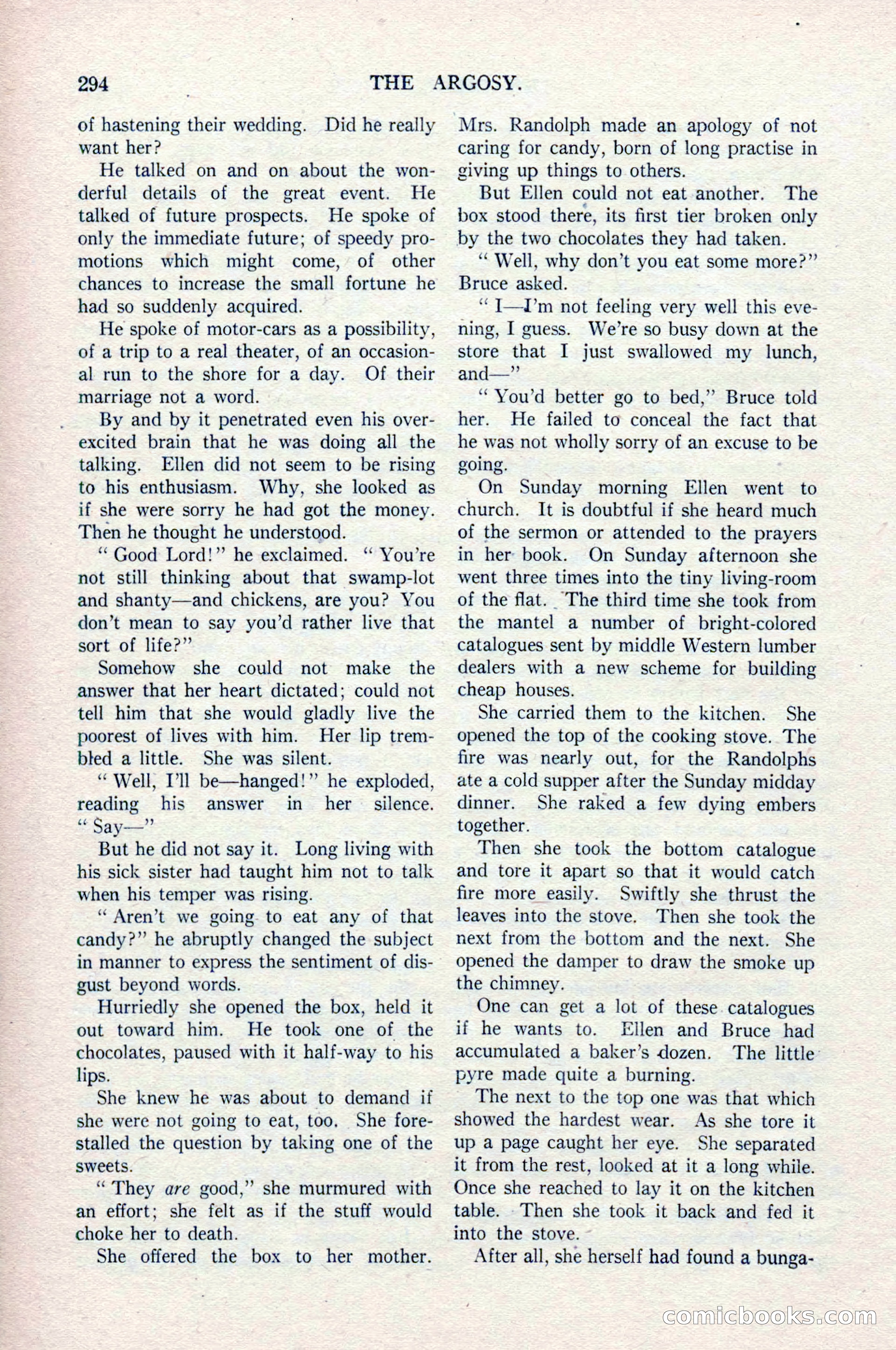
A restored page from Pulp Fiction, 1917. Page through the whole issue in the reader above.
📄 Transcribed text from this page (OCR, searchable)
Machine-transcribed from the original scan — historical spelling and the odd misread are preserved.
294 of hastening their wedding. Did he really want her? He talked on and on about the won- derful details of the great event. He talked of future prospects. He spoke of only the immediate future; of speedy pro- motions which might come, of other chances to increase the small fortune he had so suddenly acquired. He spoke of motor-cars as a possibility, of a trip to a real theater, of an occasion- al run to the shore for a day. Of their marriage not a word. ; By and by it penetrated even his over- excited brain that he was doing all the talking. Ellen did not seem to be rising to his enthusiasm. Why, she looked as if she were sorry he had got the money. Then he thought he understood. “Good Lord!” he exclaimed. ‘“ You’re not still thinking about that swamp-lot and shanty—and chickens, are you? You don’t mean to say you’d rather live that sort of life?” Somehow she could not make _ the answer that her heart dictated; could not tell him that she would gladly live the poorest of lives with him. Her lip trem- bled a little. She was silent. “Well, I'll be—hanged!”’ he exploded, reading his answer in_ her silence. éé Say—” But he did not say it. Long living with his sick sister had taught him not to talk when his temper was rising. “ Aren’t we going to eat any of that candy?” he abruptly changed the subject in manner to express the sentiment of dis- gust beyond words. Hurriedly she opened the box, held it out toward him. He took one of the chocolates, paused with it half-way to his lips. She knew he was about to demand if she were not going to eat, too. She fore- stalled the question by taking one of the sweets. “They are good,” she murmured with an effort; she felt as if the stuff would choke her to death. She offered the box to her mother. THE ARGOSY. Mrs. Randolph made an apology of not caring for candy, born of long practise in giving up things to others. But Ellen could not eat another. The box stood there, its first tier broken only by the two chocolates they had taken. “Well, why don’t you eat some more?” Bruce asked. ‘““I—J’m not feeling very well this eve- ning, I guess. We’re so busy down at the store that I just swallowed my lunch, and—”’ ‘You’d better go to bed,” Bruce told her. He failed to conceal the fact that he was not wholly sorry of an excuse to be going. On Sunday morning Ellen went to church. It is doubtful if she heard much of the sermon or attended to the prayers in her book. On Sunday afternoon she went three times into the tiny living-room of the flat. The third time she took from the mantel a number of bright-colored catalogues sent by middle Western lumber dealers with a new scheme for building cheap houses. She carried them to the kitchen. She opened the top of the cooking stove. The fire was nearly out, for the Randolphs ate a cold supper after the Sunday midday dinner. She raked a few dying embers together. Then she took the bottom catalogue and tore it apart so that it would catch fire more easily. Swiftly she thrust the leaves into the stove. Then she took the next from the bottom and the next. She opened the damper to draw the smoke up the chimney. One can get a lot of these catalogues if he wants to. Ellen and Bruce had accumulated a baker’s dozen. pyre made quite a burning. The next to the top one was that which showed the hardest wear. As she tore it up a page caught her eye. She separated it from the rest, looked at it a long while. Once she reached to lay it on the kitchen table. Then she took it back and fed it into the stove. After all, she herself had found a bunga- COMICLOOOKS The little’ (C@