
Pulp Fiction, 1917 · page 110 of 192
The Argosy, Vol. 84 No. 2 — page 110: what you’re looking at
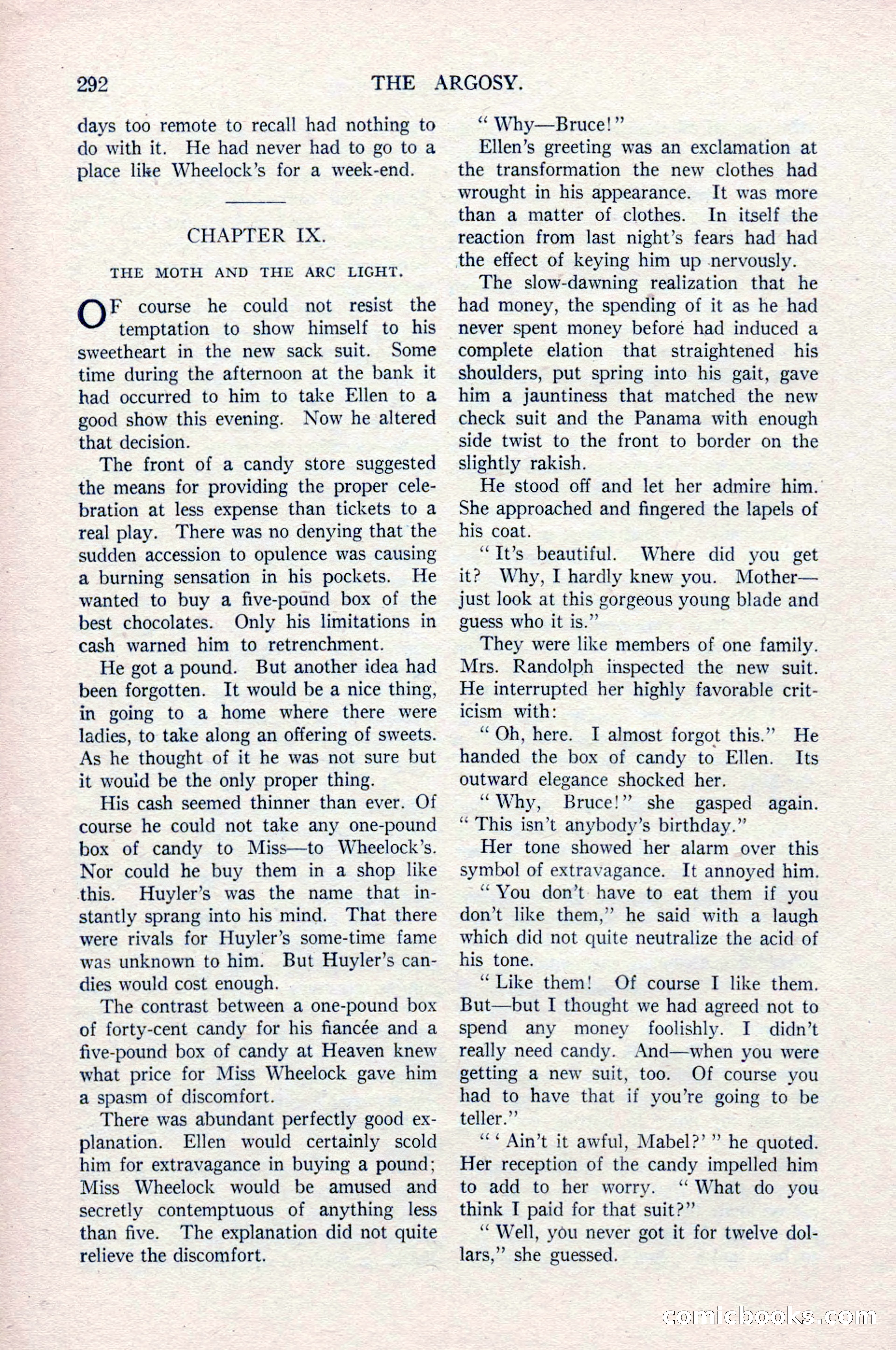
A restored page from Pulp Fiction, 1917. Page through the whole issue in the reader above.
📄 Transcribed text from this page (OCR, searchable)
Machine-transcribed from the original scan — historical spelling and the odd misread are preserved.
299 days too remote to recall had nothing to do with it. He had never had to go to a place like Wheelock’s for a week-end. CHAPTER IX. THE MOTH AND THE ARC LIGHT, Of course he could not resist the temptation to show himself to his sweetheart in the new sack suit. Some time during the afternoon at the bank it had occurred to him to take Ellen to a good show this evening. Now he altered that decision. The front of a candy store suggested the means for providing the proper cele- bration at less expense than tickets to a real play. There was no denying that the sudden accession to opulence was causing a burning sensation in his pockets. He wanted to buy a five-pound box of the best chocolates. Only his limitations in cash warned him to retrenchment. He got a pound. But another idea had been forgotten. It would be a nice thing, in going to a home where there were ladies, to take along an offering of sweets. As he thought of it he was not sure but it wouid be the only proper thing. His cash seemed thinner than ever. Of course he could not take any one-pound box of candy to Miss—to Wheelock’s. Nor could he buy them in a shop like this. Huyler’s was the name that in- stantly sprang into his mind. That there were rivals for Huyler’s some-time fame was unknown to him. But Huyler’s can- dies would cost enough. The contrast between a one-pound box of forty-cent candy for his fiancée and a five-pound box of candy at Heaven knew what price for Miss Wheelock gave him a spasm of discomfort. There was abundant perfectly good ex- planation. Ellen would certainly scold him for extravagance in buying a pound; Miss Wheelock would be amused and secretly contemptuous of anything less than five. The explanation did not quite relieve the discomfort. THE ARGOSY. * Why—Bruce!” Ellen’s greeting was an exclamation at the transformation the new clothes had wrought in his appearance. It was more than a matter of clothes. In itself the reaction from last night’s fears had had the effect of keying him up nervously. The slow-dawning realization that he had money, the spending of it as he had never spent money before had induced a complete elation that straightened his shoulders, put spring into his gait, gave him a jauntiness that matched the new check suit and the Panama with enough side twist to the front to border on the slightly rakish. He stood off and let her admire him. She approached and fingered the lapels of his coat. “It’s beautiful. Where did you get it? Why, I hardly knew you. Mother— just look at this gorgeous young blade and guess who it is.” They were like members of one family. Mrs. Randolph inspected the new suit. He interrupted her highly favorable crit- icism with: “Oh, here. I almost forgot this.” He handed the box of candy to Ellen. Its outward elegance shocked her. “Why, Bruce!” she gasped again. “This isn’t anybody’s birthday.” Her tone showed her alarm over this symbol of extravagance. It annoyed him. “You don’t: have to eat them if you don’t like them,” he said with a laugh which did not quite neutralize the acid of his tone. “Like them! Of course I like them. But—but I thought we had agreed not to spend any money foolishly. I didn’t really need candy. And—when you were getting a new suit, too. Of course you had to have that if you’re going to be teller.” “* Ain’t it awful, Mabel?’ ” he quoted. Her reception of the candy impelled him to add to her worry. ‘‘ What do you think I paid for that suit?” ‘Well, you never got it for twelve dol- lars,” she guessed. Go NOOK (C@