
Pulp Fiction, 1916 · page 94 of 212
The Argosy, Vol. 84 No. 1 — page 94: what you’re looking at
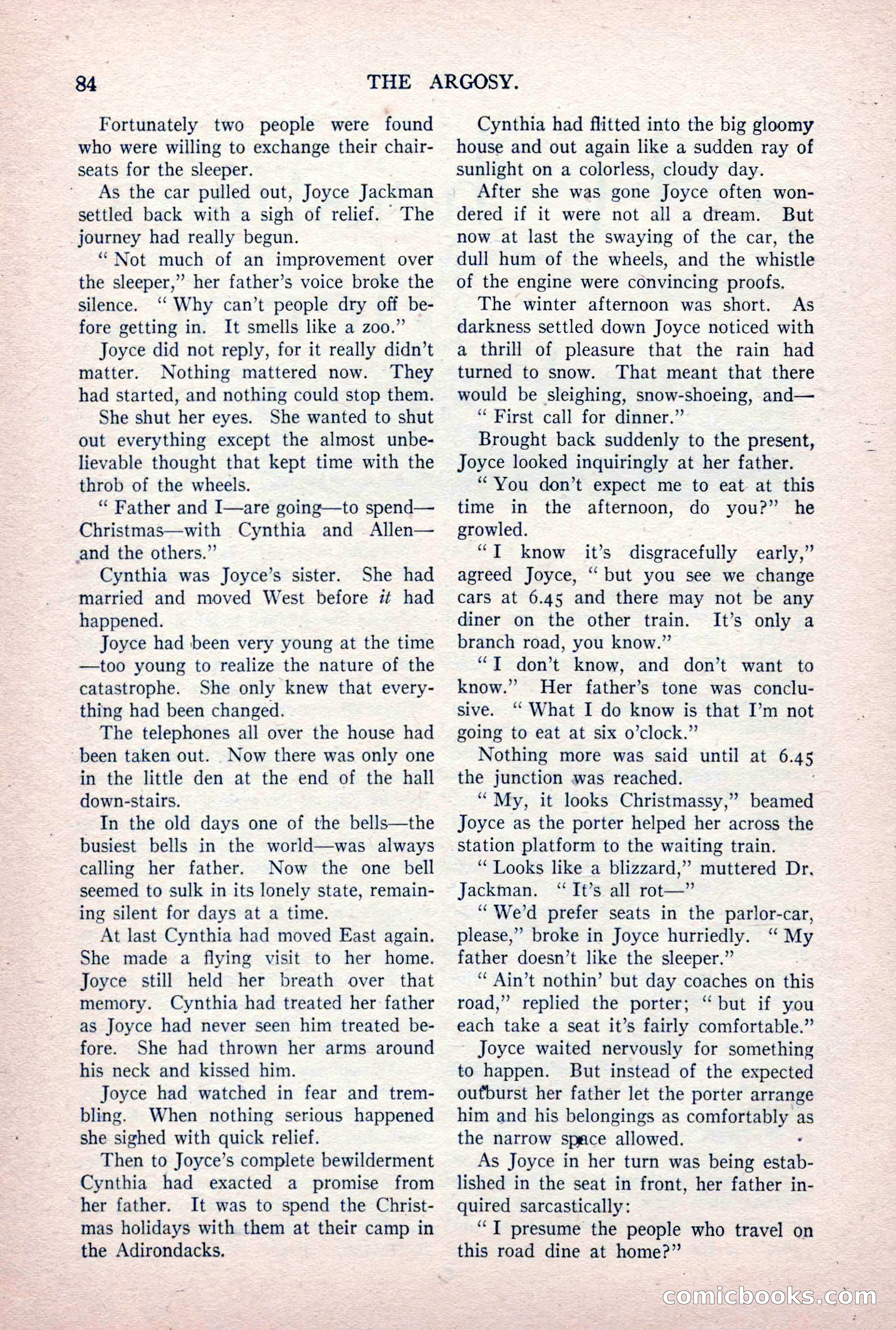
A restored page from Pulp Fiction, 1916. Page through the whole issue in the reader above.
📄 Transcribed text from this page (OCR, searchable)
Machine-transcribed from the original scan — historical spelling and the odd misread are preserved.
84 Fortunately two people were found who were willing to exchange their chair- seats for the sleeper. As the car pulled out, Joyce Jackman settled back with a sigh of relief. The journey had really begun. ““Not much of an improvement over the sleeper,” her father’s voice broke the silence. ‘‘ Why can’t people dry off be- fore getting in. It smells like a zoo.” Joyce did not reply, for it really didn’t matter. Nothing mattered now. They had started, and nothing could stop them. She shut her eyes. She wanted to shut out everything except the almost unbe- lievable thought that kept time with the throb of the wheels. “ Father and I—are going—to spend— Christmas—with Cynthia and Allen— and the others.” Cynthia was Joyce’s sister. She had married and moved West before zt had happened. Joyce had been very young at the time —too young to realize the nature of the catastrophe. She only knew that every- thing had been changed. The telephones all over the house had been taken out. Now there was only one in the little den at the end of the hall down-stairs. In the old days one of the bells—the busiest bells in the world—was always calling her father. Now the one bell seemed to sulk in its lonely state, remain- ing silent for days at a time. At last Cynthia had moved East again. She made a flying visit to her home. Joyce still held her breath over that memory. Cynthia had treated her father as Joyce had never seen him treated be- fore. She had thrown her arms around his neck and kissed him. Joyce had watched in fear and trem- bling. When nothing serious happened she sighed with quick relief. Then to Joyce’s complete bewilderment Cynthia had exacted a promise from her father. It was to spend the Christ- mas holidays with them at their camp in the Adirondacks. THE ARGOSY. Cynthia had flitted into the big gloomy house and out again like a sudden ray of sunlight on a colorless, cloudy day. After she was gone Joyce often won- dered if it were not all a dream. But now at last the swaying of the car, the dull hum of the wheels, and the whistle of the engine were convincing proofs. The winter afternoon was short. As darkness settled down Joyce noticed with a thrill of pleasure that the rain had turned to snow. That meant that there would be sleighing, snow-shoeing, and— “ First call for dinner.” Brought back suddenly to the present, Joyce looked inquiringly at her father. “You don’t expect me to eat at this time in the afternoon, do you?” he growled. “I know it’s disgracefully early,” agreed Joyce, “ but you see we change cars at 6.45 and there may not be any diner on the other train. It’s only a branch road, you know.” “T don’t know, and don’t want to know.” Her father’s tone was conclu- sive. “ What I do know is that I’m not going to eat at six o’clock.” Nothing more was said until at 6-45 the junction was reached. “My, it looks Christmassy,” beamed Joyce as the porter helped her across the station platform to the waiting train. ‘Looks like a blizzard,” muttered Dr. Jackman. “It’s all rot—” “We'd prefer seats in the parlor-car, please,” broke in Joyce hurriedly. “ My father doesn’t like the sleeper.” “Ain’t nothin’ but day coaches on this road,” replied the porter; “but if you each take a seat it’s fairly comfortable.” Joyce waited nervously for something to happen. But instead of the expected oufburst her father let the porter arrange him and his belongings as comfortably s the narrow space allowed. As Joyce in her turn was being eat lished in the seat in front, her father in- quired sarcastically: ‘““T presume the people who travel on this road dine at home?” [EOMIGDOOKS EO)