
Pulp Fiction, 1916 · page 92 of 212
The Argosy, Vol. 84 No. 1 — page 92: what you’re looking at
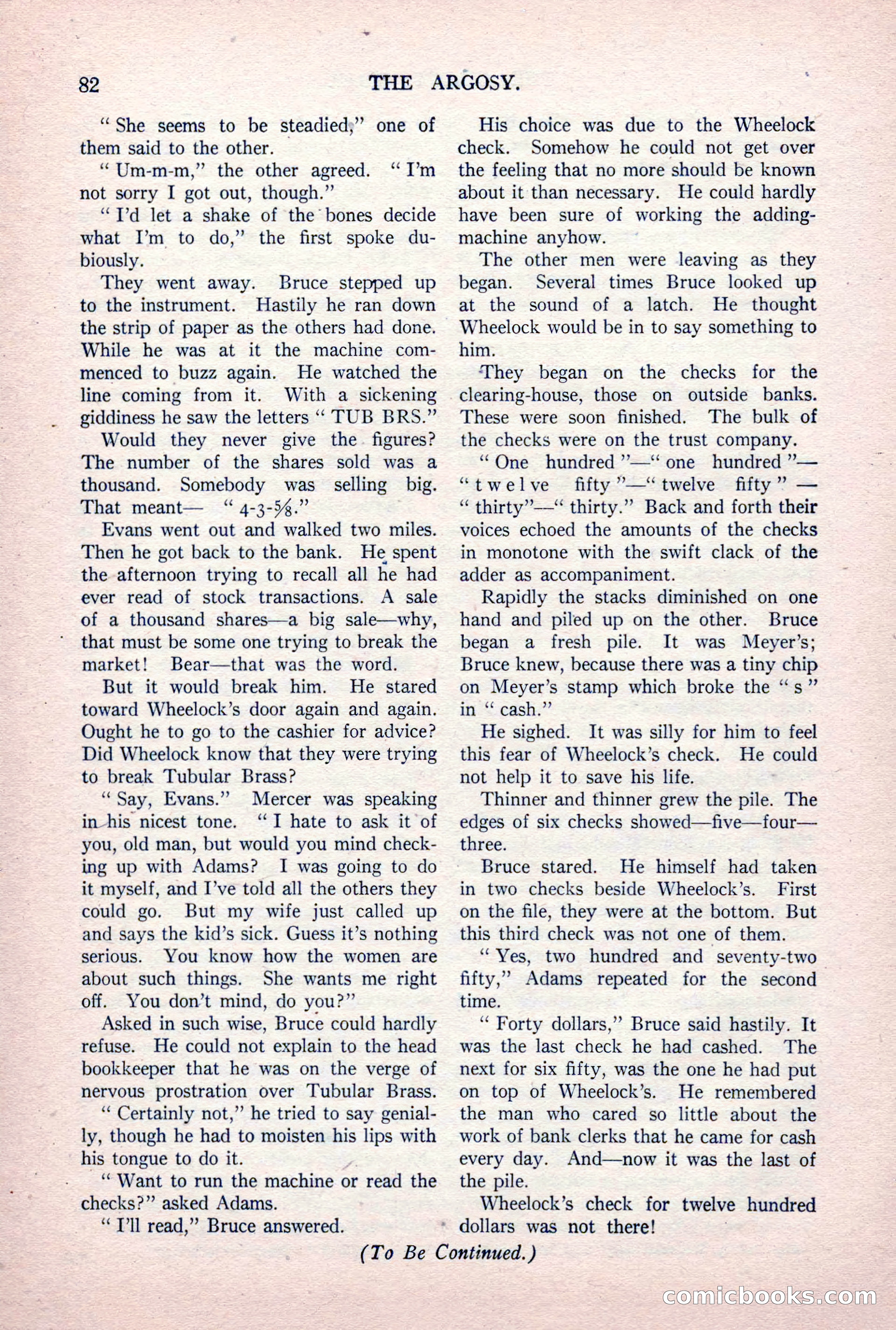
A restored page from Pulp Fiction, 1916. Page through the whole issue in the reader above.
📄 Transcribed text from this page (OCR, searchable)
Machine-transcribed from the original scan — historical spelling and the odd misread are preserved.
82 ‘““She seems to be steadied;” one of them said to the other. ‘““Um-m-m,” the other agreed. not sorry I got out, though.” “Td let a shake of the bones decide what I’m to do,” the first spoke du- biously. They went away. Bruce stepped up to the instrument. Hastily he ran down the strip of paper as the others had done. While he was at it the machine com- menced to buzz again. He watched the line coming from it. With a sickening giddiness he saw the letters “‘ TUB BRS.” Would they never give the. figures? The number of the shares sold was a thousand. Somebody was selling big. That meant— “ 4-3-5%.” Evans went out and walked two miles. Then he got back to the bank. He spent the afternoon trying to recall all he had ever read of stock transactions. A sale of a thousand shares—a big sale—why, that must be some one trying to break the market! Bear—that was the word. But it would break him. He stared toward Wheelock’s door again and again. Ought he to go to the cashier for advice? Did Wheelock know that they were trying to break Tubular Brass? ‘Say, Evans.” Mercer was speaking in-his nicest tone. “I hate to ask it of you, old man, but would you mind check- ing up with Adams? I was going to do it myself, and I’ve told all the others they could go. But my wife just called up and says the kid’s sick. Guess it’s nothing serious. You know how the women are about such things. She wants me right off. You don’t mind, do you?” Asked in such wise, Bruce could hardly refuse. He could not explain to the head bookkeeper that he was on the verge of nervous prostration over Tubular Brass. “‘ Certainly not,” he tried to say genial- ly, though he had to moisten his lips with his tongue to do it. ‘“ Want to run the machine or read the checks?” asked Adams. ‘Tl read,” Bruce answered. ce I’m THE ARGOSY. His choice was due to the Wheelock check. Somehow he could not get over the feeling that no more should be known about it than necessary. He could hardly have been sure of working the adding- machine anyhow. The other men were leaving as they began. Several times Bruce looked up at the sound of a latch. He thought Wheelock would be in to say something to him. They began on the checks for the clearing-house, those on outside banks. These were soon finished. The bulk of the checks were on the trust company. “One hundred ’’—‘ one hundred ’— “twelve fifty ”"—‘“twelve fifty”? — “ thirty” ——“ thirty.” Back and forth their voices echoed the amounts of the checks in monotone with the swift clack of the adder as accompaniment. Rapidly the stacks diminished on one hand and piled up on the other. Bruce began a fresh pile. It was Meyer’s; Bruce knew, because there was a tiny chip on Meyer’s stamp which broke the “s” in ‘‘ cash.” He sighed. It was silly for him to feel this fear of Wheelock’s check. He could not help it to save his life. Thinner and thinner grew the pile. The edges of six checks showed—five—four— three. Bruce stared. He himself had taken in two checks beside Wheelock’s. First on the file, they were at the bottom. But this third check was not one of them. ‘Yes, two hundred and seventy-two fifty,’ Adams repeated for the second time. “Forty dollars,” Bruce said hastily. It was the last check he had cashed. The next for six fifty, was the one he had put on top of Wheelock’s. He remembered the man who cared so little about the work of bank clerks that he came for cash every day. And—now it was the last of the pile. Wheelock’s check for twelve hundred * dollars was not there! (To Be Continued. ) EOPMIE OOOKS, (E@)