
Pulp Fiction, 1916 · page 74 of 212
The Argosy, Vol. 84 No. 1 — page 74: what you’re looking at
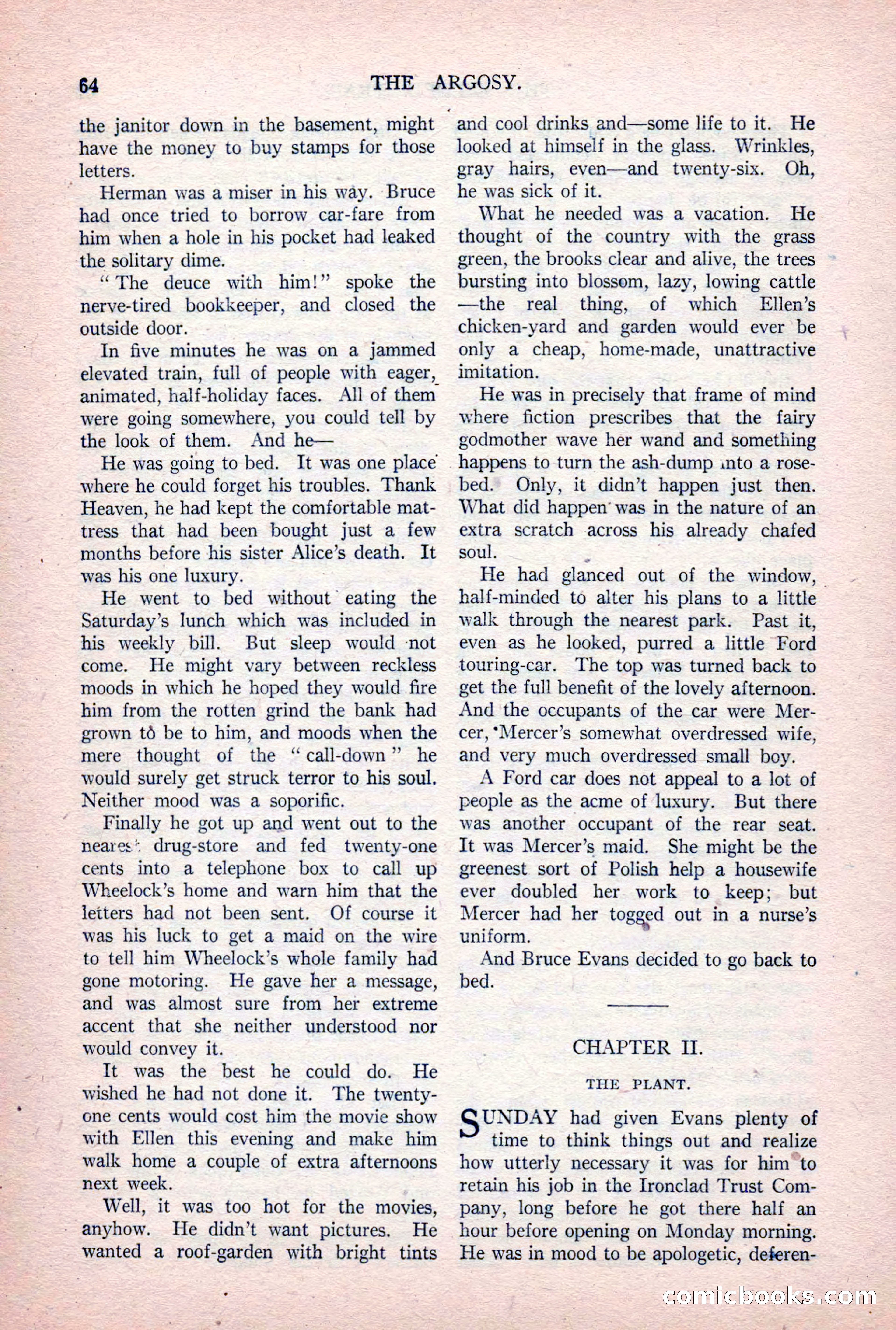
A restored page from Pulp Fiction, 1916. Page through the whole issue in the reader above.
📄 Transcribed text from this page (OCR, searchable)
Machine-transcribed from the original scan — historical spelling and the odd misread are preserved.
64 the janitor down in the basement, might have the money to buy stamps for those letters. ' Herman was a miser in his way. Bruce had once tried to borrow car-fare from him when a hole in his pocket had leaked the solitary dime. “The deuce with him!” spoke the nerve-tired bookkeeper, and closed the outside door. In five minutes he was on a jammed elevated train, full of people with eager, animated, half-holiday faces. All of them were going somewhere, you could tell by the look of them. And he— He was going to bed. It was one place where he could forget his troubles. Thank Heaven, he had kept the comfortable mat- tress that had been bought just a few months before his sister Alice’s death. It was his one luxury. He went to bed without eating the Saturday’s lunch which was included in his weekly bill. But sleep would -not come. He might vary between reckless moods in which he hoped they would fire him from the rotten grind the bank had grown td be to him, and moods when the mere thought of the “call-down” he would surely get struck terror to his soul. Neither mood was a soporific. Finally he got up and went out to the neares. drug-store and fed twenty-one cents into a telephone box to call up Wheelock’s home and warn him that the letters had not been sent. Of course it was his luck to get a maid on the wire to tell him Wheelock’s whole family had gone motoring. He gave her a message, and was almost sure from her extreme accent that she neither understood nor would convey it. It was the best he could do. He wished he had not done it. The twenty- one cents would cost him the movie show with Ellen this evening and make him walk home a couple of extra afternoons next week. Well, it was too hot for the movies, - anyhow. He didn’t want pictures. He wanted a roof-garden with bright tints and cool drinks and—some life to it. THE ARGOSY. He looked at himself in the glass. Wrinkles, gray hairs, even—and twenty-six. Oh, he was sick of it. What he needed was a vacation. He thought of the country with the grass green, the brooks clear and alive, the trees bursting into blossom, lazy, lowing cattle —the real thing, of which Ellen’s chicken-yard and garden would ever be only a cheap, home-made, unattractive imitation. He was in precisely that frame of mind where fiction prescribes that the fairy godmother wave her wand and something _happens to turn the ash-dump into a rose- bed. Only, it didn’t happen just then. What did happen’ was in the nature of an extra scratch across his already chafed soul. | He had glanced out of the window, | half-minded to alter his plans to a little walk through the nearest park. Past it, even as he looked, purred a little Ford touring-car. The top was turned back to get the full benefit of the lovely afternoon. And the occupants of the car were Mer- cer, *Mercer’s somewhat overdressed wife, and very much overdressed small boy. A Ford car does not appeal to a lot of people as the acme of luxury. But there was another occupant of the rear seat. It was Mercer’s maid. She might be the greenest sort of Polish help a housewife ever doubled her work to keep; but Mercer had her togged out in a nurse’s uniform. And Bruce Evans decided to go back to ~ bed. CHAPTER II. THE PLANT. UNDAY had given Evans plenty of time to think things out and realize how utterly necessary it was for him to retain his job in the Ironclad Trust Com- pany, long before he got there half an hour before opening on Monday morning. He was in mood to be apologetic, deferen- (E00) .OO AAG cS (E@)