
Pulp Fiction, 1916 · page 26 of 212
The Argosy, Vol. 84 No. 1 — page 26: what you’re looking at
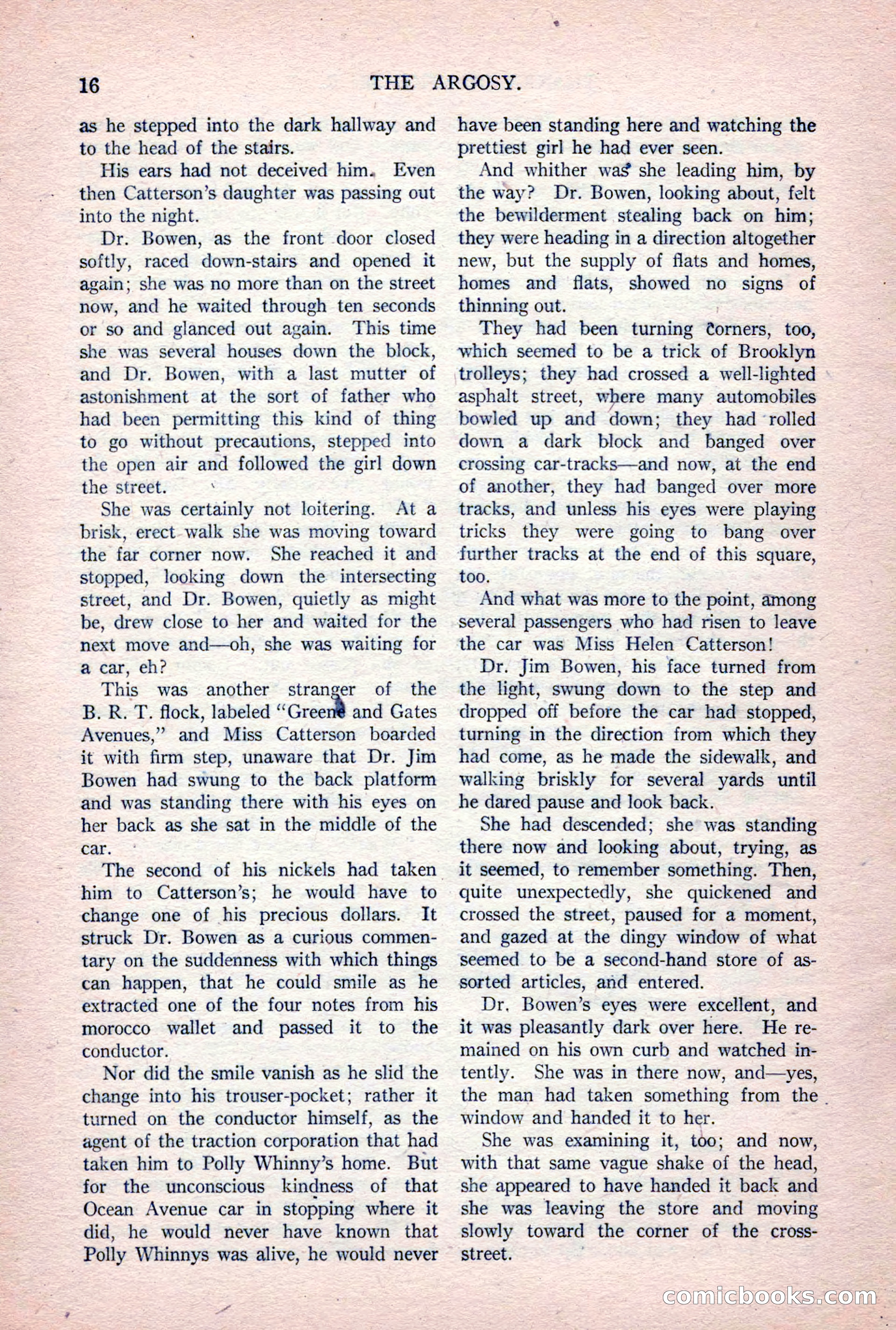
A restored page from Pulp Fiction, 1916. Page through the whole issue in the reader above.
📄 Transcribed text from this page (OCR, searchable)
Machine-transcribed from the original scan — historical spelling and the odd misread are preserved.
16 THE as he stepped into the dark hallway and to the head of the stairs. His ears had not deceived him. Even then Catterson’s daughter was passing out into the night. Dr. Bowen, as the front door closed softly, raced down-stairs and opened it again; she was no more than on the street now, and he waited through ten seconds or so and glanced out again. This time she was several houses down the block, and Dr. Bowen, with a last mutter of astonishment at the sort of father who had been permitting this kind of thing to go without precautions, stepped into the open air and followed the girl down the street. ; She was certainly not loitering. At a brisk, erect- walk she was moving toward the far corner now. She reached it and stopped, looking down the intersecting street, and Dr. Bowen, quietly as might be, drew close to her and waited for the next move and—oh, she was waiting for a car, eh? This was another stranger of the B. R. T. flock, labeled “Greent and Gates Avenues,” and Miss Catterson boarded it with firm step, unaware that Dr. Jim Bowen had swung to the back platform and was standing there with his eyes on her back as she sat in the middle of the car. The second of his nickels had taken him to Catterson’s; he would have to change one of his precious dollars. It struck Dr. Bowen as a curious commen- tary on the suddenness with which things can happen, that he could smile as he extracted one of the four notes from his morocco wallet and passed it to the conductor. Nor did the smile vanish as he slid the change into his trouser-pocket; rather it turned on the conductor himself, as the agent of the traction corporation that had taken him to Polly Whinny’s home. But for the unconscious kindness of that Ocean Avenue car in stopping where it did, he would never have known that Polly Whinnys was alive, he would never ARGOSY. have been standing here and watching the prettiest girl he had ever seen. And whither wag she leading him, by the way? Dr. Bowen, looking about, felt the bewilderment stealing back on him; they were heading in a direction altogether new, but the supply of flats and homes, homes and flats, showed no signs of thinning out. They had been turning Corners, too, which seemed to be a trick of Brooklyn trolleys; they had crossed a well-lighted asphalt street, where many automobiles bowled up and down; they had ‘rolled down a dark block and banged over crossing car-tracks—and now, at the end of another, they had banged over more tracks, and unless his eyes were playing tricks they were going to bang over further tracks at the end of this square, too. And what was more to the point, among several passengers who had risen to leave the car was Miss Helen Catterson! Dr. Jim Bowen, his face turned from the light, swung down to the step and dropped off before the car had stopped, turning in the direction from which they had come, as he made the sidewalk, and walking briskly for several yards until he dared pause and look back. She had descended; she was standing there now and looking about, trying, as it seemed, to remember something. Then, quite unexpectedly, she quickened and crossed the street, paused for a moment, and gazed at the dingy window of what seemed to be a second-hand store of as- sorted articles, and entered. Dr. Bowen’s eyes were excellent, and it was pleasantly dark over here. He re- mained on his own curb and watched in- tently. She was in there now, and—yes, the man had taken something from the - window and handed it to her. She was examining it, too; and now, with that same vague shake of the head, she appeared to have handed it back and she was leaving the store and moving slowly toward the corner of the cross- street. (E@) MINE IOO<S (E@)