
Pulp Fiction, 1916 · page 160 of 212
The Argosy, Vol. 84 No. 1 — page 160: what you’re looking at
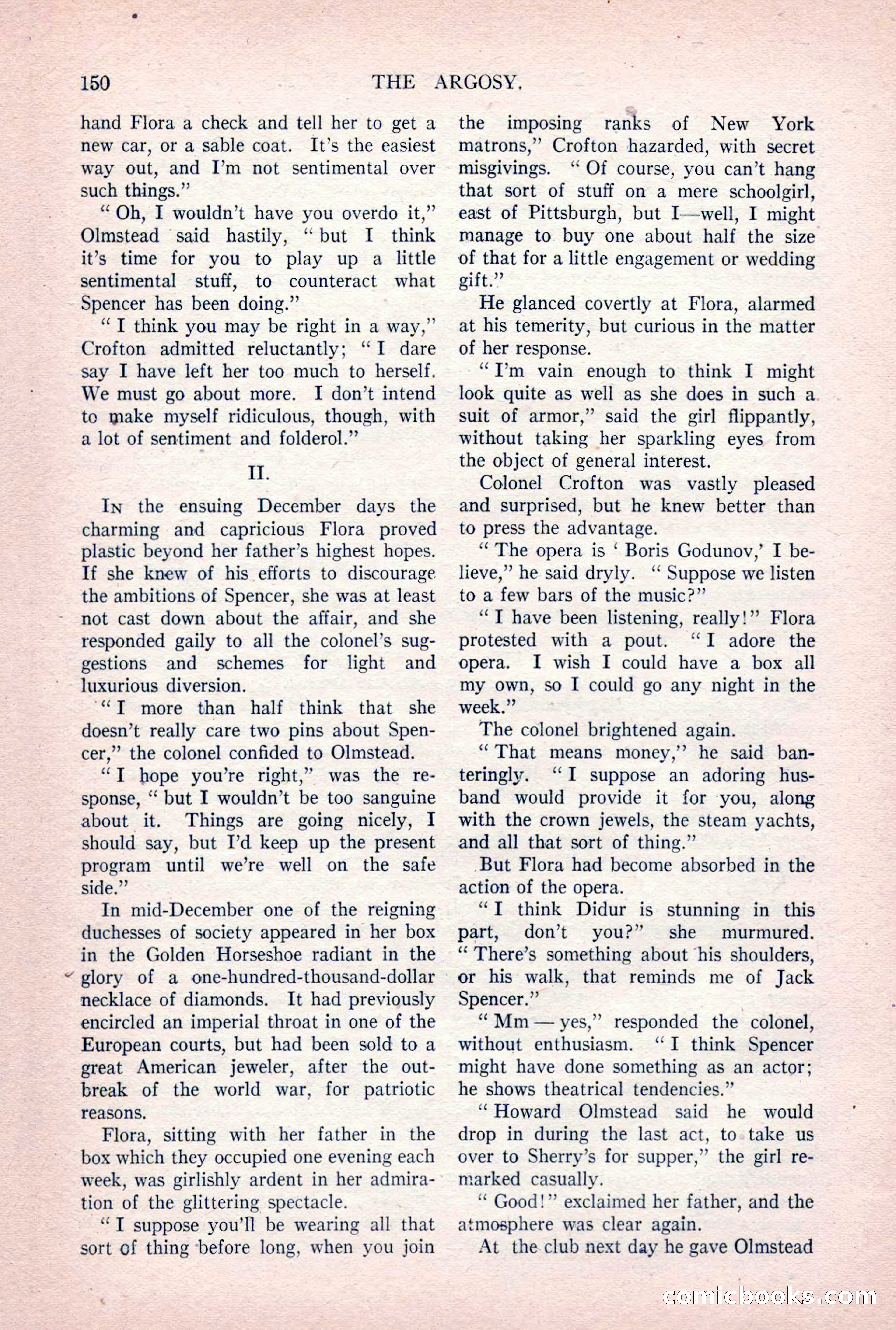
A restored page from Pulp Fiction, 1916. Page through the whole issue in the reader above.
📄 Transcribed text from this page (OCR, searchable)
Machine-transcribed from the original scan — historical spelling and the odd misread are preserved.
150 hand Flora a check and tell her to get a new car, or a sable coat. It’s the easiest way out, and I’m not sentimental over such things.” “Oh, I wouldn’t have you overdo it,” Olmstead said hastily, ‘but I think it’s time for you to play up a little sentimental stuff, to counteract what Spencer has been doing.” “T think you may be right in a way,” Crofton admitted reluctantly; “I dare say I have left her too much to herself. We must go about more. I don’t intend to make myself ridiculous, though, with a lot of sentiment and folderol.” Il. In the ensuing December days the charming and capricious Flora proved plastic beyond her father’s highest hopes. If she knew of his efforts to discourage the ambitions of Spencer, she was at least not cast down about the affair, and she responded gaily to all the colonel’s sug- gestions and schemes for light and luxurious diversion. “T more than half think that she doesn’t really care two pins about Spen- cer,” the colonel confided to Olmstead. “JT hope you’re right,” was the re- sponse, “ but I wouldn’t be too sanguine about it. Things are going nicely, I should say, but I’'d keep up the present program until we’re well on the safe side.” In mid-December one of the reigning duchesses of society appeared in her box in the Golden Horseshoe radiant in the glory of a one-hundred-thousand-dollar necklace of diamonds. It had previously encircled an imperial throat in one of the European courts, but had been sold to a great American jeweler, after the out- break of the world war, for patriotic reasons. Flora, sitting with her father in the box which they occupied one evening each week, was girlishly ardent in her admira- tion of the glittering spectacle. -“T suppose you’ll be wearing all that sort of thing before long, when you join THE ARGOSY, the imposing ranks of New York matrons,”’ Crofton hazarded, with secret misgivings. ‘‘ Of course, you can’t hang that sort of stuff on a mere schoolgirl, east of Pittsburgh, but I—well, I might manage to buy one about half the size of that for a little engagement or wedding gift.” He glanced covertly at Flora, alarmed at his temerity, but curious in the matter of her response. “I’m vain enough to think I might look quite as well as she does in such a suit of armor,” said the girl flippantly, without taking her sparkling eyes from the object of general interest. Colonel Crofton was vastly pleased and surprised, but he knew better than to press the advantage. ‘The opera is ‘ Boris Godunov,’ I be- lieve,” he said dryly. ‘‘ Suppose we listen to a few bars of the music?” ‘““T have been listening, really!” Flora protested with a pout. “I adore the opera. I wish I could have a box all my own, so I could go any night in the week.” The colonel brightened again. “That means money,’’ he said ban- teringly. “I suppose an adoring hus- band would provide it for you, along with the crown jewels, the steam yachts, and all that sort of thing.” But Flora had become absorbed in the action of the opera. “T think Didur is stunning in this part, don’t you?” she murmured. ‘““There’s something about his shoulders, or his walk, that reminds me of Jack Spencer.” : “Mm — yes,” responded the colonel, without enthusiasm. ‘I think Spencer might have done something as an actor; he shows theatrical tendencies.” ‘Howard Olmstead said he would drop in during the last act, to take us over to Sherry’s for supper,” the girl re- marked casually. ‘““ Good!” exclaimed her father, and the atmosphere was clear again. At the club next day he gave Olmstead ECOMMICLOOO S (E@)