
Pulp Fiction, 1916 · page 138 of 212
The Argosy, Vol. 84 No. 1 — page 138: what you’re looking at
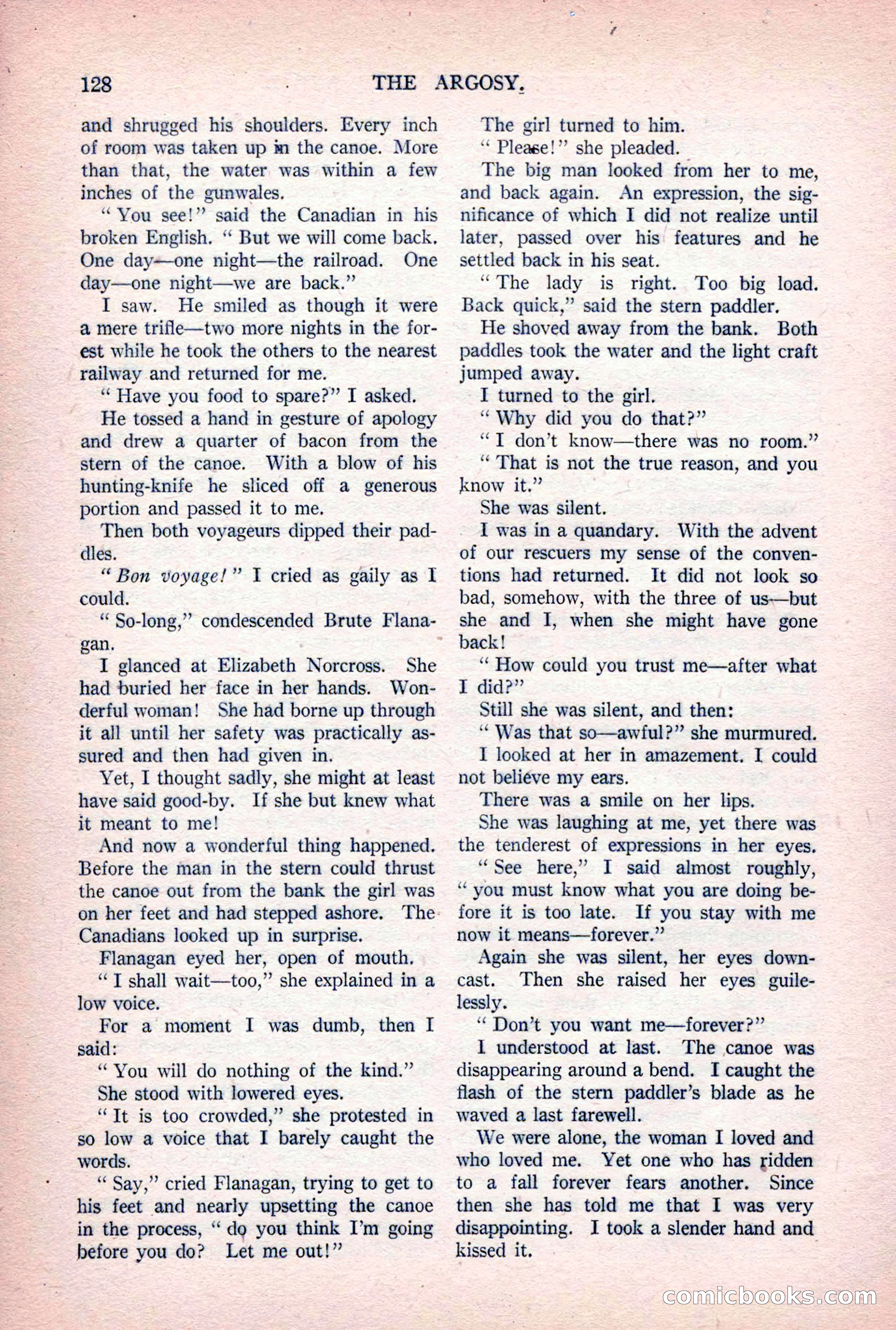
A restored page from Pulp Fiction, 1916. Page through the whole issue in the reader above.
📄 Transcribed text from this page (OCR, searchable)
Machine-transcribed from the original scan — historical spelling and the odd misread are preserved.
128 and shrugged his shoulders. Every inch of room was taken up m the canoe. More than that, the water was within a few inches of the gunwales. “You see!” said the Canadian in his broken English. “* But we will come back. One day—one night—the railroad. One day—one night—we are back.” I saw. He smiled as though it were a mere trifle—two more nights in the for- est while he took the others to the nearest railway and returned for me. “Have you food to spare?” I asked. He tossed a hand in gesture of apology and drew a quarter of bacon from the stern of the canoe. With a blow of his hunting-knife he sliced off a generous portion and passed it to me, Then both voyageurs dipped their pad- dles. “ Bon voyage!” I cried as gaily as I could. “ So-long,” condescended Brute Flana- gan, I glanced at Elizabeth Norcross. She had buried her face in her hands. Won- derful woman! She had borne up through it all until her safety was practically as- sured and then had given in. Yet, I thought sadly, she might at least have said good-by. If she but knew what it meant to me! And now a wonderful thing happened. Before the man in the stern could thrust the canoe out from the bank the girl was on her feet and had stepped ashore. Canadians looked up in surprise. Flanagan eyed her, open of mouth. ‘“‘T shall wait—too,” she explained in a low voice. For a moment I was dumb, then I said: “You will do nothing of the kind.” She stood with lowered eyes. “It is too crowded,” she protested in so low a voice that I barely caught the words. “Say,” cried Flanagan, trying to get to his feet and nearly upsetting the canoe in the process, “do you think I’m going before you do? Let me out!” The: THE ARGOSY. The girl turned to him. ‘* Please!”’ she pleaded. — The big man looked from her to me, and back again. An expression, the sig- nificance of which I did not realize until later, passed over his features and he settled back in his seat. “The lady is right. Too big load. Back quick,” said the stern paddler. He shoved away from the bank. Both paddles took the water and the light craft jumped away. I turned to the girl. ‘“Why did you do that?” ‘““T don’t know—there was no room.” ‘That is not the true reason, and you know it.” She was silent. I was in a quandary. With the advent of our rescuers my sense of the conven- tions had returned. It did not look so bad, somehow, with the three of us—but she and I, when she might have gone back! ‘““ How could you trust me—after what I did?” Still she was silent, and then: ‘“ Was that so—awful?” she murmured. I looked at her in amazement. I could not beliéve my ears. There was a smile on her lips. She was laughing at me, yet there was the tenderest of expressions in her eyes. ‘““See here,” I said almost roughly, ‘“you must know what you are doing be- fore it is too late. If you stay with me now it means—forever.” Again she was silent, her eyes down- cast. Then she raised her eyes guile- lessly. “Don’t you want me—forever?” I understood at last. The canoe was disappearing around a bend. I caught the flash of the stern paddler’s blade as he waved a last farewell. We were alone, the woman I loved and who loved me. Yet one who has ridden to a fall forever fears another. Since then she has told me that I was very disappointing. I took a slender hand and kissed it. CORMICLOOOKS (C@