
Pulp Fiction, 1916 · page 127 of 212
The Argosy, Vol. 84 No. 1 — page 127: what you’re looking at
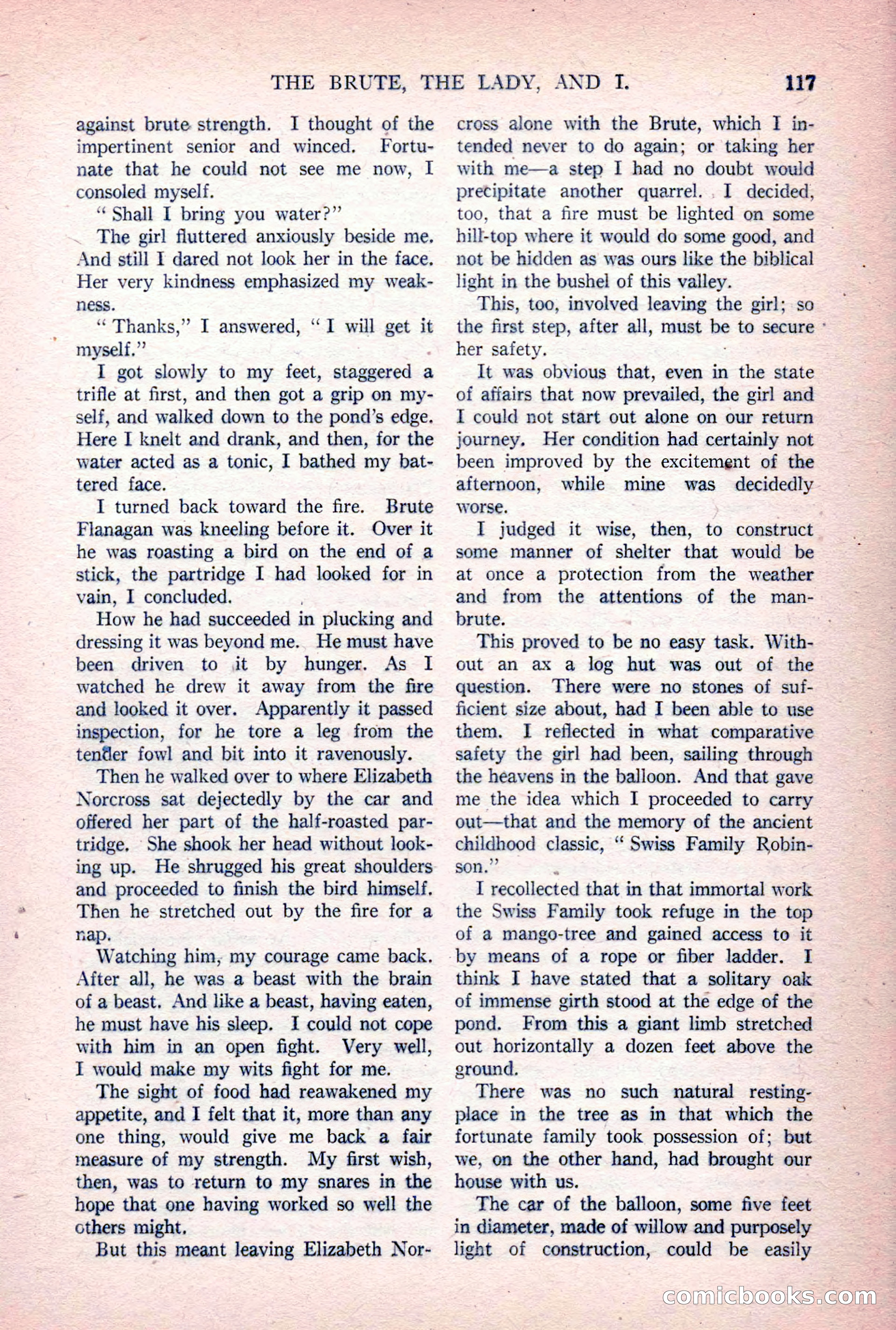
A restored page from Pulp Fiction, 1916. Page through the whole issue in the reader above.
📄 Transcribed text from this page (OCR, searchable)
Machine-transcribed from the original scan — historical spelling and the odd misread are preserved.
THE BRUTE, THE LADY, against brute strength. I thought of the impertinent senior and winced. Fortu- nate that he could not see me now, Il consoled myself. ‘* Shall I bring you water?” The girl fluttered anxiously beside me. And still I dared not look her in the face. Her very kindness emphasized my weak- ness. “Thanks,” I answered, “I will get it myself.” I got slowly to my feet, staggered 2 a trifle at first, and then got a grip on my- self, and walked down to the pond’s edge. Here I knelt and drank, and then, for the water acted as a tonic, I bathed my bat- tered face. I turned back toward the fire. Brute Flanagan was kneeling before it. Over it he was roasting a bird on the end of a stick, the partridge I had looked for in vain, I concluded. How he had succeeded i in plucking and dressing it was beyond me. He must have been driven to jit by hunger. As I watched he drew it away from the fire and looked it over. Apparently it passed inspection, for he tore a leg from the tenfer fowl and bit into it ravenously. Then he walked over to where Elizabeth Norcross sat dejectedly by the car and offered her part of the half-roasted par- tridge, She shook her head without look- ing up. He shrugged his great shoulders and proceeded to finish the bird himself. Then he stretched out by the fire for a nap. Watching him, my courage came back. Aiter all, he was a beast with the brain of a beast. And like a beast, having eaten, he must have his sleep. I could not cope with him in an open fight. Very well, I would make my wits fight for me. The sight of food had reawakened my appetite, and I felt that it, more than any one thing, would give me back a fair measure of my strength. My first wish, then, was to return to my snares in the hope that one having worked so well the others might, But this meant leaving Elizabeth Nor- AND I. cross alone with the Brute, which I in- tended never to do again; or taking her with me—a step I had no doubt would precipitate another quarrel. .I decided, too, that a fire must be lighted on some hill-top where it would do some good, and not be hidden as was ours like the biblical light in the bushel of this valley. This, too, involved leaving the girl; so the first step, after all, must ne to secure ° her safety. It was obvious that, even in the state of affairs that now prevailed, the girl and I could not start out alone on our return journey. Her condition had certainly not been improved by the excitement of the afternoon, while mine was decidedly worse. I judged it wise, then, to construct some manner of shelter that would be at once a protection from the weather and from the attentions of the man- brute. This proved to be no easy task. With- out an ax a log hut was out of the question. There were no stones of suf- ficient size about, had I been able to use them. I reflected in what comparative safety the girl had been, sailing through the heavens in the balloon. And that gave me the idea which I proceeded to carry out—that and the memory of the ancient childhood classic, ‘‘ Swiss Family Robin- son.’ 117 | I recollected that in that immortal work the Swiss Family took refuge in the top of a mango-tree and gained access to it ‘by means of a rope or fiber ladder. I think I have stated that a solitary oak of immense girth stood at the edge of the pond. From this a giant limb stretched out horizontally a dozen feet above the ground. There was no such natural resting- place in the tree as in that which the fortunate family took possession of; but we, on the other hand, had brought our house with us. The car of the balloon, some five feet in diameter, made of willow and purposely light of construction, could be easily COPMICLOOLKS (E@)