
Pulp Fiction, 1916 · page 124 of 212
The Argosy, Vol. 84 No. 1 — page 124: what you’re looking at
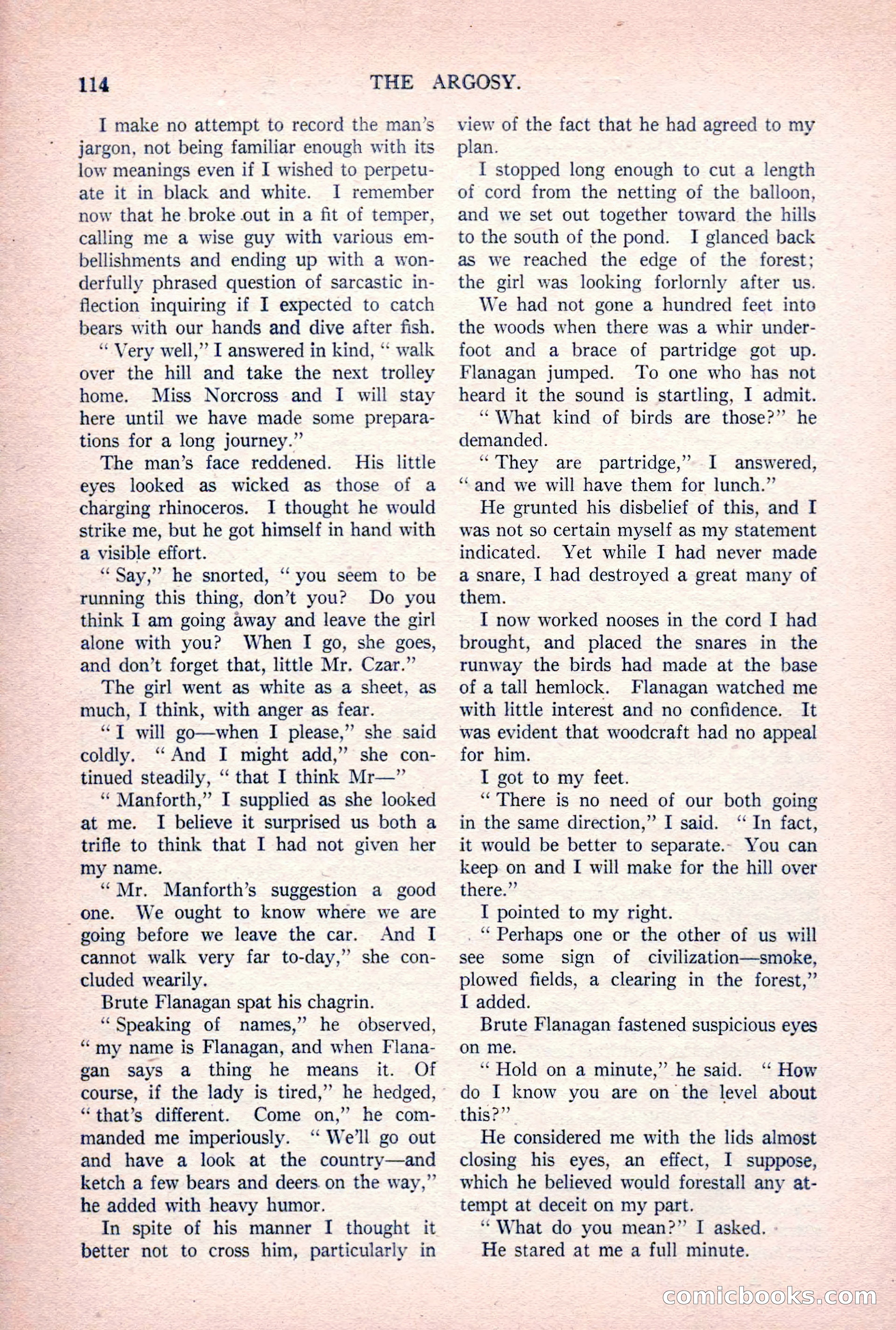
A restored page from Pulp Fiction, 1916. Page through the whole issue in the reader above.
📄 Transcribed text from this page (OCR, searchable)
Machine-transcribed from the original scan — historical spelling and the odd misread are preserved.
114 I make no attempt to record the man’s jargon, not being familiar enough with its low meanings even if I wished to perpetu- ate it in black and white. I remember now that he broke out in a fit of temper, calling me a wise guy with various em- bellishments and ending up with a won- derfully phrased question of sarcastic in- flection inquiring if I expected to catch bears with our hands and dive after fish. ‘Very well,” I answered in kind, “ walk over the hill and take the next trolley home. Miss Norcross and I will stay here until we have made some prepara- tions for a long journey.” The man’s face reddened. His little eyes looked as wicked as those of a charging rhinoceros. I thought he would strike me, but he got himself in hand with a visible effort. “Say,” he snorted, ‘“ you seem to be running this thing, don’t you? Do you think I am going away and leave the girl alone with your? When [I go, she goes, and don’t forget that, little Mr. Czar.” The girl went as white as a sheet, as much, I think, with anger as fear. ‘“T will go—when I please,” she said coldly. “And I might add,” she con- tinued steadily, ‘ that I think Mr—” “ Manforth,” I supplied as she looked at me. I believe it surprised us both a trifle to think that I had not given her my name. “Mr. Manforth’s suggestion a good one. We ought to know where we are going before we leave the car. And I cannot walk very far to-day,” she con- cluded wearily. Brute Flanagan spat his chagrin. ‘Speaking of names,” he observed, “my name is Flanagan, and when Flana- ean says a thing he means it. Of course, if the lady is tired,” he hedged, “that’s different. Come on,” he com- manded me imperiously. ‘‘ We'll go out and have a look at the country—and ketch a few bears and deers. on the way,” he added with heavy humor. In spite of his manner I thought it better not to cross him, particularly in THE ARGOSY. view of the fact that he had agreed to my plan. I stopped long enough to cut a length of cord from the netting of the balloon, and we set out together toward the hills to the south of the pond. I glanced back as we reached the edge of the forest; the girl was looking forlornly after us. We had not gone a hundred feet into the woods when there was a whir under- foot and a brace of partridge got up. Flanagan jumped. To one who has not heard it the sound is startling, I admit. “What kind of birds are those?” he demanded. “They are partridge,” I answered, “and we will have them for lunch.” He grunted his disbelief of this, and I was not so certain myself as my statement indicated. Yet while I had never made a snare, I had destroyed a great many of them. I now worked nooses in the cord I had brought, and placed the snares in the runway the birds had made at the base of a tall hemlock. Flanagan watched me with little interest and no confidence. It was evident that woodcraft had no appeal for him. I got to my feet. “There is no need of our both going in the same direction,” I said. “ In fact, it would be better to separate.- You can keep on and I will make for the hill over there.” [ pointed to my right. _“ Perhaps one or the other of us will see some sign of civilization—smoke, plowed fields, a clearing in the forest,” I added. Brute Flanagan fastened suspicious eyes on me. ‘“ Hold on a minute,” he said. ‘‘ How do I know you are on the level about this?” He considered me with the lids almost closing his eyes, an effect, I suppose, which he believed would forestall any at- tempt at deceit on my part. ‘What do you mean?” I asked. - He stared at me a full minute. CORMICLOOOKS (C@