
Pulp Fiction, 1916 · page 120 of 212
The Argosy, Vol. 84 No. 1 — page 120: what you’re looking at
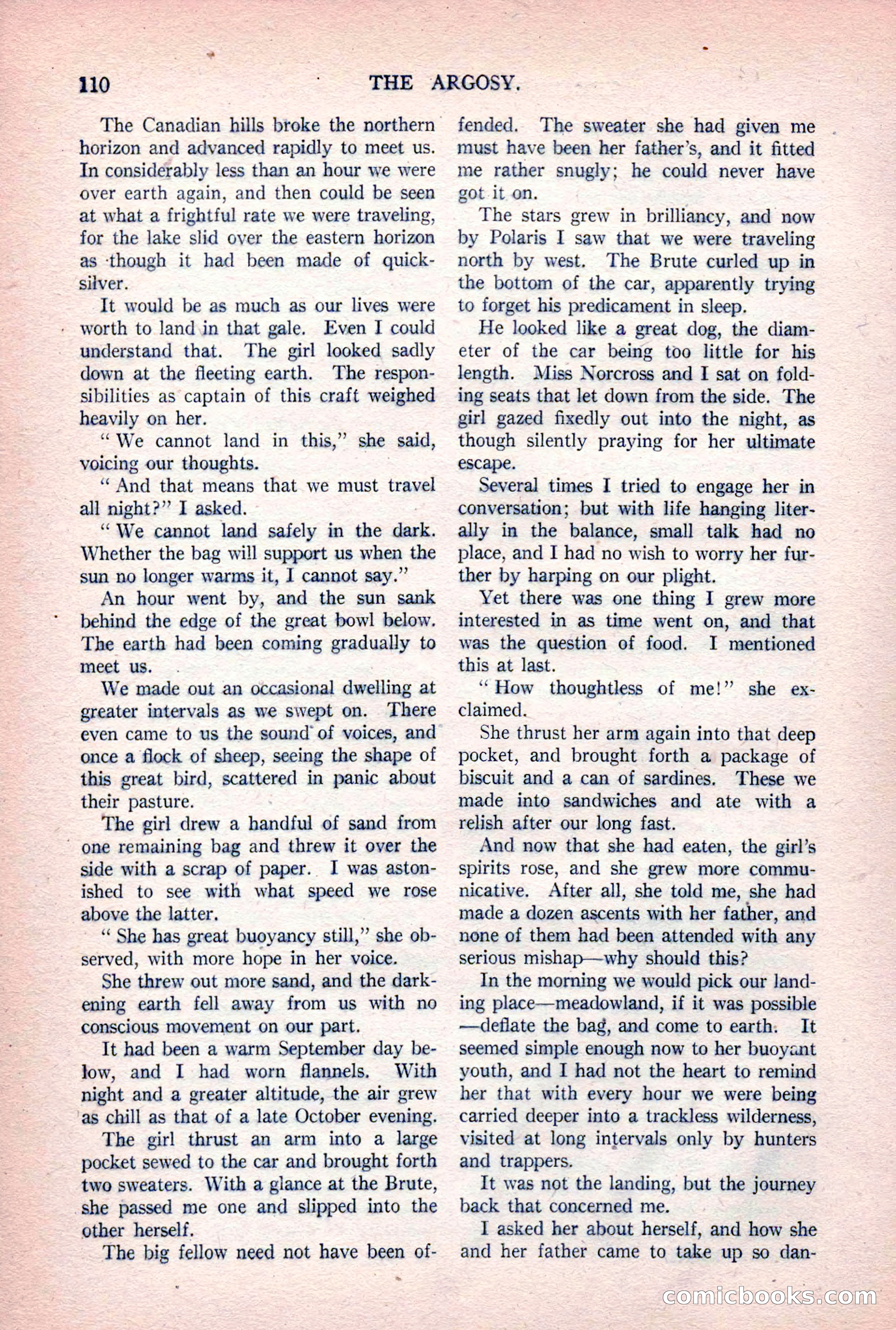
A restored page from Pulp Fiction, 1916. Page through the whole issue in the reader above.
📄 Transcribed text from this page (OCR, searchable)
Machine-transcribed from the original scan — historical spelling and the odd misread are preserved.
110 . horizon and advanced rapidly to meet us. In considerably less than an hour we were over earth again, and then could be seen at what a frightful rate we were traveling, for the lake slid over the eastern horizon as ‘though it had been made of quick- Sliver. It would be as much as our lives were - worth to land.in that gale. Even I could understand that. The girl looked sadly down at the fleeting earth. The respon- sibilities as captain of this craft weighed heavily on her. ‘We cannot land in this,” she said, voicing our thoughts. ‘“ And that means that we must travel all night?” I asked. “We cannot land safely in the dark. Whether the bag will support us when the sun no longer warms it, I cannot say.”’ An hour went by, and the sun sank behind the edge of the great bowl below. The earth had been coming gradually to meet us. We made out an occasional dwelling at greater intervals as we swept on. ‘There even came to us the sound of voices, and once a flock of sheep, seeing the shape of this great bird, scattered in panic about their pasture. The girl drew a handful of sand from one remaining bag and threw it over the side with a scrap of paper. I was aston- ished to see with what speed we rose above the latter. ‘‘ She has great buoyancy still,” she ob- served, with more hope in her voice. She threw out more sand, and the dark- ening earth fell away from us with no conscious movement on our part. It had been a warm September day be- low, and I had worn flannels, With night and a greater altitude, the air grew ‘as chill as that of a late October evening. The girl thrust an arm into a large pocket sewed to the car and brought forth two sweaters. With a glance at the Brute, she passed me one and slipped into the other herself. The big fellow need not have been of- a) THE ARGOSY. The Canadian hills broke the northern fended. The sweater she had given me . must have been her father’s, and it fitted me rather snugly; he could never have got it on. The stars grew in brilliancy, and now by Polaris I saw that we were traveling north by west. The Brute curled up in the bottom of the car, apparently trying to forget his predicament in sleep. He looked like a great dog, the diam- eter of the car being too little for his length. Miss Norcross and I sat on fold- ing seats that let down from the side. The girl gazed fixedly out into the night, as though silently praying for her ultimate escape. Several times I tried to engage her in conversation; but with life hanging liter- ally in the balance, small talk had no place, and I had no wish to worry her fur- ther by harping on our plight. Yet there was one thing I grew more interested in as time went on, and that was the question of food. I mentioned this at last. ‘“How thoughtless of me!” she ex- claimed. She thrust her arm again into that deep pocket, and brought forth a package of biscuit and a can of sardines. These we made into sandwiches and ate with a relish after our long fast. And now that she had eaten, the girl’s spirits rose, and she grew more commu- nicative. After all, she told me, she had made a dozen ascents with her father, and none of them had been attended with any serious mishap—why should this? In the morning we would pick our Jand- ing place—meadowland, if it was possible —deflate the bag, and come to earth: It seemed simple enough now to her buoyant youth, and I had not the heart to remind her that with every hour we were being carried deeper into a trackless wilderness, visited at long intervals only by hunters and trappers. It was not the landing, but the journey back that concerned me. I asked her about herself, and how she and her father came to take up so dan- COnnicooolks (C@)