
Pulp Fiction, 1916 · page 117 of 212
The Argosy, Vol. 84 No. 1 — page 117: what you’re looking at
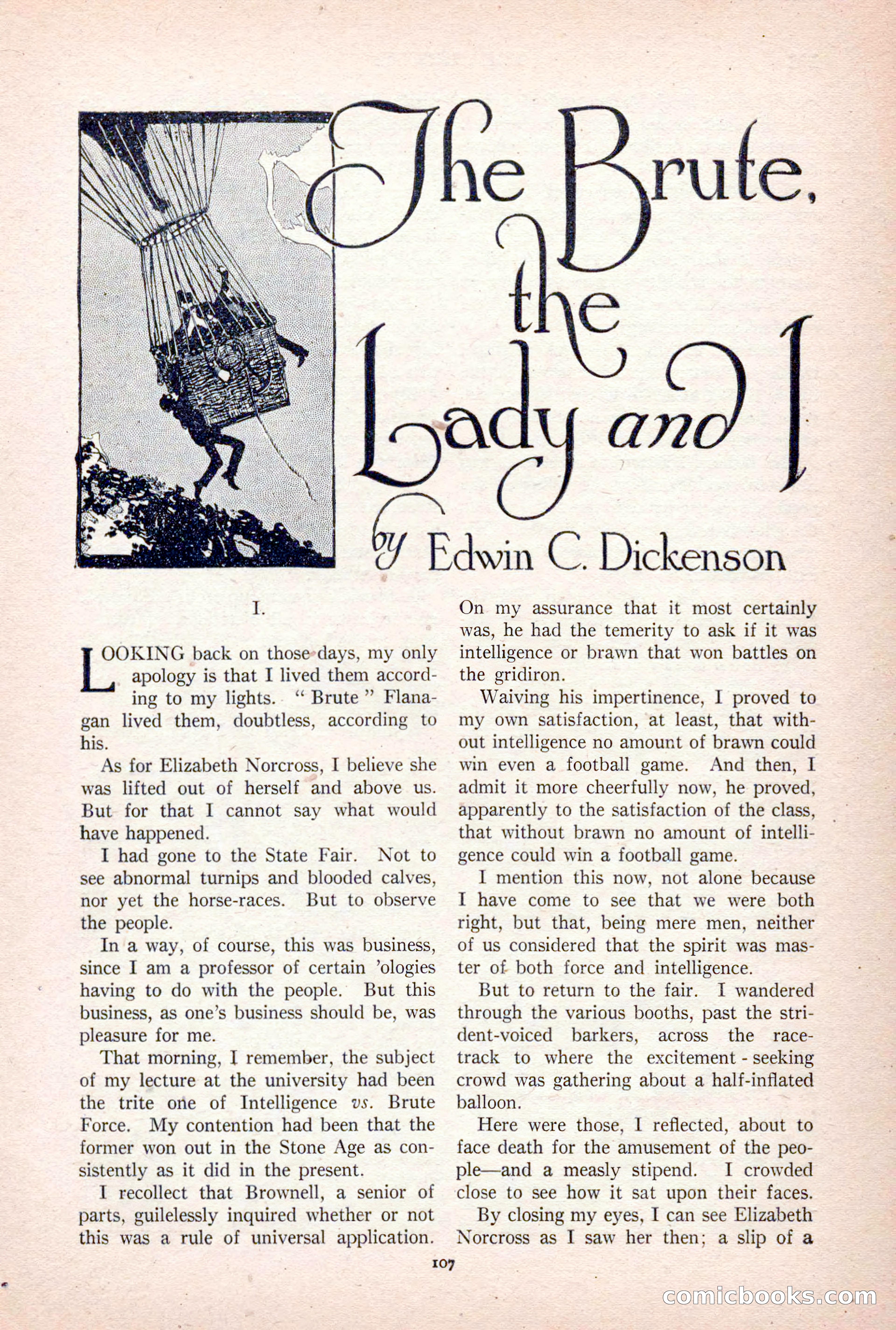
A restored page from Pulp Fiction, 1916. Page through the whole issue in the reader above.
📄 Transcribed text from this page (OCR, searchable)
Machine-transcribed from the original scan — historical spelling and the odd misread are preserved.
OOKING back on thoserdays, my only apology is that I lived them accord- ing to my lights.. “ Brute” Flana- gan lived them, doubtless, according to his. As for Elizabeth Norcross, I believe she was lifted out of herself and above us. But for that I cannot say what would have happened. I had gone to the State Fair. Not to see abnormal turnips and blooded calves, nor yet the horse-races. But to observe the people. In a way, of course, this was business, since I am a professor of certain ’ologies having to do with the people. But this business, as one’s business should be, was pleasure for me. That morning, ] remember, the subject of my lecture at the university had been the trite one of Intelligence vs. Brute Force. My contention had been that the former won out in the Stone Age as con- sistently as it did in the present. I recollect that Brownell, a senior of parts, guilelessly inquired whether or not this was a rule of universal application. 107 he rute, ady and by Edwin C Dickenson On my assurance that it most certainly was, he had the temerity to ask if it was intelligence or brawn that won battles on the gridiron. Waiving his impertinence, I proved to my own satisfaction, at least, that with- out intelligence no amount of brawn could win even a football game. And then, I admit it more cheerfully now, he proved, apparently to the satisfaction of the class, that without brawn no amount of intelli- gence could win a football game. I mention this now, not alone because I have come to see that we were both right, but that, being mere men, neither of us considered that the spirit was mas- ter of both force and intelligence. But to return to the fair. I wandered through the various booths, past the stri- dent-voiced barkers, across the race- track to where the excitement - seeking crowd was gathering about a half-inflated balloon. Here were those, I reflected, about to face death for the amusement of the peo- ple—and a measly stipend. I crowded close to see how it sat upon their faces. By closing my eyes, I can see Elizabeth Norcross as I saw her then; a slip of a CORMMICGLOOOKS <9