
Pulp Fiction, 1916 · page 95 of 204
The Argosy, Vol. 83 No. 1 — page 95: what you’re looking at
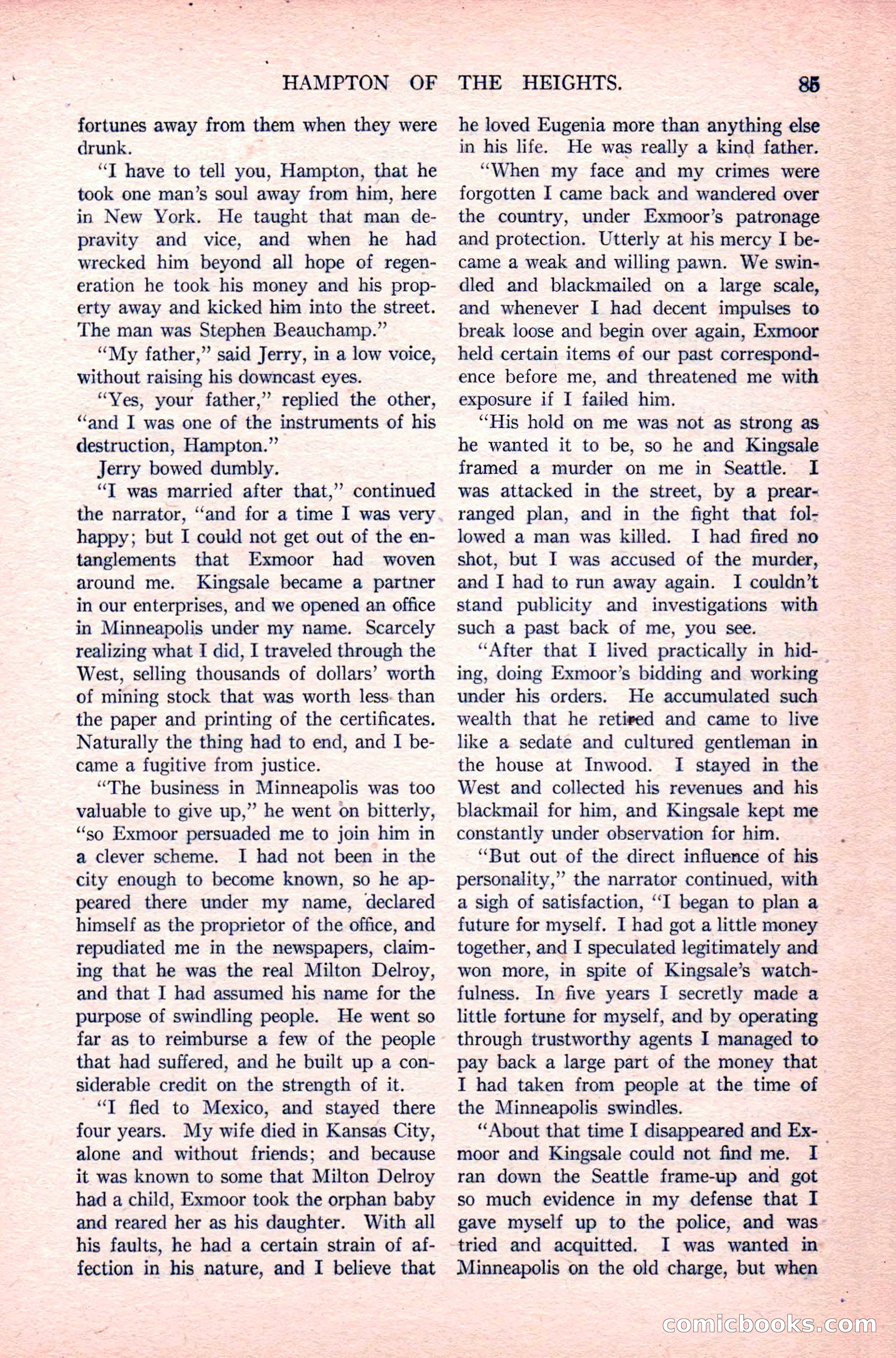
A restored page from Pulp Fiction, 1916. Page through the whole issue in the reader above.
📄 Transcribed text from this page (OCR, searchable)
Machine-transcribed from the original scan — historical spelling and the odd misread are preserved.
HAMPTON OF fortunes away from them when they were drunk. } “T have to tell you, Hampton, that he took one man’s soul away from him, here in New York. He taught that man de- pravity and vice, and when he had wrecked him beyond all hope of regen- eration he took his money and his prop- erty away and kicked him into the street. The man was Stephen Beauchamp.” “My father,” said Jerry, in a low voice, without raising his downcast eyes. “Ves, your father,” replied the other, “and I was one of the instruments of his destruction, Hampton.” Jerry bowed dumbly. “JT was married after that,” continued the narrator, “and for a time I was very happy; but I could not get out of the en- tanglements that Exmoor had woven around me. Kingsale became a partner in our enterprises, and we opened an office in Minneapolis under my name. Scarcely realizing what I did, I traveled through the West, selling thousands of dollars’ worth of mining stock that was worth less. than the paper and printing of the certificates. Naturally the thing had to end, and I be- came a fugitive from justice. “The business in Minneapolis was too valuable to give up,” he went on bitterly, “so Exmoor persuaded me to join him in a clever scheme. I had not been in the city enough to become known, so he ap- peared there under my name, declared himself as the proprietor of the office, and repudiated me in the newspapers, claim- ing that he was the real Milton Delroy, and that I had assumed his name for the purpose of swindling people. He went so far as to reimburse a few of the people that had suffered, and he built up a con- siderable credit on the strength of it. “T fled to Mexico, and stayed there four years. My wife died in Kansas City, alone and without friends; and because it was known to some that Milton Delroy had a child, Exmoor took the orphan baby and reared her as his daughter. With all his faults, he had a certain strain of af- fection in his nature, and I believe that THE HEIGHTS. 85 he loved Eugenia more than anything else in his life. He was really a kind father. “When my face and my crimes were forgotten I came back and wandered over the country, under Exmoor’s patronage and protection. Utterly at his mercy I be- came a weak and willing pawn. We swin- dled and blackmailed on a large scale, and whenever I had decent impulses to break loose and begin over again, Exmoor held certain items of our past correspond- ence before me, and threatened me with exposure if I failed him. “His hold on me was not as strong as” he wanted it to be, so he and Kingsale framed a murder on me in Seattle. I was attacked in the street, by a prear- ranged plan, and in the fight that fol- lowed a man was killed. I had fired no shot, but I was accused of the murder, and I had to run away again. I couldn’t stand publicity and investigations with such a past back of me, you see. “After that I lived practically in hid-_ ing, doing Exmoor’s bidding and working under his orders. He accumulated such wealth that he retived and came to live like a sedate and cultured gentleman in the house at Inwood. I stayed in the West and collected his revenues and his blackmail for him, and Kingsale kept me constantly under observation for him. “But out of the direct influence of his personality,” the narrator continued, with a sigh of satisfaction, “I began to plan a future for myself. I had got a little money together, and I speculated legitimately and won more, in spite of Kingsale’s watch- fulness. In five years I secretly made a little fortune for myself, and by operating through trustworthy agents I managed to pay back a large part of the money that I had taken from people at the time of the Minneapolis swindles. ‘About that time I disappeared and Ex- moor and Kingsale could not find me. I ran down the Seattle frame-up and got so much evidence in my defense that I gave myself up to the police, and was tried and acquitted. Minneapolis on the old charge, but when COMMICLOOOKS I was wanted in (E@)