
Pulp Fiction, 1916 · page 93 of 204
The Argosy, Vol. 83 No. 1 — page 93: what you’re looking at
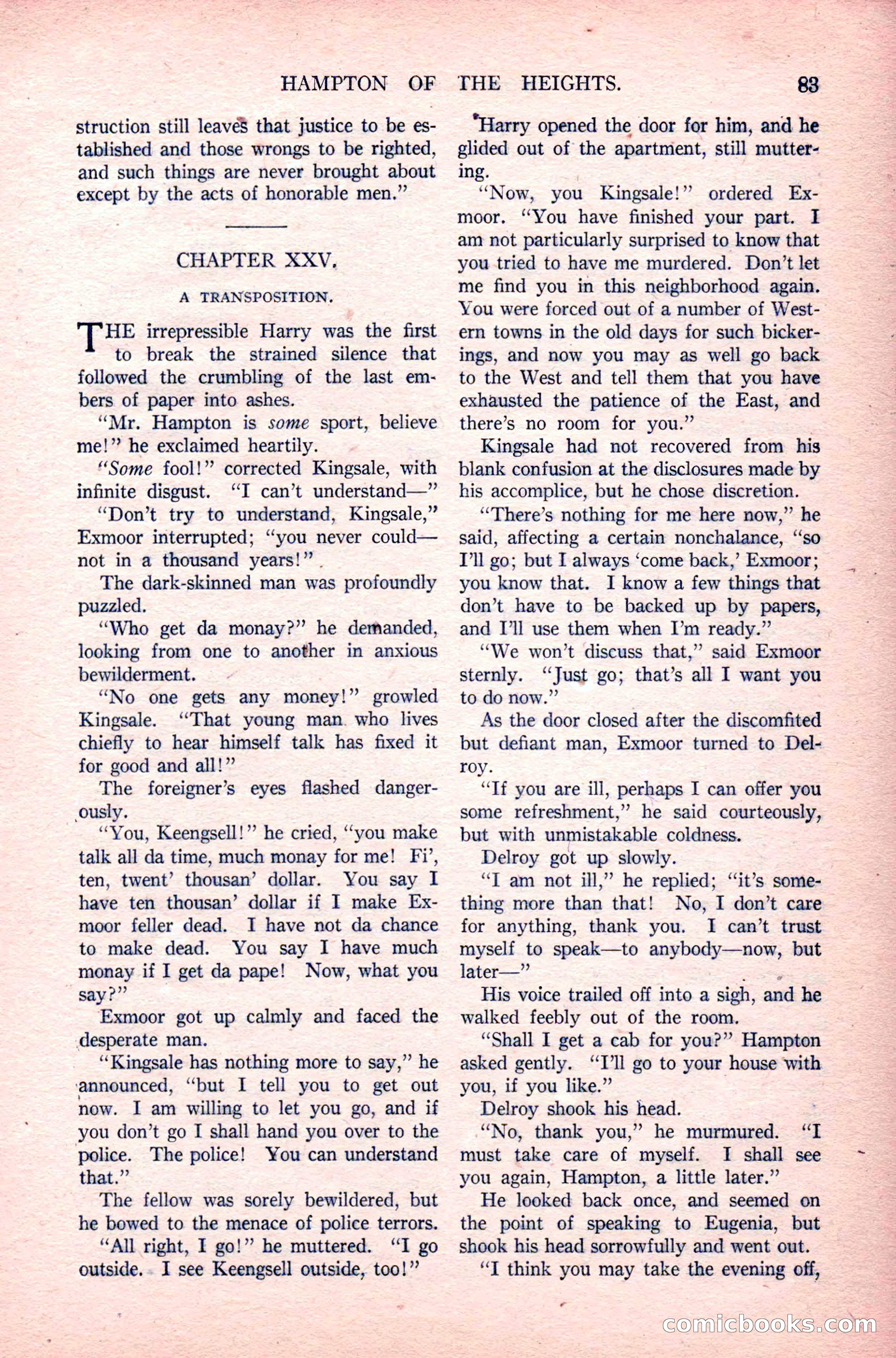
A restored page from Pulp Fiction, 1916. Page through the whole issue in the reader above.
📄 Transcribed text from this page (OCR, searchable)
Machine-transcribed from the original scan — historical spelling and the odd misread are preserved.
HAMPTON OF struction still leave that justice to be es- tablished and those wrongs to be righted, and such things are never brought about except by the acts of honorable men.” CHAPTER XXV, A TRANSPOSITION. "THE irrepressible Harry was the first to break the strained silence that followed the crumbling of the last em- bers of paper into ashes. “Mr. Hampton is some sport, believe me!” he exclaimed heartily. “Some fool!” corrected Kingsale, with infinite disgust. “I can’t understand—” “Don’t try to understand, Kingsale,” Exmoor interrupted; “you never could— not in a thousand years!” . The dark-skinned man was profoundly puzzled. “Who get da monay?” he demanded, looking from one to another in anxious bewilderment. “No one gets any money!” growled Kingsale. ‘That young man. who lives chiefly to hear himself talk has fixed it for good and all!” The foreigner’s eyes flashed danger- ously, “Vou, Keengsell!” he cried, ““you make talk all da time, much monay for me! Fi’, ten, twent’ thousan’ dollar. You say I have ten thousan’ dollar if I make Ex- moor feller dead. I have not da chance to make dead. You say I have much monay if I get da pape! Now, what you say?” Exmoor got up calmly and faced the desperate man. “Kingsale has nothing more to say,” he announced, “but I tell you to get out now. I am willing to let you go, and if you don’t go I shall hand you over to the police. The police! You can understand that.” The fellow was sorely bewildered, but he bowed to the menace of police terrors. “All right, I go!” he muttered. “I go outside... I see Keengsell outside, too!” THE HEIGHTS. 83 “Harry opened the door for him, and he glided out of the apartment, still mutter- ing. ‘Now, you Kingsale!” ordered Ex- moor. “You have finished your part. I am not particularly surprised to know that you tried to have me murdered. Don’t let me find you in this neighborhood again. You were forced out of a number of West- ern towns in the old days for such bicker- ings, and now you may as well go back to the West and tell them that you have exhausted the patience of the East, and there’s no room for you.” Kingsale had not recovered from his blank confusion at the disclosures made by his accomplice, but he chose discretion. ‘““There’s nothing for me here now,” he said, affecting a certain nonchalance, “so I'll go; but I always ‘come back,’ Exmoor; you know that. I know a few things that don’t have to be backed up by papers, and I'll use them when I’m ready.” ‘“‘We won’t discuss that,” said Exmoor sternly. “Just go; that’s all I want you to do now.” As the door closed after the discomfited but defiant man, Exmoor turned to Del- roy. “Tf you are ill, perhaps I can offer you some refreshment,” he said courteously, but with unmistakable coldness. Delroy got up slowly. “T am not ill,” he replied; “it’s some- thing more than that! No, I don’t care for anything, thank you. I can’t trust myself to speak—to anybody—now, but later—”’ = His voice trailed off into a sigh, and he walked feebly out of the room. “Shall I get a cab for you?” Hampton asked gently. ‘“TI’ll go to your house with you, if you like.” Delroy shook his head. “No, thank you,” he murmured. “I must take care of myself. I shall see you again, Hampton, a little later.” He looked back once, and seemed on the point of speaking to Eugenia, but shook his head sorrowfully and went out. “I think you may take the evening off, v COMMICLO® (C Ss (E(0)