
Pulp Fiction, 1916 · page 84 of 204
The Argosy, Vol. 83 No. 1 — page 84: what you’re looking at
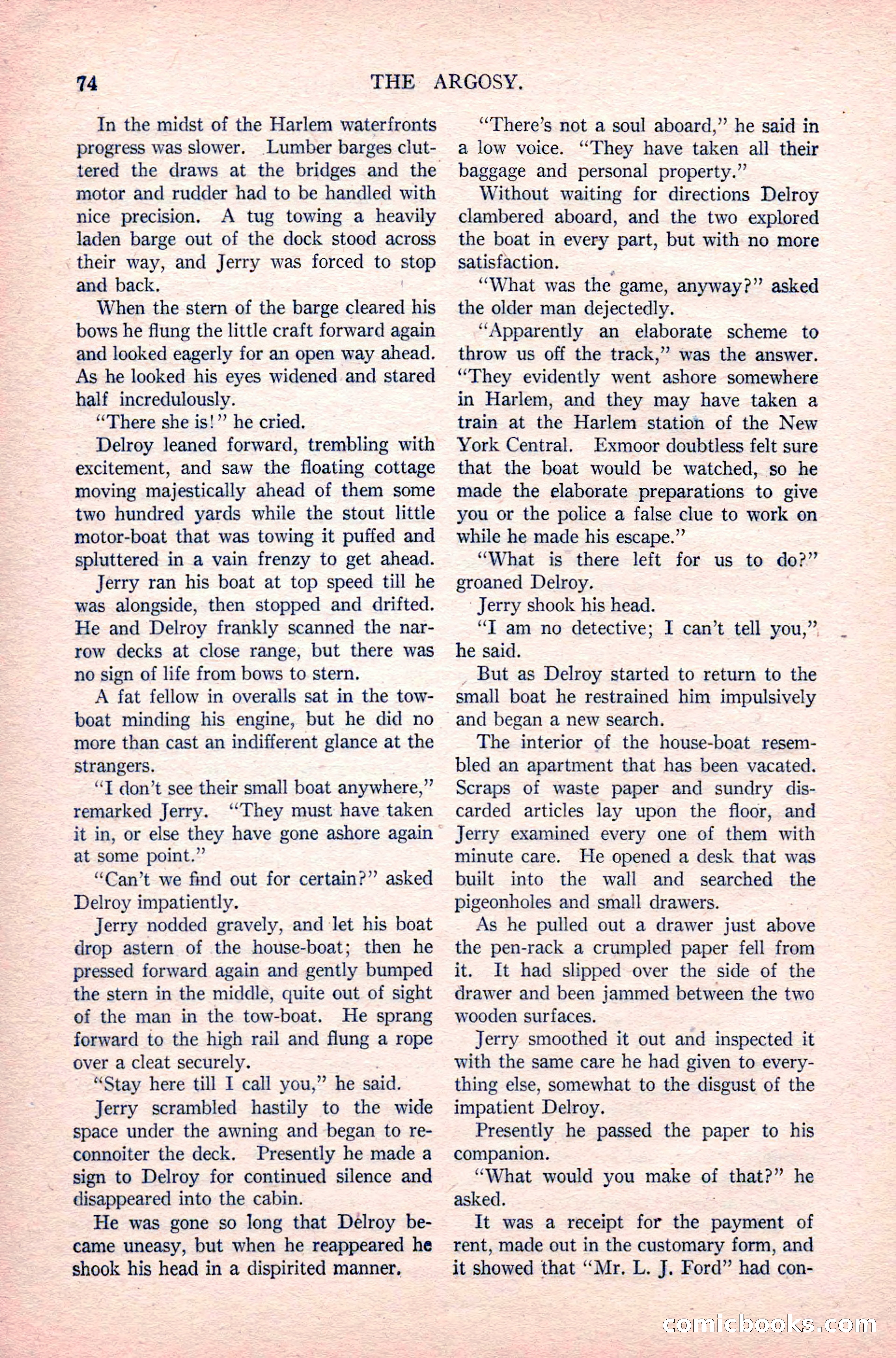
A restored page from Pulp Fiction, 1916. Page through the whole issue in the reader above.
📄 Transcribed text from this page (OCR, searchable)
Machine-transcribed from the original scan — historical spelling and the odd misread are preserved.
74 In the midst of the Harlem waterfronts progress was slower. Lumber barges clut- tered the draws at the bridges and the motor and rudder had to be handled with nice precision. A tug towing a heavily laden barge out of the dock stood across their way, and Jerry was forced to stop and back, When the stern of the barge cleared his bows he flung the little craft forward again and looked eagerly for an open way ahead. As he looked his eyes widened and stared half incredulously. “There she is!”’ he cried. Delroy leaned forward, trembling with excitement, and saw the floating cottage moving majestically ahead of them some two hundred yards while the stout little motor-boat that was towing it puffed and spluttered in a vain frenzy to get ahead. Jerry ran his boat at top speed till he was alongside, then stopped and drifted. He and Delroy frankly scanned the nar- row decks at close range, but there was no sign of life from bows to stern. A fat fellow in overalls sat in the tow- boat minding his engine, but he did no more than cast an indifferent glance at the strangers. “T don’t see their small boat anywhere,” remarked Jerry. ‘They must have taken it in, or else they have gone ashore again at some point.” “Can’t we find out for certain?” asked Delroy impatiently. Jerry nodded gravely, and let his boat drop astern of the house-boat; then he pressed forward again and gently bumped the stern in the middle, quite out of sight of the man in the tow-boat. He sprang forward to the high rail and flung a rope over a cleat securely. “Stay here till I call you,” he said. Jerry scrambled hastily to the wide space under the awning and began to re- connoiter the deck. Presently he made a sign to Delroy for continued silence and disappeared into the cabin. He was gone so long that Delroy be- came uneasy, but when he reappeared he shook his head in a dispirited manner. THE ARGOSY. “There’s not a soul aboard,” he said in a low voice. “They have taken all their baggage and personal property.” Without waiting for directions Delroy clambered aboard, and the two explored the boat in every part, but with no more satisfaction. : “What was the game, anyway?” asked the older man dejectedly. “Apparently an elaborate scheme to throw us off the track,” was the answer. “They evidently went ashore somewhere in Harlem, and they may have taken a train at the Harlem station of the New York Central. Exmoor doubtless felt sure that the boat would be watched, so he made the elaborate preparations to give you or the police a false clue to work on while he made his escape.” “What is there left for us to do?” groaned Delroy. Jerry shook his head. “JT am no detective; I can’t tell you,” he said. But as Delroy started to return to the small boat he restrained him impulsively and began a new search. The interior of the house-boat resem- bled an apartment that has been vacated. Scraps of waste paper and sundry dis- carded articles lay upon the floor, and Jerry examined every one of them with minute care. He opened a desk that was built into the wall and searched the pigeonholes and small drawers. As he pulled out a drawer just abe the pen-rack a crumpled paper fell from it. It had slipped over the side of the drawer and been jammed between the two wooden surfaces. Jerry smoothed it out and inspected it with the same care he had given to every- thing else, somewhat to the disgust of the impatient Delroy. Presently he passed the paper to his companion. “What would you make a that?” he asked. It was a receipt for the payment of rent, made out in the customary form, and it showed that “Mr. L. J. Ford” had con- eConniciooks (S@)