
Pulp Fiction, 1916 · page 82 of 204
The Argosy, Vol. 83 No. 1 — page 82: what you’re looking at
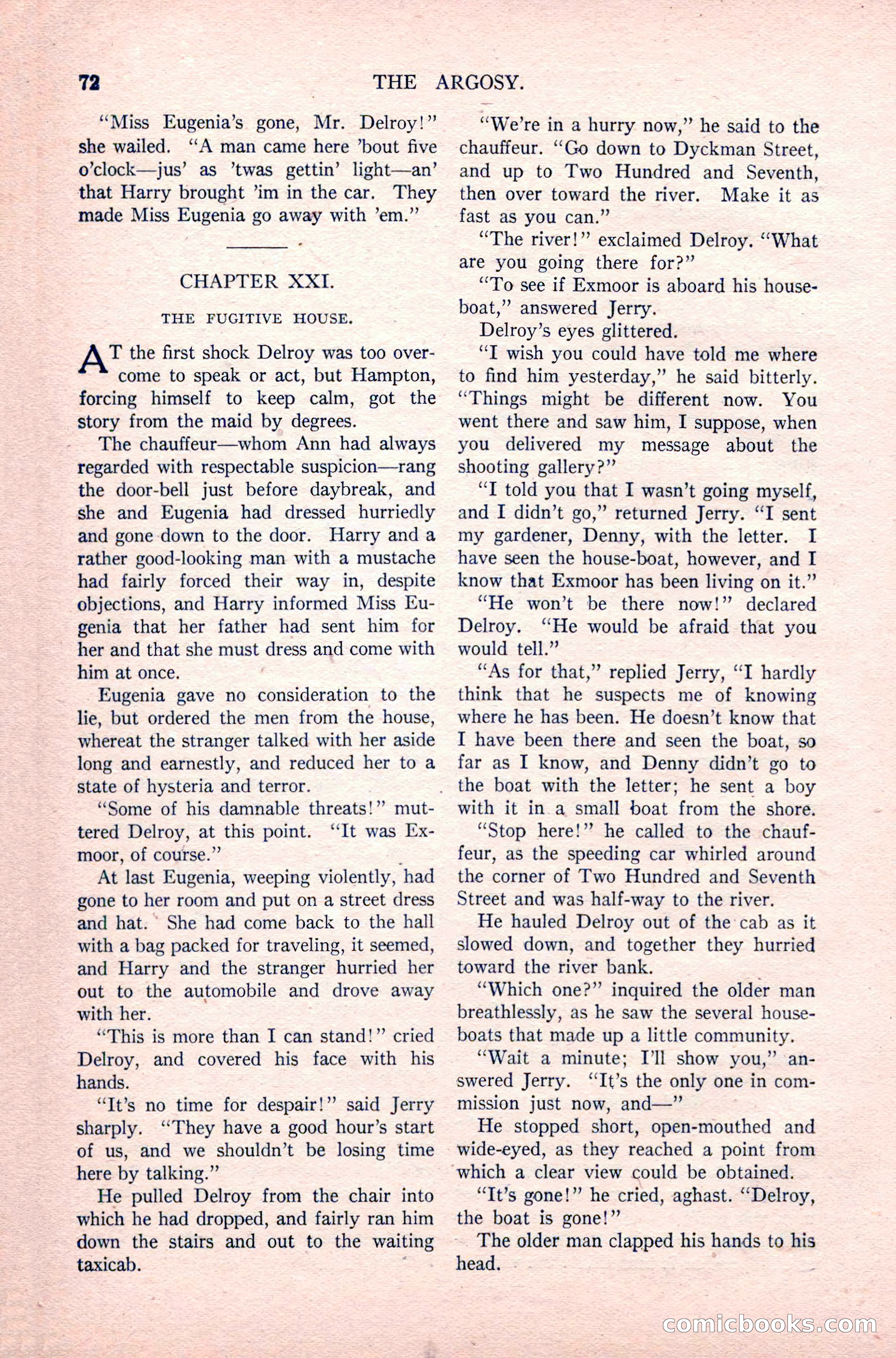
A restored page from Pulp Fiction, 1916. Page through the whole issue in the reader above.
📄 Transcribed text from this page (OCR, searchable)
Machine-transcribed from the original scan — historical spelling and the odd misread are preserved.
72 “Miss Eugenia’s gone, Mr. Delroy!” she wailed. “A man came here ’bout five o’clock—jus’ as ’twas gettin’ light—an’ that Harry brought ’im in the car. They made Miss Eugenia go away with ’em.”’ CHAPTER XXI. THE FUGITIVE HOUSE. A! the first shock Delroy was too over- come to speak or act, but Hampton, forcing himself to keep calm, got the story from the maid by degrees. The chauffeur—whom Ann had always regarded with respectable suspicion—rang the door-bell just before daybreak, and she and Eugenia had dressed hurriedly and gone down to the door. Harry anda rather good-looking man with a mustache had fairly forced their way in, despite objections, and Harry informed Miss Ku- genia that her father had sent him for her and that she must dress and come with him at once. Eugenia gave no consideration to the lie, but ordered the men from the house, whereat the stranger talked with her aside long and earnestly, and reduced her to a state of hysteria and terror. ‘Some of his damnable threats!” mut- tered Delroy, Be this point. “It was Ix- moor, of course.’ At last Eugenia, weeping violently, had gone to her room and put on a street dress and hat. She had come back to the hall with a bag packed for traveling, it seemed, and Harry and the stranger hurried her out to the automobile and drove away with her. “This is more than I can stand!” cried Delroy, and covered his face with his hands. “It’s no time for despair!” said Jerry sharply. “They have a good hour’s start of us, and we shouldn’t be losing time here by talking.” He pulled Delroy from the chair into which he had dropped, and fairly ran him down the stairs and out to the waiting taxicab. THE ARGOSY. ‘““We’re in a hurry now,” he said to the chauffeur. ‘““Go down to Dyckman Street, and up to Two Hundred and Seventh, then over toward the river. Make it as fast as you can.” “The river!”’ exclaimed Delroy. ‘“What are you going there for?” “To see if Exmoor is aboard his house- boat,” answered Jerry. Delroy’s eyes glittered. ‘“T wish you could have told me where to find him yesterday,” he said bitterly. “Things might be different now. You went there and saw him, I suppose, when you delivered my message about the shooting gallery?” “T told you that I wasn’t going myself, and I didn’t go,” returned Jerry. “I sent my gardener, Denny, with the letter. I have seen the house-boat, however, and I know that Exmoor has been living on it.” ‘““He won’t be there now!” declared Delroy. “He would be afraid that you would tell.” “As for that,” replied Jerry, “I hardly think that he suspects me of knowing where he has been. He doesn’t know that I have been there and seen the boat, so far as I know, and Denny didn’t go to _ the boat with the letter; he sent a boy with it in a small boat from the shore. “Stop here!” he called to the chauf- feur, as the speeding car whirled around the corner of Two Hundred and Seventh Street and was half-way to the river. He hauled Delroy out of the cab as it slowed down, and together they hurried toward the river bank. “Which one?” inquired the older man breathlessly, as he saw the several house- boats that made up a little community. “Wait a minute; I'll show you,” an- swered Jerry. “It’s the only one in com- mission just now, and—” He stopped short, open-mouthed and wide-eyed, as they reached a point from which a clear view could be obtained. “It’s gone!” he cried, aghast. “Delroy, the boat is gone!” The older man clapped his hands to his head. COPMICLOOOKS (©)