
Pulp Fiction, 1916 · page 60 of 204
The Argosy, Vol. 83 No. 1 — page 60: what you’re looking at
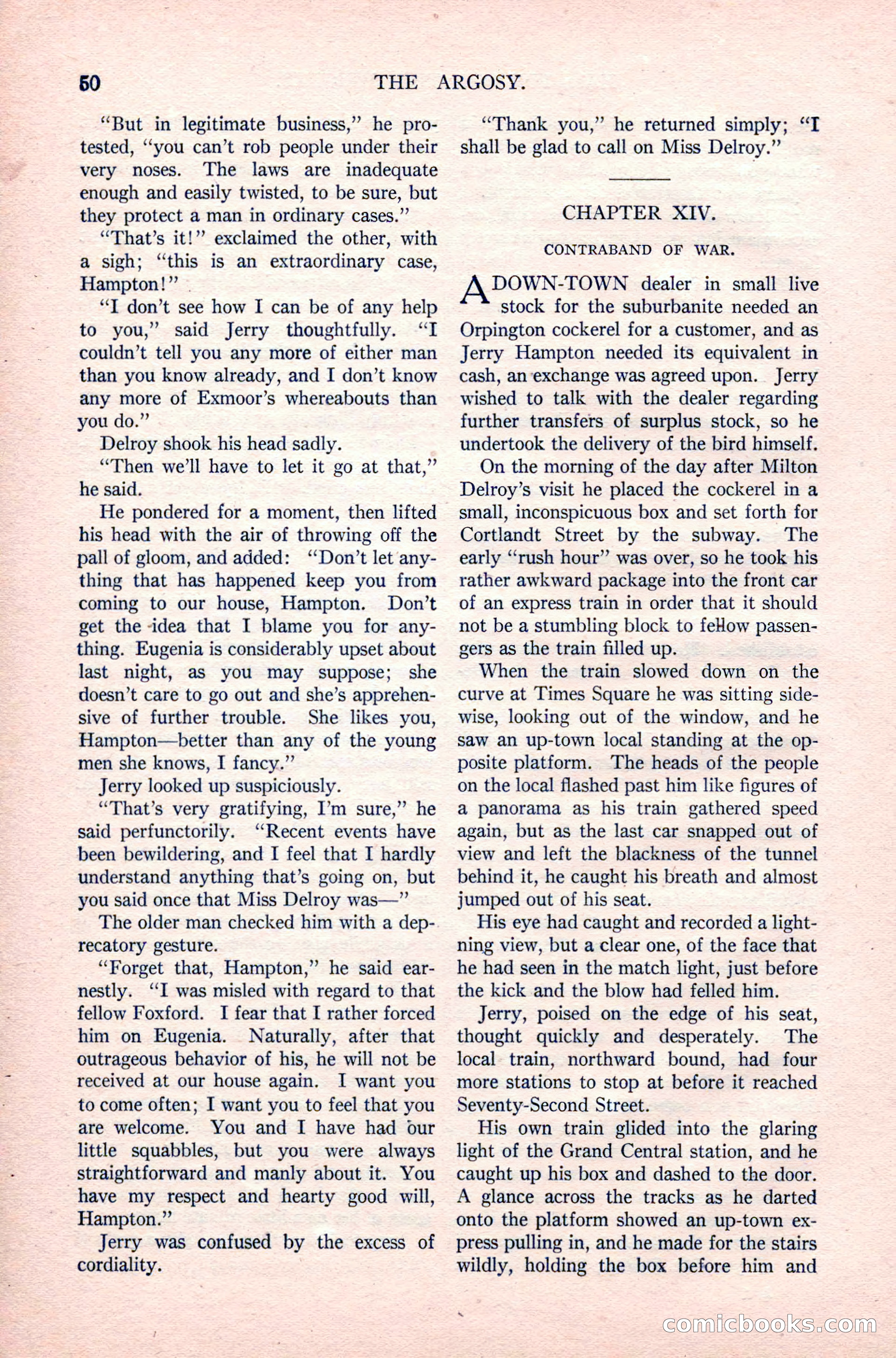
A restored page from Pulp Fiction, 1916. Page through the whole issue in the reader above.
📄 Transcribed text from this page (OCR, searchable)
Machine-transcribed from the original scan — historical spelling and the odd misread are preserved.
50 “But in legitimate business,” he pro- tested, “‘you can’t rob people under their very noses. The laws are inadequate enough and easily twisted, to be sure, but they protect a man in ordinary cases.” “That’s it!” exclaimed the other, with a sigh; “this is an extraordinary case, Hampton!” . “TY don’t see how I can be of any help to you,’ said Jerry thoughtfully. “I couldn’t tell you any more of either man than you know already, and I don’t know any more of Exmoor’s whereabouts than you do.” Delroy shook his head sadly. “Then we'll have to let it go at that,” he said. He pondered for a moment, then lifted his head with the air of throwing off the pall of gloom, and added: “Don’t let any- thing that has happened keep you from coming to our house, Hampton. Don’t get the -idea that I blame you for any- thing. Eugenia is considerably upset about last night, as you may suppose; she doesn’t care to go out and she’s apprehen- sive of further trouble. She likes you, Hampton—better than any of the young men she knows, I fancy.” Jerry looked up suspiciously. “That’s very gratifying, I’m sure,” he said perfunctorily. “Recent events have been bewildering, and I feel that I hardly understand anything that’s going on, but you said once that Miss Delroy was—”’ The older man checked him with a dep- recatory gesture. “Forget that, Hampton,” he said ear- nestly. ‘I was misled with regard to that fellow Foxford. I fear that I rather forced him on Eugenia. Naturally, after that outrageous behavior of his, he will not be received at our house again. I want you to come often; I want you to feel that you are welcome. You and I have had our little squabbles, but you were always straightforward and manly about it. You have my respect and hearty good will, Hampton.” Jerry was confused by the excess of cordiality. THE ARGOSY. “Thank you,” he returned simply; “T shall be glad to call on Miss Delroy.” CHAPTER XIV. CONTRABAND OF WAR. DOWN-TOWN dealer in small live stock for the suburbanite needed an Orpington cockerel for a customer, and as — Jerry Hampton needed its equivalent in cash, an exchange was agreed upon. Jerry wished to talk with the dealer regarding further transfers of surplus stock, so he undertook the delivery of the bird himself. On the morning of the day after Milton Delroy’s visit he placed the cockerel in a small, inconspicuous box and set forth for Cortlandt Street by the subway. The early “rush hour” was over, so he took his rather awkward package into the front car of an express train in order that it should not be a stumbling block to feHow passen- gers as the train filled up. When the train slowed down on the curve at Times Square he was sitting side- wise, looking out of the window, and he saw an up-town local standing at the op- posite platform. The heads of the people on the local flashed past him like figures of a panorama as his train gathered speed again, but as the last car snapped out of view and left the blackness of the tunnel behind it, he caught his breath and almost jumped out of his seat. His eye had caught and recorded a light- ning view, but a clear one, of the face that he had seen in the match light, just before the kick and the blow had felled him. Jerry, poised on the edge of his seat, thought quickly and desperately. The local train, northward bound, had four more stations to stop at before it reached Seventy-Second Street. His own train glided into the glaring light of the Grand Central station, and he caught up his box and dashed to the door. A glance across the tracks as he darted onto the platform showed an up-town ex- press pulling in, and he made for the stairs wildly, holding the box before him and ECORMICLOOOKS (C@)