
Pulp Fiction, 1916 · page 55 of 204
The Argosy, Vol. 83 No. 1 — page 55: what you’re looking at
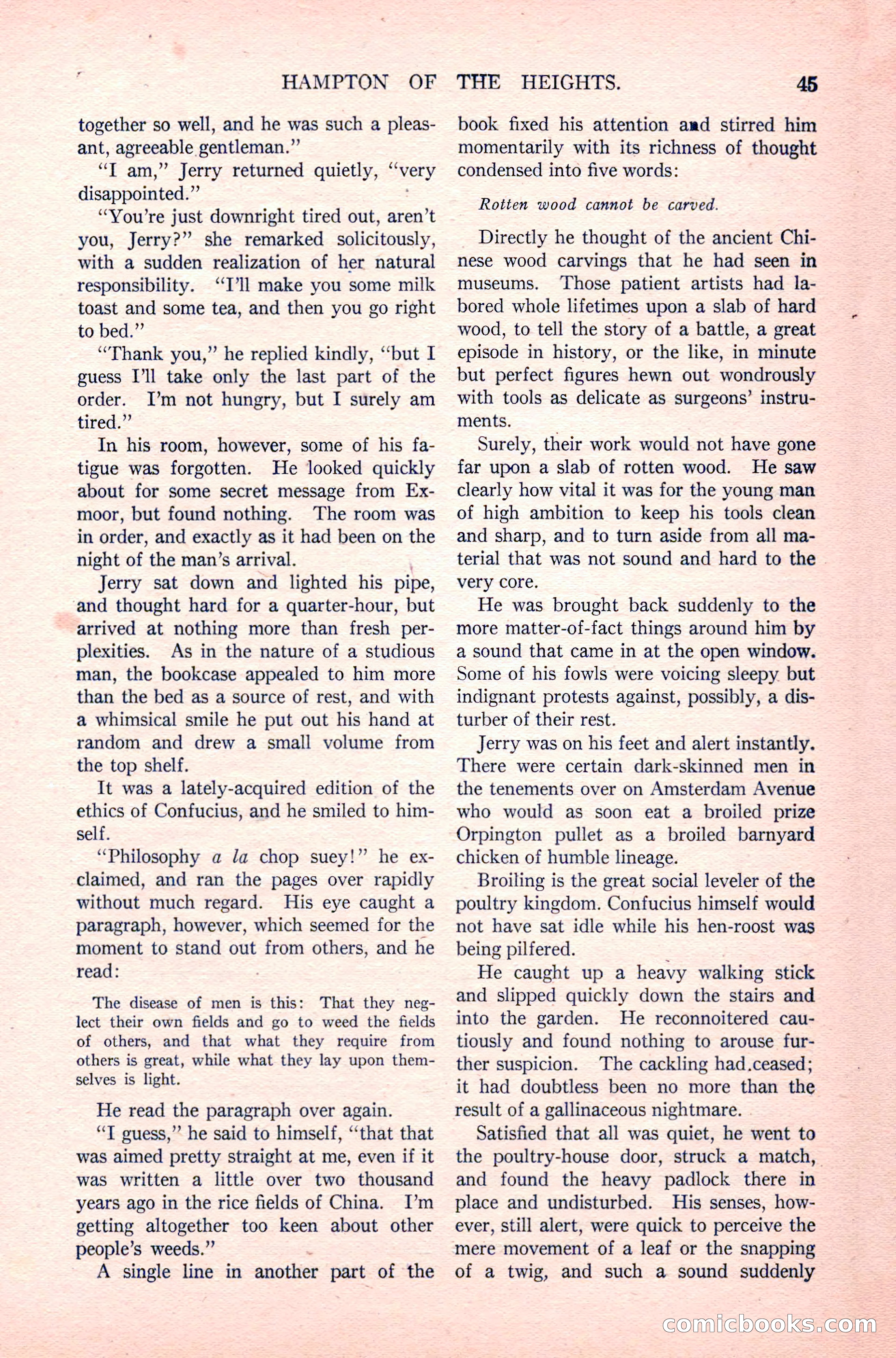
A restored page from Pulp Fiction, 1916. Page through the whole issue in the reader above.
📄 Transcribed text from this page (OCR, searchable)
Machine-transcribed from the original scan — historical spelling and the odd misread are preserved.
HAMPTON OF together so well, and he was such a pleas- ant, agreeable gentleman.” “T am,” Jerry returned quietly, disappointed.” ‘“You’re just downright tired out, aren’t you, Jerry?” she remarked solicitously, with a sudden realization of her natural responsibility. ‘“T’ll make you some milk toast and some tea, and then you go right to bed.” “Thank you,” he replied kindly, “but I guess I’ll take only the last part of the order. I’m not hungry, but I surely am tired.” In his room, however, some of his fa- tigue was forgotten. He looked quickly about for some secret message from Ex- moor, but found nothing. The room was in order, and any. as it had been on the night of the man’s arrival. Jerry sat down and lighted his pipe, and thought hard for a quarter-hour, but arrived at nothing more than fresh per- plexities. As in the nature of a studious man, the bookcase appealed to him more than the bed as a source of rest, and with a whimsical smile he put out his hand at random and drew a small volume from the top shelf. It was a lately-acquired edition of the ethics of Confucius, and he smiled to him- self. ‘Philosophy a da chop suey!” he ex- claimed, and ran the pages over rapidly without much regard. His eye caught a paragraph, however, which seemed for the moment to stand out from others, and he read: “very The disease of men is this: That they neg- lect their own fields and go to weed the fields of others, and that what they require from others is great, while what they lay upon them- selves is light. He read the paragraph over again. “T guess,” he said to himself, “that that was aimed pretty straight at me, even if it was written a little over two thousand years ago in the rice fields of China. I’m getting altogether too keen about other people’s weeds.” A single line in another part of the THE HEIGHTS. 45 book fixed his attention ard stirred him momentarily with its richness of thought condensed into five words: Rotten wood cannot be carved. Directly he thought of the ancient Chi- nese wood carvings that he had seen in museums. Those patient artists had la- bored whole lifetimes upon a slab of hard wood, to tell the story of a battle, a great episode in history, or the like, in minute but perfect figures hewn out wondrously with tools as delicate as surgeons’ instru- ments. Surely, their work would not have gone far upon a slab of rotten wood. He saw clearly how vital it was for the young man of high ambition to keep his tools clean and sharp, and to turn aside from all ma- terial that was not sound and hard to the | very core. He was brought back suddenly to the more matter-of-fact things around him by a sound that came in at the open window. Some of his fowls were voicing sleepy but indignant protests against, possibly, a dis- turber of their rest. Jerry was on his feet and alert instantly. There were certain dark-skinned men in the tenements over on Amsterdam Avenue who would as soon eat a broiled prize Orpington pullet as a broiled barnyard chicken of humble lineage. Broiling is the great social leveler of the poultry kingdom. Confucius himself would not have sat idle while his hen-roost was being pilfered. ; He caught up a heavy walking stick and slipped quickly down the stairs and into the garden. He reconnoitered cau- tiously and found nothing to arouse fur- ther suspicion. The cackling had.ceased; it had doubtless been no more than the result of a gallinaceous nightmare. Satisfied that all was quiet, he went to the poultry-house door, struck a match, and found the heavy padlock there in place and undisturbed. His senses, how- ever, still alert, were quick to perceive the mere movement of a leaf or the snapping of a twig, and such a sound suddenly CORMICLOOOKS (C@)