
Pulp Fiction, 1916 · page 49 of 204
The Argosy, Vol. 83 No. 1 — page 49: what you’re looking at
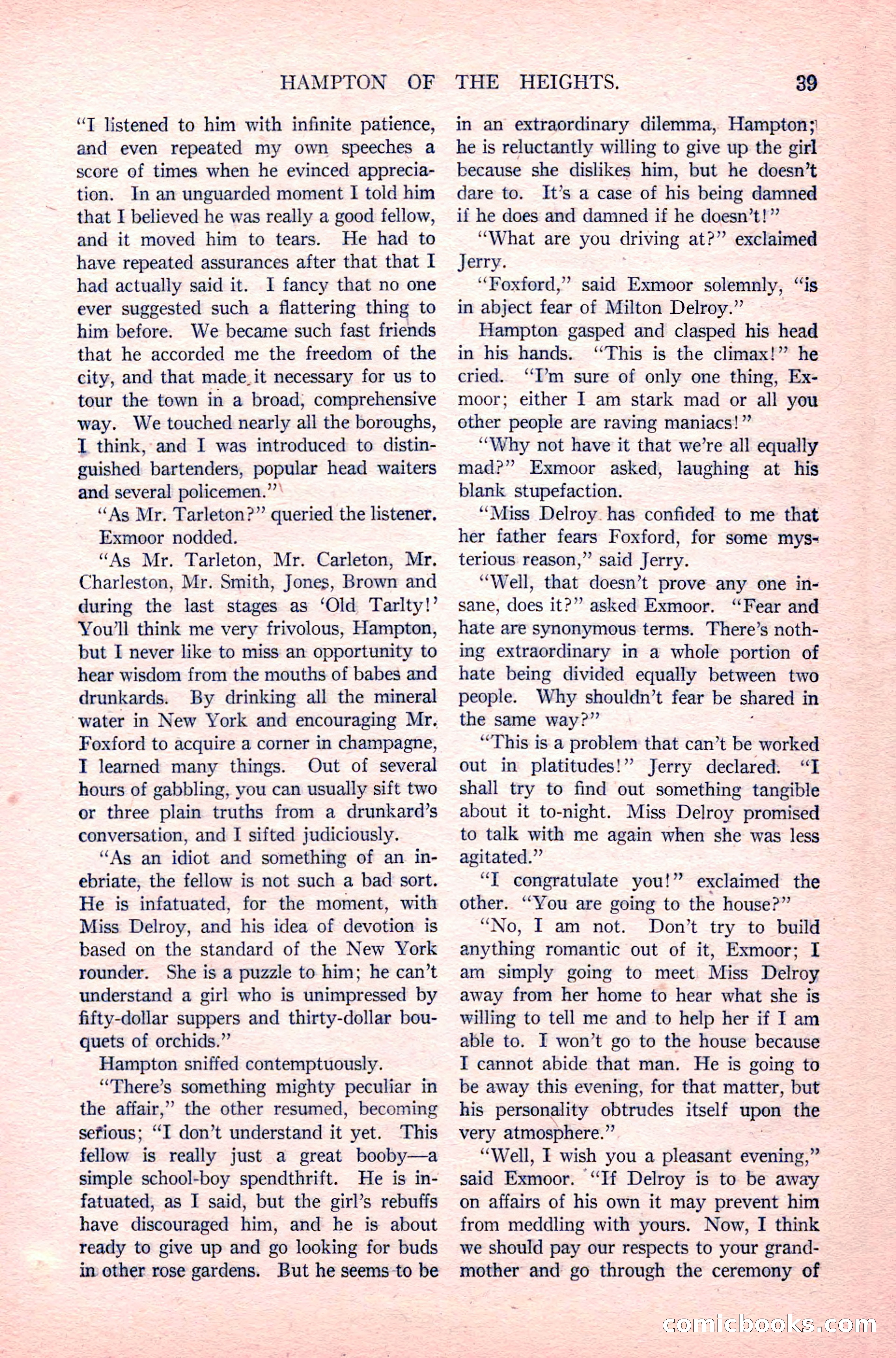
A restored page from Pulp Fiction, 1916. Page through the whole issue in the reader above.
📄 Transcribed text from this page (OCR, searchable)
Machine-transcribed from the original scan — historical spelling and the odd misread are preserved.
HAMPTON OF “T listened to him with infinite patience, and even repeated my own speeches a score of times when he evinced apprecia- tion. In an unguarded moment I told him that I believed he was really a good fellow, and it moved him to tears. He had to have repeated assurances after that that I had actually said it. I fancy that no one ever suggested such a flattering thing to him before. We became such fast friends that he accorded me the freedom of the city, and that made_it necessary for us to tour the town in a broad, comprehensive way. We touched nearly all the boroughs, I think, and I was introduced to distin- guished bartenders, popular head waiters and several policemen.” “As Mr. Tarleton?” queried the listener. Exmoor nodded. “As Mr. Tarleton, Mr. Carleton, Mr. Charleston, Mr. Smith, Jones, Brown and during the last stages as ‘Old Tarlty!’ You'll think me very frivolous, Hampton, but I never like to miss an opportunity to hear wisdom from the mouths of babes and drunkards. By drinking all the mineral ‘water in New York and encouraging Mr. Foxford to acquire a corner in champagne, I learned many things. Out of several hours of gabbling, you can usually sift two or three plain truths from a drunkard’s conversation, and I sifted judiciously. “As an idiot and something of an in- ebriate, the fellow is not such a bad sort. He is infatuated, for the moment, with Miss Delroy, and his idea of devotion is based on the standard of the New York rounder. She is a puzzle to him; he can’t understand a girl who is unimpressed by fifty-dollar suppers and thirty-dollar bou- quets of orchids.” Hampton sniffed contemptuously. “There’s something mighty peculiar in the affair,” the other resumed, becoming sefious; “I don’t understand it yet. This fellow is really just a great booby—a simple school-boy spendthrift. He is in- fatuated, as I said, but the girl’s rebuffs have discouraged him, and he is about ready to give up and go looking for buds in other rose gardens. But he seems to be THE HEIGHTS. in an extraordinary dilemma, Hampton; he is reluctantly willing to give up the girl because she dislikes him, but he doesn’t dare to. It’s a case of his being damned if he does and damned if he doesn’t!” “What are you driving at?” exclaimed Jerry. ‘‘Foxford,” said Exmoor solemnly, ‘is in abject fear of Milton Delroy.” Hampton gasped and clasped his head in his hands. ‘This is the climax!” he cried. “I’m sure of only one thing, Ex- moor; either I am stark mad or all you other people are raving maniacs!” “Why not have it that we’re all equally mad?” Exmoor asked, laughing at his blank stupefaction. “Miss Delroy. has confided to me that her father fears Foxford, for some mys- terious reason,” said Jerry. “Well, that doesn’t prove any one in- sane, does it?” asked Exmoor. ‘Fear and hate are synonymous terms. There’s noth- ing extraordinary in a whole portion of hate being divided equally between two people. Why shouldn’t fear be shared i in the same way?” “This is a problem that can’t be worked out in platitudes!” Jerry declared. “I shall try to find out something tangible about it to-night. Miss Delroy promised to talk with me again when she was less agitated.” “I congratulate you!” exclaimed the other. “You are going to the house?” “No, I am not. anything romantic out of it, Exmoor; I am simply going to meet Miss Delroy away from her home to hear what she is willing to tell me and to help her if I am able to. I won’t go to the house because I cannot abide that man. He is going to be away this evening, for that matter, but his personality obtrudes itself apes the very atmosphere.” “Well, I wish you a pleasant evening,” said Exmoor: ‘ “Tf Delroy is to be away on affairs of his own it may prevent him from meddling with yours. Now, I think we should pay our respects to your grand- mother and go through the ceremony of CORNICLO® (C <S) = 3 Don’t try to build — (C@