
Pulp Fiction, 1916 · page 33 of 204
The Argosy, Vol. 83 No. 1 — page 33: what you’re looking at
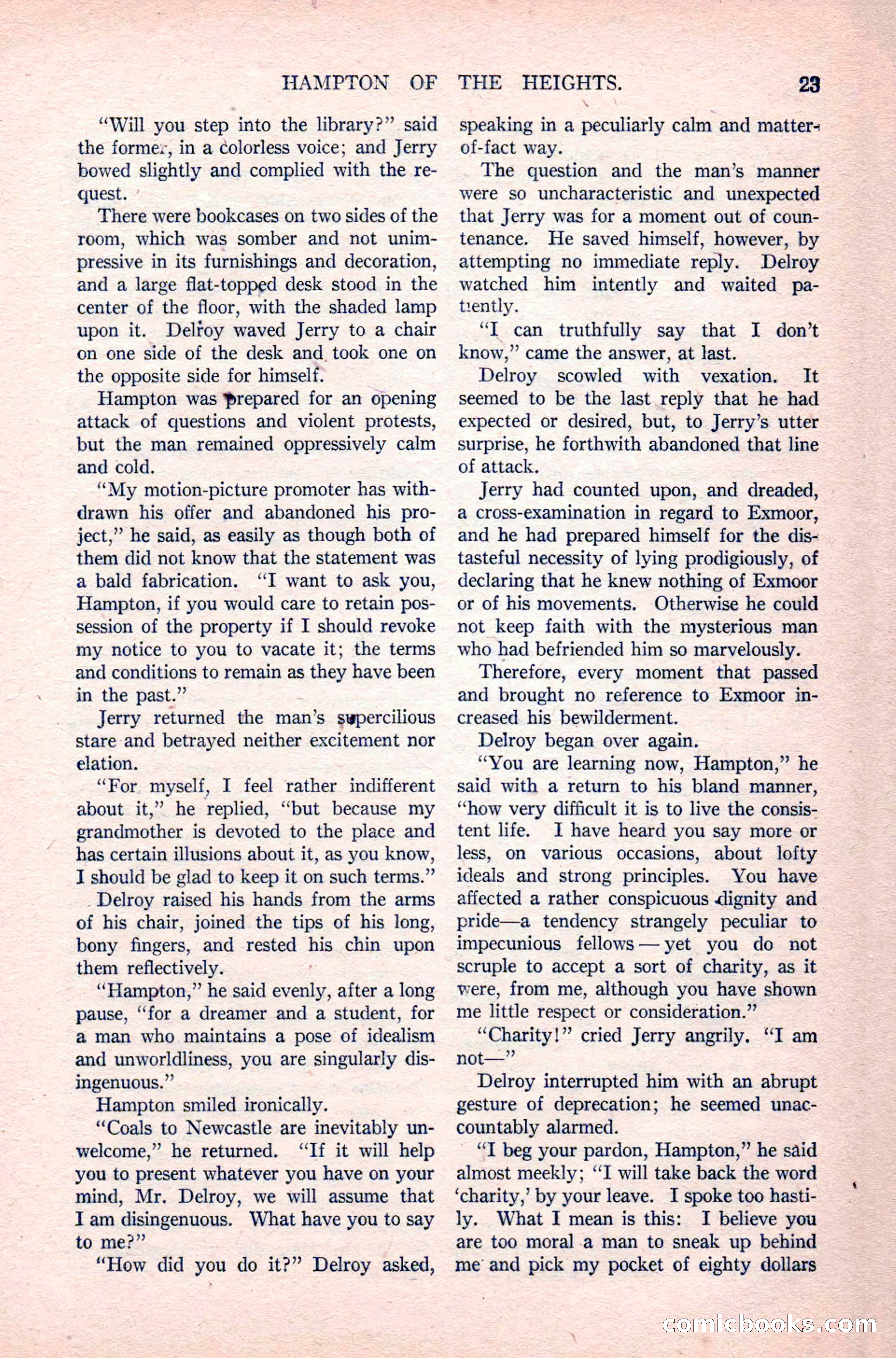
A restored page from Pulp Fiction, 1916. Page through the whole issue in the reader above.
📄 Transcribed text from this page (OCR, searchable)
Machine-transcribed from the original scan — historical spelling and the odd misread are preserved.
HAMPTON OF “Will you step into the library?” said the former, in a colorless voice; and Jerry bowed slightly and complied with the re- quest. ’ There were bookcases on two sides of the room, which was somber and not unim- pressive in its furnishings and decoration, and a large flat-topped desk stood in the center of the floor, with the shaded lamp upon it. Delroy waved Jerry to a chair on one side of the desk and took one on the opposite side for himself. Hampton was prepared for an opening attack of questions and violent protests, but the man remained oppressively calm and cold. “My motion-picture promoter has with- drawn his offer and abandoned his pro- ject,” he said, as easily as though both of them did not know that the statement was a bald fabrication. “I want to ask you, Hampton, if you would care to retain pos- session of the property if I should revoke my notice to you to vacate it; the terms and conditions to remain as they have been in the past.” Jerry returned the man’s swpercilious stare and betrayed neither excitement nor elation. “For myself, I feel rather indifferent about it,” he replied, “but because my grandmother is devoted to the place and has certain illusions about it, as you know, I should be glad to keep it on such terms.” Delroy raised his hands from the arms of his chair, joined the tips of his long, bony fingers, and rested his chin upon them reflectively. : “Hampton,” he said evenly, after a long pause, “for a dreamer and a student, for aman who maintains a pose of idealism and unworldliness, you are singularly dis- ingenuous.” Hampton smiled ironically. “Coals to Newcastle are inevitably un- welcome,” he returned. “If it will help you to present whatever you have on your mind, Mr. Delroy, we will assume that I am disingenuous. What have you to say to me?”’ “How did you do it?” Delroy asked, 23 speaking in a peculiarly calm and matter- of-fact way. The question and the man’s manner were so uncharacteristic and unexpected that Jerry was for a moment out of coun- tenance. He saved himself, however, by attempting no immediate reply. Delroy watched him intently and waited pa- trently. “TJ can truthfully say that I don’t know,”’ came the answer, at last. Delroy scowled with vexation. It seemed to be the last reply that he had expected or desired, but, to Jerry’s utter surprise, he forthwith abandoned that line of attack. Jerry had counted upon, and dreaded, a cross-examination in regard to Exmoor, and he had prepared himself for the dis- tasteful necessity of lying prodigiously, of declaring that he knew nothing of Exmoor or of his movements. Otherwise he could not keep faith with the mysterious man who had befriended him so marvelously. Therefore, every moment that passed and brought no reference to Exmoor in- creased his bewilderment. Delroy began over again. “You are learning now, Hampton,” he said with a return to his bland manner, “how very difficult it is to live the consis- tent life. I have heard you say more or less, On various occasions, about lofty ideals and strong principles. You have affected a rather conspicuous dignity and pride—a tendency strangely peculiar to impecunious fellows— yet you do not scruple to accept a sort of charity, as it were, from me, although you have shown me little respect or consideration.” “Charity!” cried Jerry angrily. “I am not—”’ Delroy interrupted him with an abrupt gesture of deprecation; he seemed unac- countably alarmed. “T beg your pardon, Hampton,” he said almost meekly; ‘I will take back the word ‘charity,’ by your leave. I spoke too hasti- ly. What I mean is this: I believe you are too moral a man to sneak up behind me’ and pick my pocket of eighty dollars THE HEIGHTS. COPMICLOOOKS (E@)