
Pulp Fiction, 1916 · page 201 of 204
The Argosy, Vol. 83 No. 1 — page 201: what you’re looking at
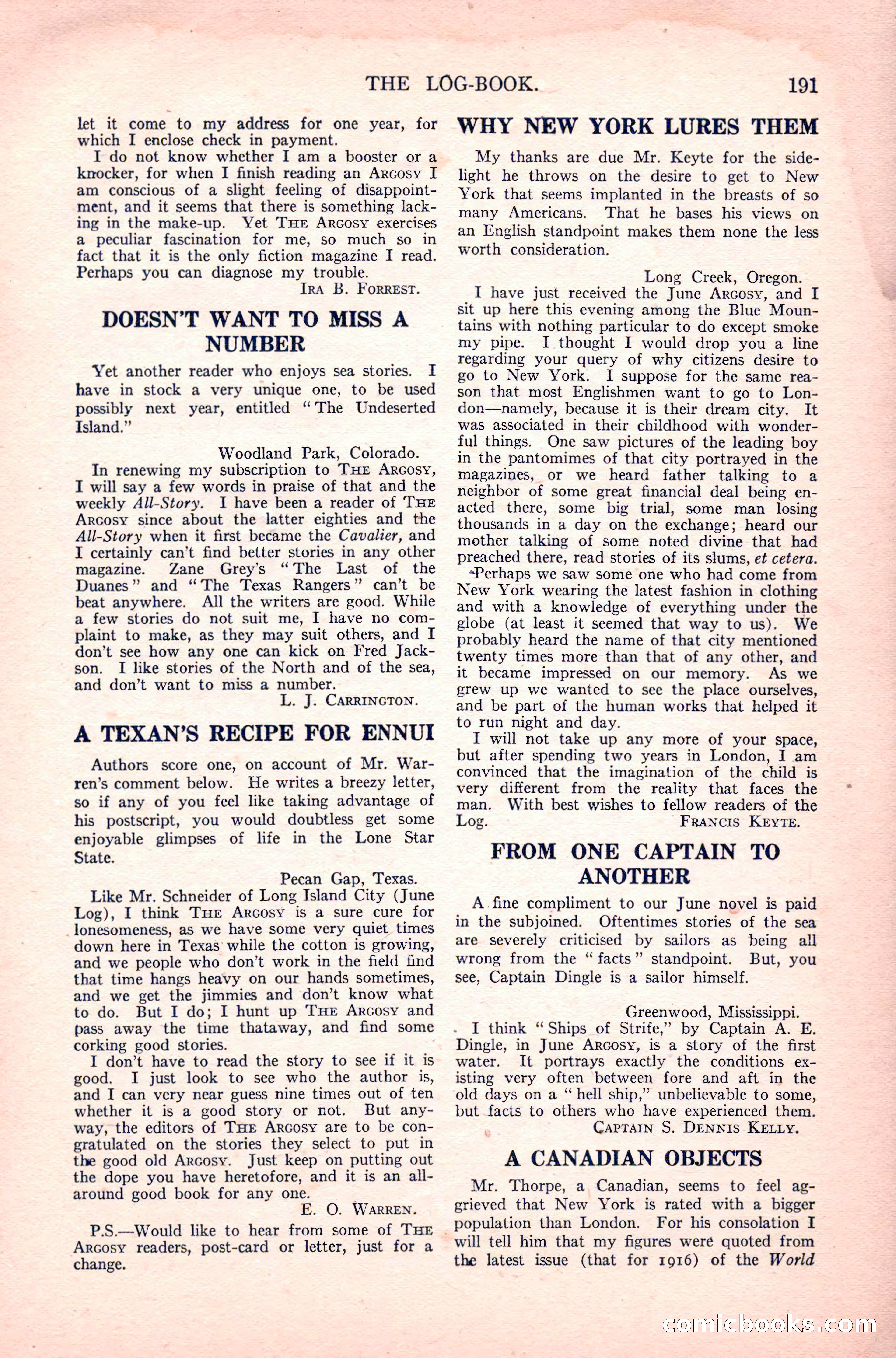
A restored page from Pulp Fiction, 1916. Page through the whole issue in the reader above.
📄 Transcribed text from this page (OCR, searchable)
Machine-transcribed from the original scan — historical spelling and the odd misread are preserved.
THE LOG-BOOK. let it come to my address for one year, for which I enclose check in payment. I do not know whether I am a booster or a knocker, for when I finish reading an Arcosy I am conscious of a slight feeling of disappoint- ment, and it seems that there is something lack- ing in the make-up. Yet THE Arcosy exercises a peculiar fascination for me, so much so in fact that it is the only fiction magazine I read. Perhaps you can diagnose my trouble. IrA B. FORREST. DOESN’T WANT TO MISS A NUMBER Yet another reader who enjoys sea stories. I have in stock a very unique one, to be used possibly next year, entitled “The Undeserted Island.” Woodland Park, Colorado. In renewing my subscription to THE ARGcosy, I will say a few words in praise of that and the weekly All-Story. I have been a reader of THE Arcosy since about the latter eighties and the All-Story when it first became the Cavalier, and I certainly can’t find better stories in any other magazine. Zane Grey’s “The Last of the Duanes” and “The Texas Rangers” can’t be beat anywhere. All the writers are good. While a few stories do not suit me, I have no com- plaint to make, as they may suit others, and I don’t see how any one can kick on Fred Jack- son. I like stories of the North and of the sea, and don’t want to miss a number. L. J. CARRINGTON. A TEXAN’S RECIPE FOR ENNUI Authors score one, on account of Mr. War- ren’s comment below. He writes a breezy letter, so if any of you feel like taking advantage of his postscript, you would doubtless get some enjoyable glimpses of life in the Lone Star State. Pecan Gap, Texas. Like Mr. Schneider of Long Island City (June Log), I think THE Arcosy is a sure cure for lonesomeness, as we have some very quiet times down here in Texas while the cotton is growing, and we people who don’t work in the field find that time hangs heavy on our hands sometimes, and we get the jimmies and don’t know what to do. But I do; I hunt up THE Arcosy and pass away the time thataway, and find some corking good stories. I don’t have to read the story to see if it is good. I just look to see who the author is, and I can very near guess nine times out of ten whether it is a good story or not. But any- way, the editors of THE Arcosy are to be con- gratulated on the stories they select to put in the good old Arcosy. Just keep on putting out the dope you have heretofore, and it is an all- around good book for any one. E. O. WarREN. P.S.—Would like to hear from some of THE Arcosy readers, post-card or letter, just for a change. 191 WHY NEW YORK LURES THEM My thanks are due Mr. Keyte for the side- light he throws on the desire to get to New York that seems implanted in the breasts of so many Americans. That he bases his views on an English standpoint makes them none the less worth consideration. Long Creek, Oregon. I have just received the June Arcosy, and I sit up here this evening among the Blue Moun- tains with nothing particular to do except smoke my pipe. I thought I would drop you a line regarding your query of why citizens desire to go to New York. I suppose for the same rea- son that most Englishmen want to go to Lon- don—namely, because it is their dream city. It was associated in their childhood with wonder- ful things. One saw pictures of the leading boy in the pantomimes of that city portrayed in the magazines, or we heard father talking to a neighbor of some great financial deal being en- acted there, some big trial, some man losing thousands in a day on the exchange; heard our mother talking of some noted divine that had preached there, read stories of its slums, et cetera. “Perhaps we saw some one who had come from New York wearing the latest fashion in clothing and with a knowledge of everything under the globe (at least it seemed that way to us). We probably heard the name of that city mentioned twenty times more than that of any other, and it became impressed on our memory. As we grew up we wanted to see the place ourselves, and be part of the human works that helped it to run night and day. I will not take up any more of your space, but after spending two years in London, I am convinced that the imagination of the child is very different from the reality that faces the man. With best wishes to fellow readers of the Log. FRANCIS KEYTE, FROM ONE CAPTAIN TO ANOTHER A fine compliment to our June novel is paid in the subjoined. Oftentimes stories of the sea are severely criticised by sailors as being all wrong from the “ facts”’ standpoint. But, you see, Captain Dingle is a sailor himself. Greenwood, Mississippi. I think “Ships of Strife,” by Captain A. E. Dingle, in June Arcosy, is a story of the first water. It portrays exactly the conditions ex- isting very often between fore and aft in the old days on a “hell ship,” unbelievable to some, but facts to others who have experienced them. CarTaAIn S. DENNIS KELLY. A CANADIAN OBJECTS Mr. Thorpe, a Canadian, seems to feel ag- grieved that New York is rated with a bigger population than London. For his consolation I will tell him that my figures weré quoted from the latest issue (that for 1916) of the World CORMMICLOOOKS (C@