
Pulp Fiction, 1916 · page 191 of 204
The Argosy, Vol. 83 No. 1 — page 191: what you’re looking at
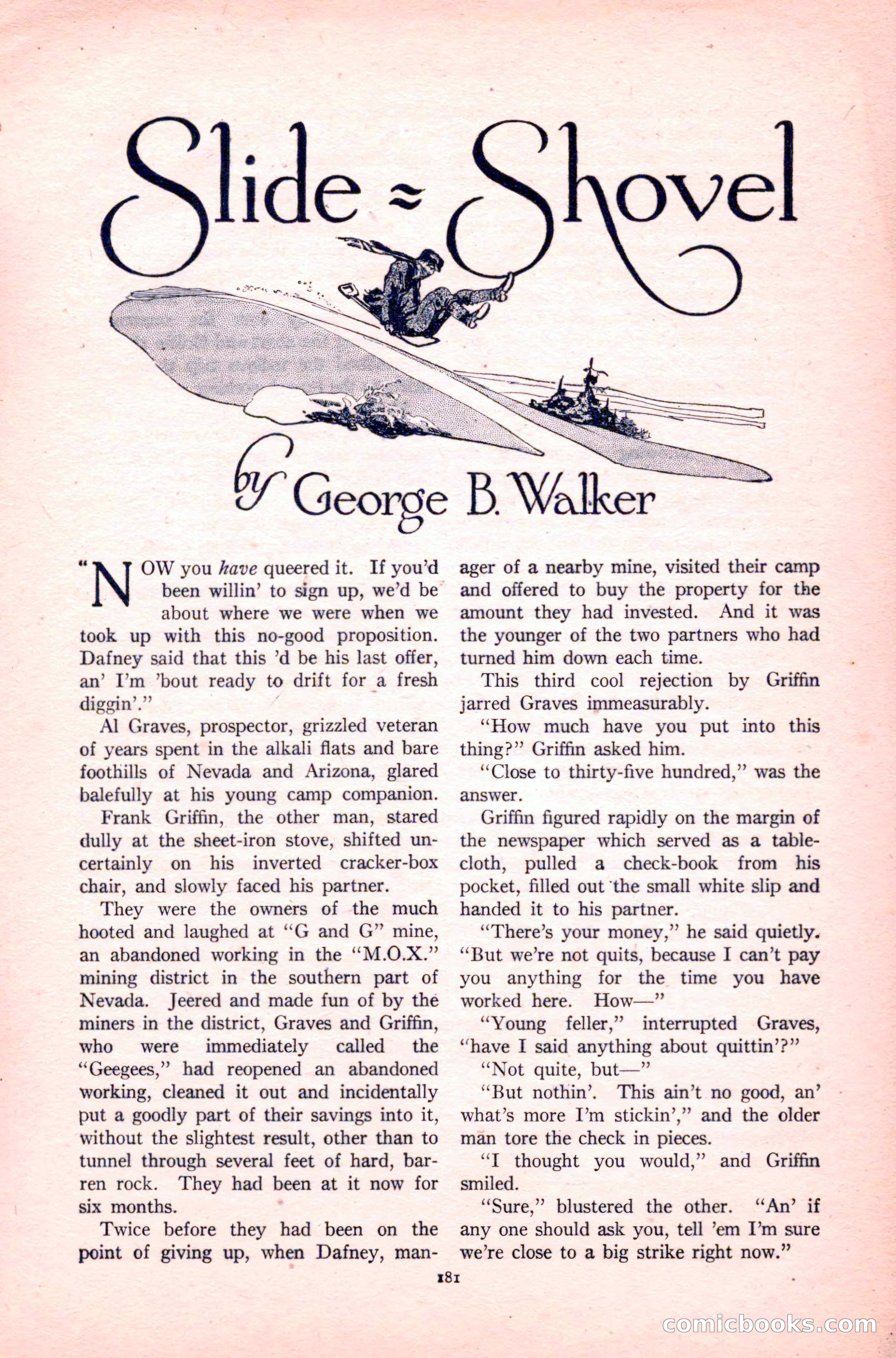
A restored page from Pulp Fiction, 1916. Page through the whole issue in the reader above.
📄 Transcribed text from this page (OCR, searchable)
Machine-transcribed from the original scan — historical spelling and the odd misread are preserved.
33 OW you dave queered it. If you’d been willin’ to sign up, we’d be about where we were when we took up with this no-good proposition. Dafney said that this ’d be his last offer, an’ I’m ’bout ready to drift for a fresh diggin’.” | Al Graves, prospector, grizzled veteran of years spent in the alkali flats and bare foothills of Nevada and Arizona, glared balefully at his young camp companion. Frank Griffin, the other man, stared dully at the sheet-iron stove, shifted un- certainly on his inverted cracker-box chair, and slowly faced his partner. They were the owners of the much hooted and laughed at ““G and G” mine, an abandoned working in the ‘“M.O.X.” mining district in the southern part of Nevada. Jeered and made fun of by the miners in the district, Graves and Griffin, who were’ immediately called the “Geegees,” had reopened an abandoned working, cleaned it out and incidentally put a goodly part of their savings into it, without the slightest result, other than to tunnel through several feet of hard, bar- ren rock. They had been at it now for six months. Twice before they had been on the point of giving up, when Dafney, man- B, Walker ager of a nearby mine, visited their camp and offered to buy the property for the amount they had invested. And it was the younger of the two partners who had turned him down each time. This third cool rejection by Griffin jarred Graves immeasurably. “How much have you put into this thing?” Griffin asked him. “Close to thirty-five hundred,” was the answer. Griffin figured rapidly on the margin of the newspaper which served as a table- cloth, pulled a _ check-book from his pocket, filled out ‘the small white slip and handed it to his partner. “There’s your money,” he said quietly. “But we’re not quits, because I can’t pay you anything for the time you have worked here. How—” “Young feller,” interrupted Graves, “have I said anything about quittin’?” “Not quite, but—”’ “But nothin’. This ain’t no good, an’ what’s more I’m stickin’,” and the older man tore the check in pieces. “T thought you would,” and Griffin smiled. “Sure,” blustered the other. ‘An’ if any one should ask you, tell ’em I’m sure we're close to a big strike right now.” 181 Go NOOLK (C@