
Pulp Fiction, 1916 · page 189 of 204
The Argosy, Vol. 83 No. 1 — page 189: what you’re looking at
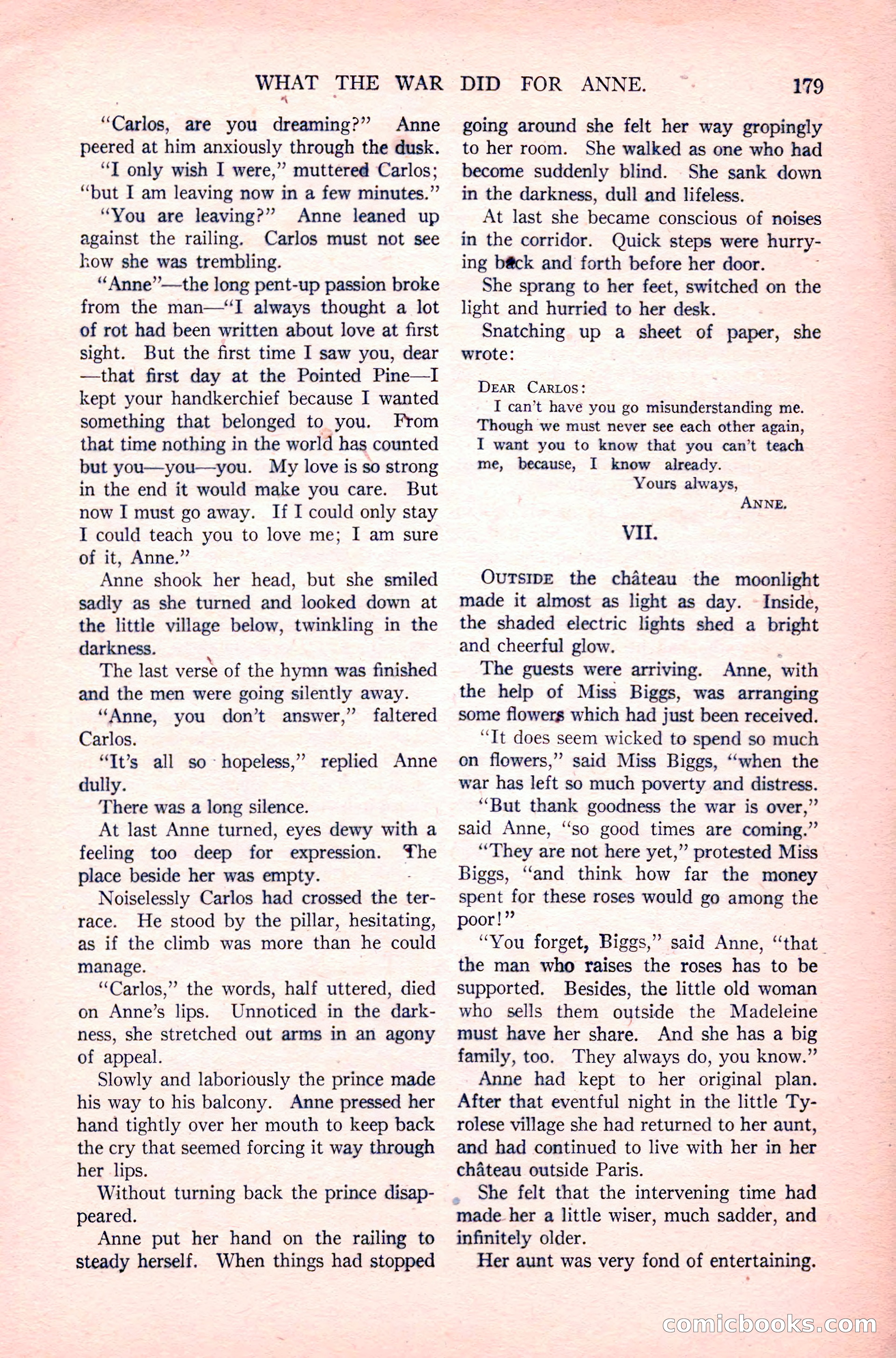
A restored page from Pulp Fiction, 1916. Page through the whole issue in the reader above.
📄 Transcribed text from this page (OCR, searchable)
Machine-transcribed from the original scan — historical spelling and the odd misread are preserved.
WHAT THE WAR “Carlos, are you oe Anne peered at him anxiously through the dusk. “T only wish I were,” muttered Carlos; “but I am leaving now in a few minutes.”’ “You are leaving?” Anne leaned up against the railing. Carlos must not see how she was trembling. “Anne’’—the long pent-up passion broke from the man—“I always thought a lot of rot had been written about love at first sight. But the first time I saw you, dear —that first day at the Pointed Pine—I kept your handkerchief because I wanted something that belonged to you. From that time nothing in the world has counted but you—you—you. My love is so strong in the end it would make you care. But now I must go away. If I could only stay I could teach you to love me; I am sure of it, Anne.” Anne shook her head, but she smiled sadly as she turned and looked down at the little village below, twinkling in the darkness. : The last verse of the hymn was finished and the men were going silently away. “Anne, you don’t answer,” faltered Carlos. “Tt’s all so hopeless,” replied Anne dully. There was a long silence. At last Anne turned, eyes dewy with a feeling too deep for expression. The place beside her was empty. Noiselessly Carlos had crossed thes ter- race. He stood by the pillar, hesitating, as if the climb was more than he could manage. “Carlos,” the words, half uttered, died on Anne’s lips. Unnoticed in the dark- ness, she stretched out arms in an agony of appeal. Slowly and laboriously the prince made his way to his balcony. Anne pressed her hand tightly over her mouth to keep back the cry that seemed forcing it way through her lips. Without turning back the prince disap- peared. Anne put her hand on the railing to steady herself. When things had stopped DID FOR ANNE. 179 going around she felt her way gropingly to her room. She walked as one who had become suddenly blind. She sank down in the darkness, dull and lifeless. At last she became conscious of noises in the corridor. Quick steps were hurry- ing back and forth before her door. She sprang to her feet, switched on the light and hurried to her desk. Snatching up a sheet of paper, she wrote: Dear CaRLos: I can’t have you go misunderstanding me. Though we must never see each other again, I want you to know that you can’t teach me, because, I know already. Yours always, ANNE, VIL. OuTsipE the chateau the moonlight made it almost as light as day. — Inside, the shaded electric lights shed a bright and cheerful glow. The guests were arriving. Anne, with the help of Miss Biggs, was arranging some flowers which had just been received. “Tt does seem wicked to spend so much on flowers,” said Miss Biggs, ‘‘when the war has left so much poverty and distress. ‘But thank goodness the war is over,” said Anne, ‘“‘so good times are coming.” “They are not here yet,” protested Miss Biggs, “and think how far the money spent for these roses would go among the poor!” “You forget, Biggs,” said Anne, “that the man who raises the roses has to be supported. Besides, the little old woman who sells them outside the Madeleine must have her share. And she has a big family, too. They always do, you know.” Anne had kept to her original plan. After that eventful night in the little Ty- rolese village she had returned to her aunt, and had continued to live with her in her chateau outside Paris. . She felt that the intervening time had made her a little wiser, much sadder, and infinitely older. Her aunt was very fond of entertaining. COMMICLOOOKS (C@