
Pulp Fiction, 1916 · page 187 of 204
The Argosy, Vol. 83 No. 1 — page 187: what you’re looking at
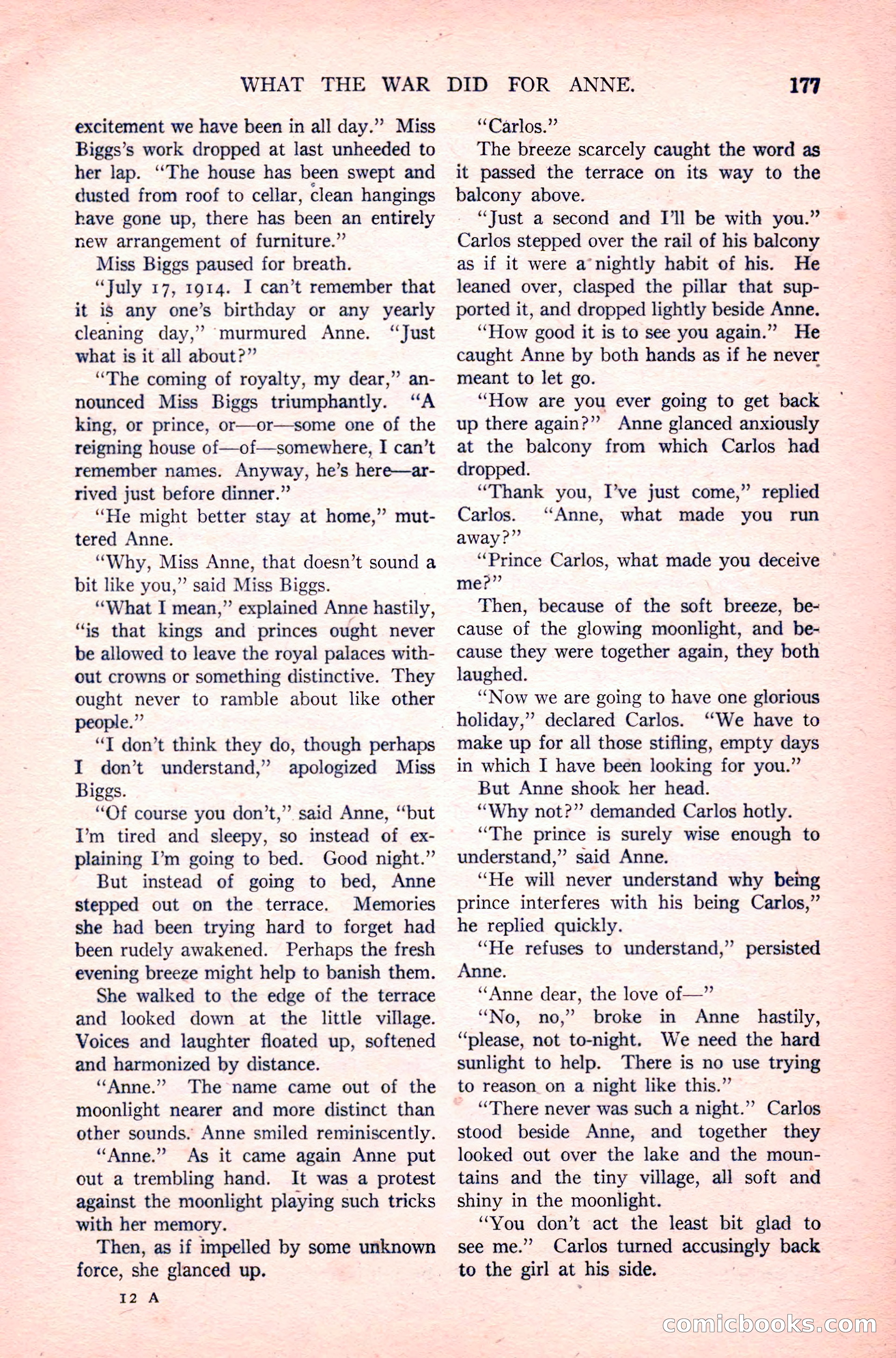
A restored page from Pulp Fiction, 1916. Page through the whole issue in the reader above.
📄 Transcribed text from this page (OCR, searchable)
Machine-transcribed from the original scan — historical spelling and the odd misread are preserved.
WHAT THE WAR DID FOR ANNE. excitement we have been in all day.” Miss Biggs’s work dropped at last unheeded to her lap. “The house has been swept and dusted from roof to cellar, clean hangings have gone up, there has been an entirely new arrangement of furniture.” Miss Biggs paused for breath. “July 17, 1914. I can’t remember that it is any one’s birthday or any yearly cleaning day,” ‘murmured Anne. “Just what is it all about?” “The coming of royalty, my dear,” an- nounced Miss Biggs triumphantly. “A king, or prince, or—or—some one of the reigning house of—of—somewhere, I can’t remember names. Anyway, he’s here—ar- rived just before dinner.” “He might better stay at home,” mut- tered Anne. “Why, Si Anne, that doesn’t sound a bit like you,” said Miss Biggs. “What I mean,” explained Anne hastily, ‘is that kings and princes ought never be allowed to leave the royal palaces with- out crowns or something distinctive. They ought never to ramble about like other people.” “T don’t think they do, though perhaps I don’t understand,” apologized Miss Biggs. “Of course you don’t,”’ said Anne, “but I’m tired and sleepy, so instead of ex- plaining I’m going to bed. Good night.” But instead of going to bed, Anne stepped out on the terrace. Memories she had been trying hard to forget had been rudely awakened. Perhaps the fresh evening breeze might help to banish them. She walked to the edge of the terrace and looked down at the little village. Voices and laughter floated up, softened and harmonized by distance. “Anne.” The name came out of the moonlight nearer and more distinct than other sounds. Anne smiled reminiscently. “Anne.” As it came again Anne put out a trembling hand. It was a protest against the moonlight playing such tricks with her memory. Then, as if impelled by some unknown force, she glanced up. 12 A 177 “Carlos.” The breeze scarcely caught the word as it passed the terrace on its way to the balcony above. “Just a second and IJ’ll be with you.” Carlos stepped over the rail of his balcony as if it were a’nightly habit of his. He leaned over, clasped the pillar that sup- ported it, and dropped lightly beside Anne. “How good it is to see you again.” He caught Anne by both hands as if he never meant to let go. “How are you ever going to get back up there again?” Anne glanced anxiously at the balcony from which Carlos had dropped. “Thank you, I’ve just come,” replied Carlos. “Anne, what made you run away?” “Prince Carlos, what made you deceive © me?” Then, because of the soft breeze, be- cause of the glowing moonlight, and be- cause they were together again, they both laughed. ‘““Now we are going to have one glorious holiday,” declared Carlos. “We have to make up for all those stifling, empty days in which I have been looking for you.” But Anne shook her head. “Why not?” demanded Carlos hotly. “The prince is surely wise enough to understand,” said Anne. ‘He will never understand why being prince interferes with his being Carlos,” he replied quickly. ‘“‘He refuses to understand,” persisted Anne. ‘Anne dear, the love of—” “No, no,” broke in Anne _ hastily, “please, not to-night. We need the hard sunlight to help. There is no use trying to reason on a night like this.” “There never was such a night.” Carlos stood beside Anne, and together they looked out over the lake and the moun- tains and the tiny village, all soft and shiny in the moonlight. Nee: don’t act the least bit glad to see me.” Carlos turned acc Mange back to the se at Ais side. Go NOOK (C@)