
Pulp Fiction, 1916 · page 181 of 204
The Argosy, Vol. 83 No. 1 — page 181: what you’re looking at
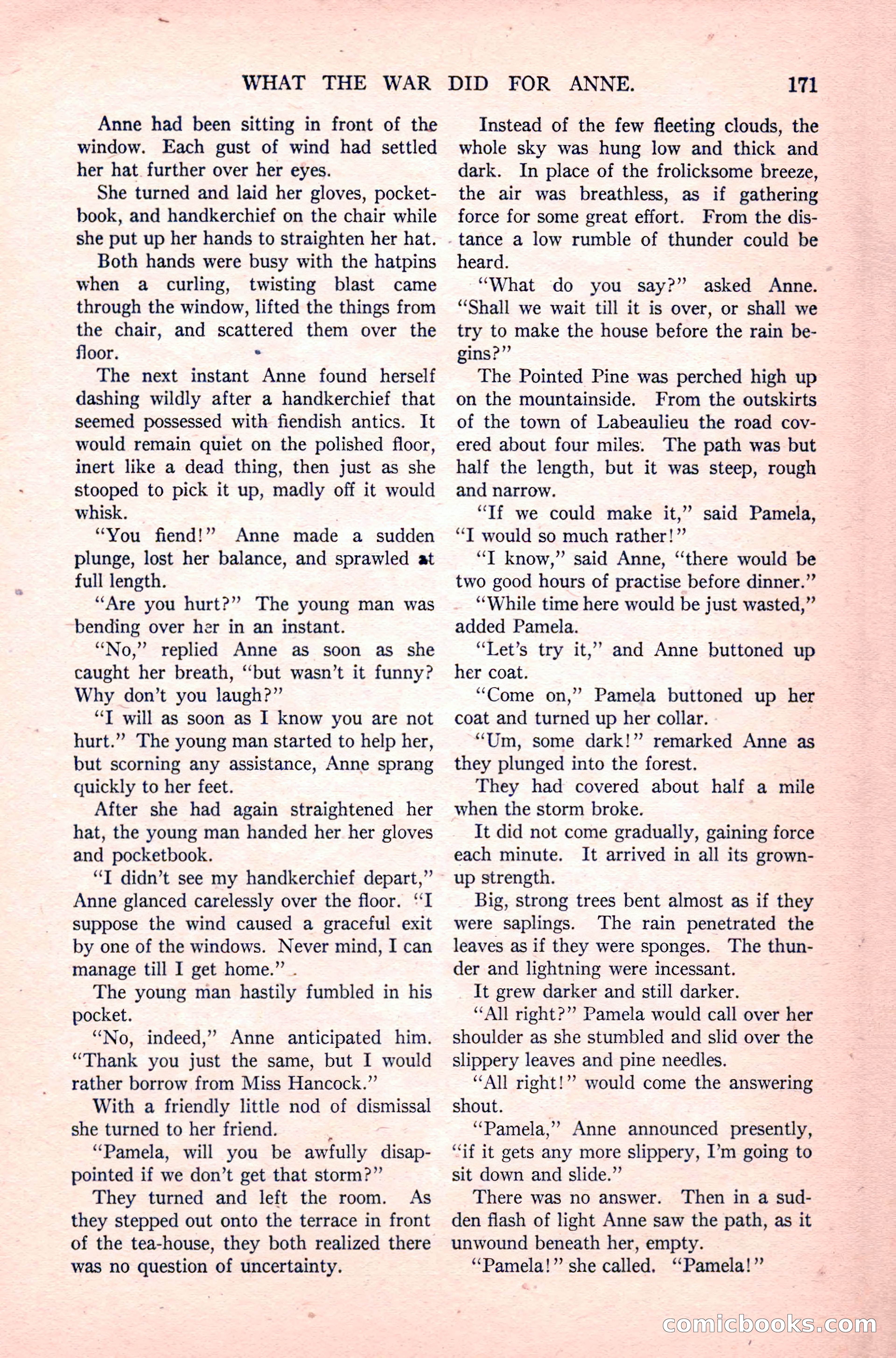
A restored page from Pulp Fiction, 1916. Page through the whole issue in the reader above.
📄 Transcribed text from this page (OCR, searchable)
Machine-transcribed from the original scan — historical spelling and the odd misread are preserved.
WHAT THE WAR DID FOR ANNE. Anne had been sitting in front of the window. Each gust of wind had settled her hat. further over her eyes. She turned and laid her gloves, pocket- book, and handkerchief on the chair while she put up her hands to straighten her hat. Both hands were busy with the hatpins when a curling, twisting blast came through the window, lifted the things from the chair, and scattered them over the floor. * The next instant Anne found herself dashing wildly after a handkerchief that seemed possessed with fiendish antics. It would remain quiet on the polished floor, inert like a dead thing, then just as she stooped to pick it up, madly off it would whisk. “You fiend!” Anne made a sudden plunge, lost her balance, and sprawled at full length. ‘“‘Are you hurt?” The young man was bending over her in an instant. “No,” replied Anne as soon as she caught her breath, “but wasn’t it funny? Why don’t you laugh?” “T will as soon as I know you are not hurt.” The young man started to help her, but scorning any assistance, Anne sprang quickly to her feet. After she had again straightened her hat, the young man handed her her gloves and pocketbook. “T didn’t see my handkerchief depart,” Anne glanced carelessly over the floor. ‘I suppose the wind caused a graceful exit by one of the windows. Never mind, I can manage till I get home.” . The young man hastily fumbled in his pocket. “No, indeed,” Anne anticipated him. “Thank you just the same, but I would rather borrow from Miss Hancock.” With a friendly little nod of dismissal she turned to her friend. ‘ “Pamela, will you be awfully disap- pointed if we don’t get that storm?”’ They turned and left the room. As they stepped out onto the terrace in front of the tea-house, they both realized there was no question of uncertainty. 171 Instead of the few fleeting clouds, the whole sky was hung low and thick and dark. In place of the frolicksome breeze, the air was breathless, as if gathering force for some great effort. From the dis- -tance a low rumble of thunder could be heard. “What do you say?” asked Anne. “Shall we wait till it is over, or shall we try to make the house before the rain be- gins?” The Pointed Pine was perched high up on the mountainside. From the outskirts of the town of Labeaulieu the road cov- ered about four miles. The path was but half the length, but it was steep, rough and narrow. | “If we could make it,” said Pamela, “T would so much rather!” “T know,” said Anne, “‘there would be two good hours of practise before dinner.” ‘While time here would be just wasted,” added Pamela. “‘Let’s try it,’ and Anne buttoned up her coat. “Come on,” Pamela buttoned up her coat and turned up her collar. : “Um, some dark!” remarked Anne as they plunged into the forest. They had covered about half a mile when the storm broke. It did not come gradually, gaining force each minute. It arrived in all its grown- up strength. Big, strong trees bent almost as if they were saplings. The rain penetrated the leaves as if they were sponges. The thun- der and lightning were incessant. It grew darker and still darker. “All right?”? Pamela would call over her shoulder as she stumbled and slid over the slippery leaves and pine needles. ‘All right!” would come the answering shout. “Pamela,” Anne announced presently, “if it gets any more slippery, I’m going to sit down and slide.” There was no answer. Then in a sud- den flash of light Anne saw the path, as it unwound beneath her, empty. “Pamela!” she called. “‘Pamela!”’ ECORMICLOOOLK (E@)