
Pulp Fiction, 1916 · page 175 of 204
The Argosy, Vol. 83 No. 1 — page 175: what you’re looking at
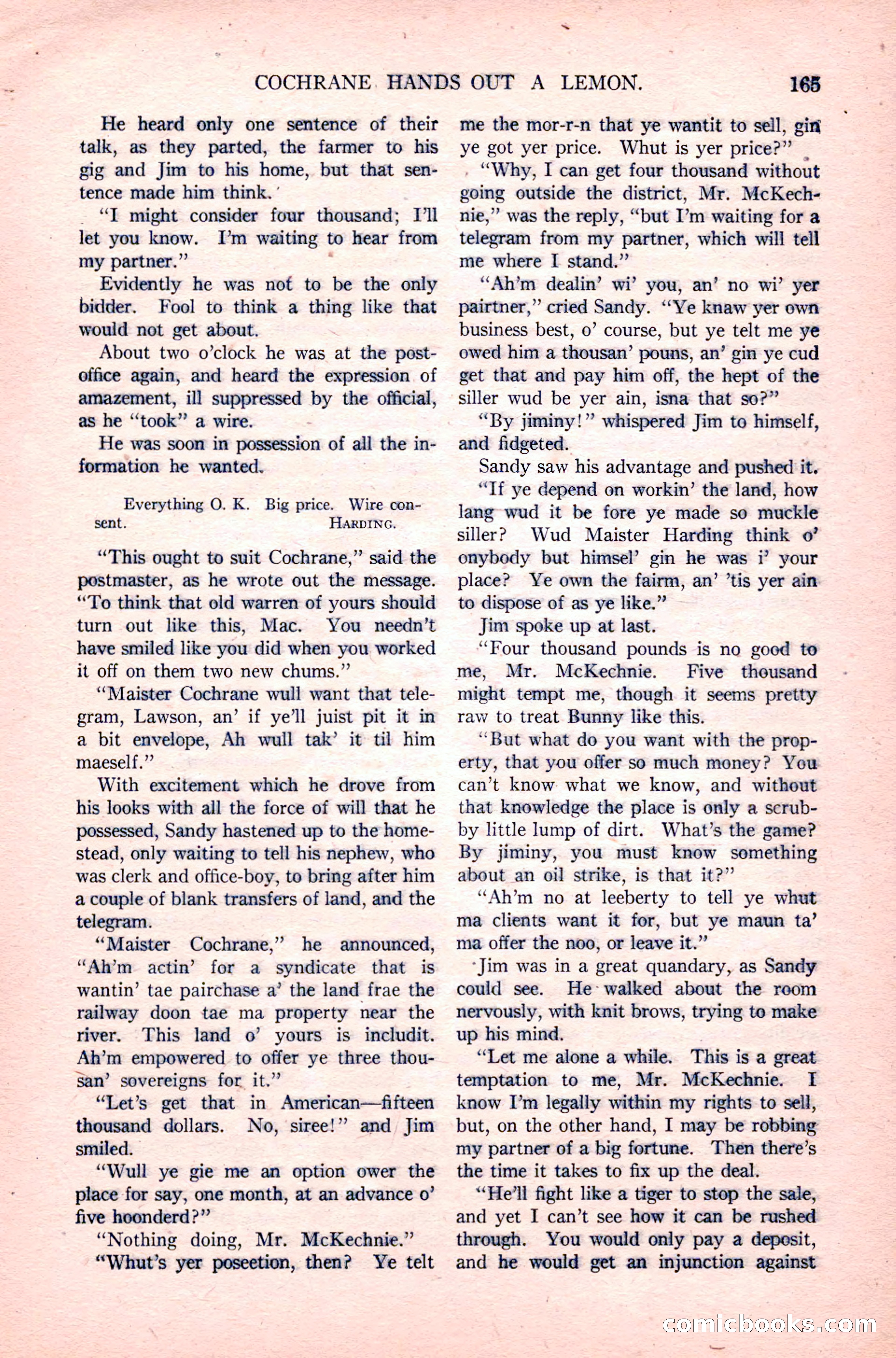
A restored page from Pulp Fiction, 1916. Page through the whole issue in the reader above.
📄 Transcribed text from this page (OCR, searchable)
Machine-transcribed from the original scan — historical spelling and the odd misread are preserved.
COCHRANE. HANDS OUT A LEMON. He heard only one sentence of their talk, as they parted, the farmer to his gig and Jim to his home, but that sen- tence made him think. ’ _ “YT might consider four thousand; I'll let you know. I’m waiting to hear from my partner.”’ Evidently he was not to be the only bidder. Fool to think a thing like that would not get about. About two o’clock he was at the post- office again, and heard the expression of amazement, ill suppressed ~ the official, as he “took” a wire. He was soon in possession of all the in- formation he wanted. Everything O. K. Big price. Wire con- sent. HARDING. “This ought to suit Cochrane,” said the postmaster, as he wrote out the message. “To think that old warren of yours should turn out like this, Mac. You needn’t have smiled like you did when you worked it off on them two new chums.” ‘““Maister Cochrane wull want that tele- gram, Lawson, an’ if ye’ll juist pit it in a bit envelope, Ah wull tak’ it til him maeself.” With excitement which he drove from his looks with all the force of will that he possessed, Sandy hastened up to the home- stead, only waiting to tell his nephew, who was clerk and office-boy, to bring after him a couple of blank transfers of land, and the telegram. “Maister Cochrane,” he announced, “Ah’m actin’ for a syndicate that is wantin’ tae pairchase a’ the land frae the railway doon tae ma property near the river. This land o’ yours is includit. Ah’m empowered to offer ye three thou- san’ sovereigns for it.” “Let’s get that in American—fifteen thousand dollars. No, siree!” and Jim smiled. “Wull ye gie me an option ower the place for say, one month, at an advance 0’ five hoonderd?” “Nothing doing, Mr. McKechnie.” “Whut’s yer poseetion, then? Ye telt me, 165 me the mor-r-n that ye wantit to sell, gin ye got yer price. Whut is yer price?” _ . “Why, I can get four thousand without going outside the district, Mr. McKech- nie,” was the reply, “but I’m waiting for a telegram from my partner, which will tell me where I stand.” “Ah’m dealin’ wi’ you, an’ no wi’ yer pairtner,” cried Sandy. “Ye knaw yer own business best, 0’ course, but ye telt me ye owed him a thousan’ pouns, an’ gin ye cud get that and pay him off, the hept of the siller wud be yer ain, isna that so?” “By jiminy!” whispered Jim to himself, and fidgeted. Sandy saw his advantage and pushed it. “If ye depend on workin’ the land, how lang wud it be fore ye made so muckle siller? Wud Maister Harding think 0’ onybody but himsel’ gin he was i’ your place? Ye own the fairm, an’ ’tis yer ain to dispose of as ye like.” Jim spoke up at last. ‘Four thousand pounds is no goed to Mr. McKechnie. Five thousand might tempt me, though it seems pretty raw to treat Bunny like this. ‘But what do you want with the prop- erty, that you offer so much money? You can’t know what we know, and without that knowledge the place is only a scrub- by little lump of dirt. What’s the game? By jiminy, you must know something about an oil strike, is that it?” ‘“Ah’m no at leeberty to tell ye whut ma clients want it for, but ye maun ta’ ma offer the noo, or leave it.” ‘Jim was in a great quandary, as Sandy could see. He- walked about the reom nervously, with knit brows, trying to make up his mind. “Let me alone a while. This i is a great temptation to me, Mr. McKechnie. I know I’m legally within my rights to sell, but, on the other hand, I may be robbing my partner of a big fortune. Then there’s the time it takes to fix up the deal. “He'll fight like a tiger to stop the sale, and yet I can’t see how it can be rushed through. You would only pay a deposit, and he would get an injunction against CORMICGLOOOKS —- (C@)