
Pulp Fiction, 1916 · page 17 of 204
The Argosy, Vol. 83 No. 1 — page 17: what you’re looking at
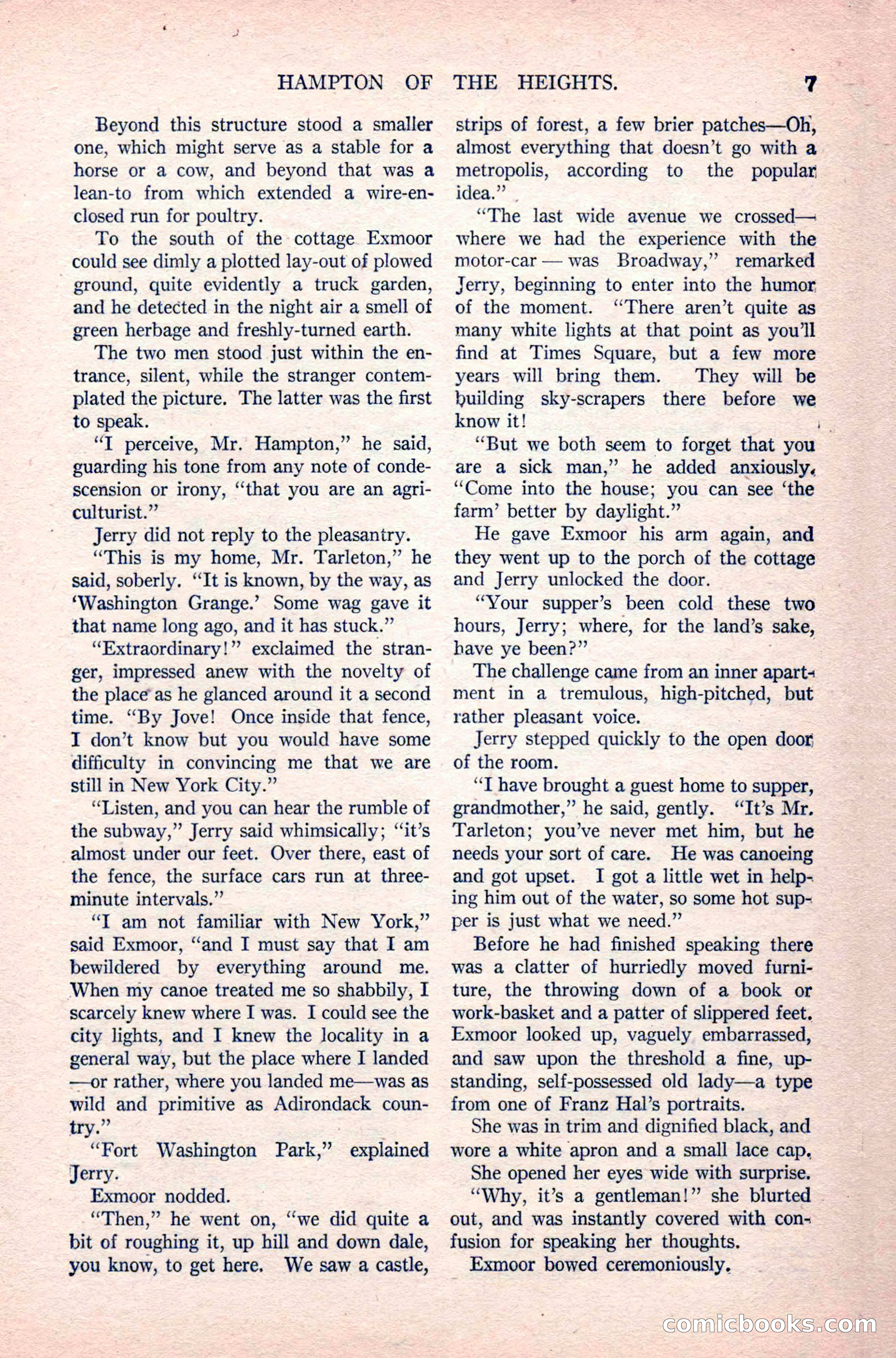
A restored page from Pulp Fiction, 1916. Page through the whole issue in the reader above.
📄 Transcribed text from this page (OCR, searchable)
Machine-transcribed from the original scan — historical spelling and the odd misread are preserved.
HAMPTON OF Beyond this structure stood a smaller one, which might serve as a stable for a horse or a cow, and beyond that was a lean-to from which extended a wire-en- closed run for poultry. To the south of the cottage Exmoor could see dimly a plotted lay-out of plowed ground, quite evidently a truck garden, and he detected in the night air a smell of green herbage and freshly-turned earth. The two men stood just within the en- trance, silent, while the stranger contem- plated the picture. The latter was the first to speak. “T perceive, Mr. Hampton,” he said, guarding his tone from any note of conde- scension or irony, “that you are an agri- culturist.” Jerry did not reply to the pleasaniry. “This is my home, Mr. Tarleton,” he said, soberly. ‘It is known, by the way, as ‘Washington Grange.’ Some wag gave it that name long ago, and it has stuck.” “Extraordinary!” exclaimed the stran- ger, impressed anew with the novelty of the place’ as he glanced around it a second time. “By Jove! Once inside that fence, I don’t know but you would have some difficulty in convincing me that we are still in New York City.” “Listen, and you can hear the rumble of the subway,” Jerry said whimsically; “‘it’s almost under our feet. Over there, east of the fence, the surface cars run at three- minute intervals.” “T am not familiar with New York,” said Exmoor, ‘“‘and I must say that I am bewildered by everything around me. When my canoe treated me so shabbily, I scarcely knew where I was. I could see the city lights, and I knew the locality in a general way, but the place where I landed —or rather, where you landed me—was as wild and primitive as Adirondack coun- “Fort Washington Park,” explained Jerry. Exmoor nodded. “Then,” he went on, “we did quite a bit of roughing it, up hill and down dale, you know, to get here. We saw a castle, THE HEIGHTS. 7 strips of forest, a few brier patches—Oh, almost everything that doesn’t go with a metropolis, according to the popular idea.” “The last wide avenue we crossed— where we had the experience with the motor-car — was Broadway,” remarked Jerry, beginning to enter into the humor of the moment. “There aren’t quite as many white lights at that point as youll find at Times Square, but a few more years will bring them. They will be building sky-scrapers there before we know it! “But we both seem to forget that you 7 are a sick man,” he added anxiously, ‘Come into the house; you can see ‘the farm’ better by daylight.” He gave Exmoor his arm again, and they went up to the porch of the cottage and Jerry unlocked the door. “Your supper’s been cold these two hours, Jerry; where, for the land’s sake, have ye been?” , | The challenge came from an inner apart- ment in a tremulous, high-pitched, but rather pleasant voice. Jerry stepped quickly to the open door of the room. ‘“T have brought a guest home to supper, grandmother,” he said, gently. “It’s Mr. Tarleton; you’ve never met him, but he needs your sort of care. He was canoeing and got upset. I got a little wet in help- ing him out of the water, so some hot sup- per is just what we need.” Before he had finished speaking there was a clatter of hurriedly moved furni- ture, the throwing down of a book or work-basket and a patter of slippered feet. Exmoor looked up, vaguely embarrassed, and saw upon the threshold a fine, up- standing, self-possessed old lady—a type from one of Franz Hal’s portraits. She was in trim and dignified black, and wore a white apron and a small lace cap. She opened her eyes wide with surprise. “Why, it’s a gentleman!” she blurted out, and was instantly covered with con- fusion for speaking her thoughts. Exmoor bowed ceremoniously. COMIC OOOLX< Gor