
Pulp Fiction, 1916 · page 146 of 204
The Argosy, Vol. 83 No. 1 — page 146: what you’re looking at
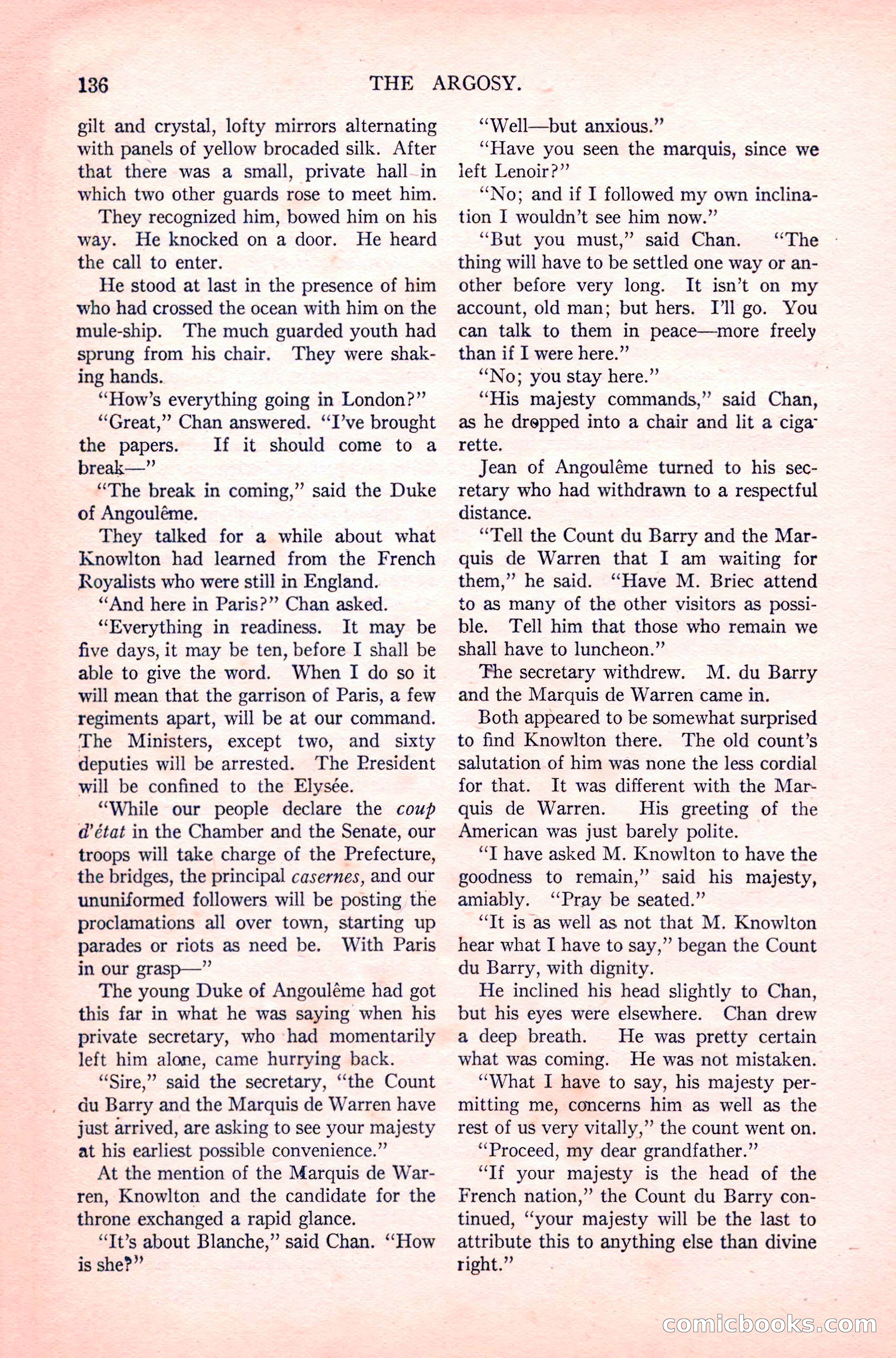
A restored page from Pulp Fiction, 1916. Page through the whole issue in the reader above.
📄 Transcribed text from this page (OCR, searchable)
Machine-transcribed from the original scan — historical spelling and the odd misread are preserved.
136 gilt and crystal, lofty mirrors alternating with panels of yellow brocaded silk. After that there was a small, private hall-in which two other guards rose to meet him. They recognized him, bowed him on his way. He knocked on a door. He heard the call to enter. He stood at last in the presence of him who had crossed the ocean with him on the mule-ship. The much guarded youth had sprung from his chair. They were shak- ing hands. “How’s everything going in London?’”’ “Great,” Chan answered. “I’ve brought the papers. If it should come to a break—” “The break in coming,” said the Duke of Angouléme. They talked for a while about what Knowlton had learned from the French Royalists who were still in England. “And here in Paris?” Chan asked. “Everything in readiness. It may be five days, it may be ten, before I shall be able to give the word. When I do so it will mean that the garrison of Paris, a few regiments apart, will be at our command. The Ministers, except two, and sixty deputies will be arrested. The President will be confined to the Elysée. “While our people declare the coup d’état in the Chamber and the Senate, our troops will take charge of the Prefecture, the bridges, the principal casernes, and our ununiformed followers will be posting the proclamations all over town, starting up parades or riots as need be. With Paris in our grasp—” The young Duke of Angouléme had got this far in what he was saying when his private secretary, who had momentarily left him alone, came hurrying back. “Sire,” said the secretary, “the Count du Barry and the Marquis de Warren have just arrived, are asking to see your majesty at his earliest possible convenience.” At the mention of the Marquis de War- ren, Knowlton and the candidate for the throne exchanged a rapid glance. “Tt’s about Blanche,” said Chan. ‘“‘How is she?” THE ARGOSY. “‘Well—but anxious.” ‘lave you seen the marquis, since we left Lenoir?” "No; and if I followed my own inclina- tion I wouldn’t see him now.” “But you must,” said Chan. “The thing will have to be settled one way or an- other before very long. It isn’t on my account, old man; but hers. I'll go. You can talk to them in peace—more freely than if I were here.”’ “No; you stay here.” “His majesty commands,” said Chan, as he drepped into a chair and lit a ciga Fete: Jean of Angouléme turned to his sec- retary who had withdrawn to a respectful distance. “Tell the Count du Barry and the Mar- quis de Warren that I am waiting for them,” he said. ‘‘Have M. Briec attend to as many of the other visitors as possi- ble. Tell him that those who remain we shall have to luncheon.” ‘Fhe secretary withdrew. M. du Barry and the Marquis de Warren came in. Both appeared to be somewhat surprised to find Knowlton there. The old count’s salutation of him was none the less cordial for that. It was different with the Mar- quis de Warren. His greeting of the American was just barely polite. “T have asked M. Knowlton to have the goodness to remain,” said his majesty, amiably. “Pray be seated.” “It is as well as not that M. Knowlton hear what I have to say,” began the Count du Barry, with dignity. He inclined his head slightly to Chan, but his eyes were elsewhere. Chan drew a deep breath. He was pretty certain what was coming. He was not mistaken. ‘What I have to say, his majesty per- mitting me, concerns him as well as the rest of us very vitally,” the count went on. “Proceed, my dear grandfather.” “Tf your majesty is the head of the French nation,” the Count du Barry con- tinued, ‘“‘your majesty will be the last to attribute this to anything else than divine right.” Gomichbook (C@