
Pulp Fiction, 1916 · page 144 of 204
The Argosy, Vol. 83 No. 1 — page 144: what you’re looking at
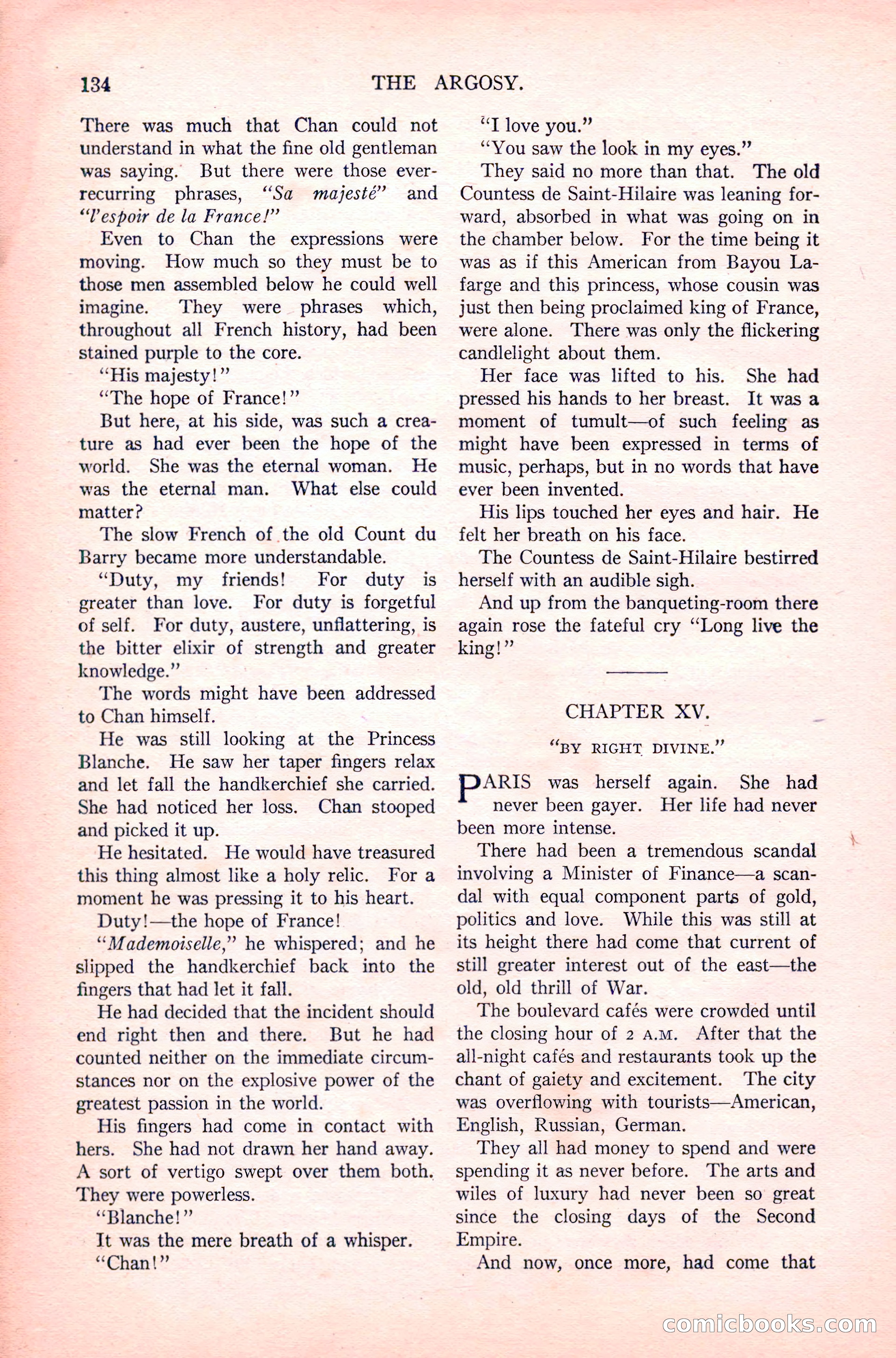
A restored page from Pulp Fiction, 1916. Page through the whole issue in the reader above.
📄 Transcribed text from this page (OCR, searchable)
Machine-transcribed from the original scan — historical spelling and the odd misread are preserved.
134 There was much that Chan could not understand in what the fine old gentleman was saying. But there were those ever- recurring phrases, “Sa mayesié’ and ‘Vespoir de la France!” Even to Chan the expressions were moving. How much so they must be to those men assembled below he could well imagine. They were phrases. which, throughout all French history, had been stained purple to the core. “His majesty!” “The hope of France!” But here, at his side, was such a crea- ture as had ever been the hope of the world. She was the eternal woman. He was the eternal man. What else could matter? The slow French of the old Count du Barry became more understandable. “Duty, my friends! For duty is greater than love. For duty is forgetful of self. For duty, austere, unflattering, is the bitter elixir of strength and greater knowledge.” The words might have been addressed to Chan himself. He was still looking at the Princess Blanche. He saw her taper fingers relax and let fall the handkerchief she carried. She had noticed her loss. Chan stooped and picked it up. He hesitated. He would have treasured this thing almost like a holy relic. Fora moment he was pressing it to his heart. Duty!—the hope of France! “Mademoiselle,” he whispered; and he slipped the handkerchief back into the fingers that had let it fall. He had decided that the incident should end right then and there. But he had counted neither on the immediate circum- stances nor on the explosive power of the greatest passion in the world. His fingers had come in contact with hers. She had not drawn her hand away. A sort of vertigo swept over them both. They were powerless. “Blanche!” It was the mere breath of a whisper. “Chan!” THE ARGOSY. “T love you.” ‘You saw the look in my eyes.” They said no more than that. The old Countess de Saint-Hilaire was leaning for- ward, absorbed in what was going on in the chamber below. For the time being it was as if this American from Bayou La- farge and this princess, whose cousin was just then being proclaimed king of France, were alone. There was only the flickering candlelight about them. Her face was lifted to his. She had pressed his hands to her breast. It was a moment of tumult—of such feeling as might have been expressed in terms of music, perhaps, but in no words that have ever been invented. His lips touched her eyes and hair. He felt her breath on his face. The Countess de Saint-Hilaire bestirred herself with an audible sigh. And up from the banqueting-room there again rose the fateful cry “Long live the king!” es CHAPTER XV. “BY RIGHT DIVINE.” PARIS was herself again. She had never been gayer. Her life had never been more intense. There had been a tremendous scandal involving a Minister of Finance—a scan- dal with equal component parts of gold, politics and love. While this was still at its height there had come that current of still greater interest out of the east—the old, old thrill of War. The boulevard cafés were crowded until the closing hour of 2 a.m. After that the all-night cafés and restaurants took up the chant of gaiety and excitement. ‘The city was overflowing with tourists—American, English, Russian, German. They all had money to spend and were spending it as never before. The arts and wiles of luxury had never been so great since the closing days of the Second Empire. And now, once more, had come that GomiGchdooks (C@