
Pulp Fiction, 1916 · page 14 of 204
The Argosy, Vol. 83 No. 1 — page 14: what you’re looking at
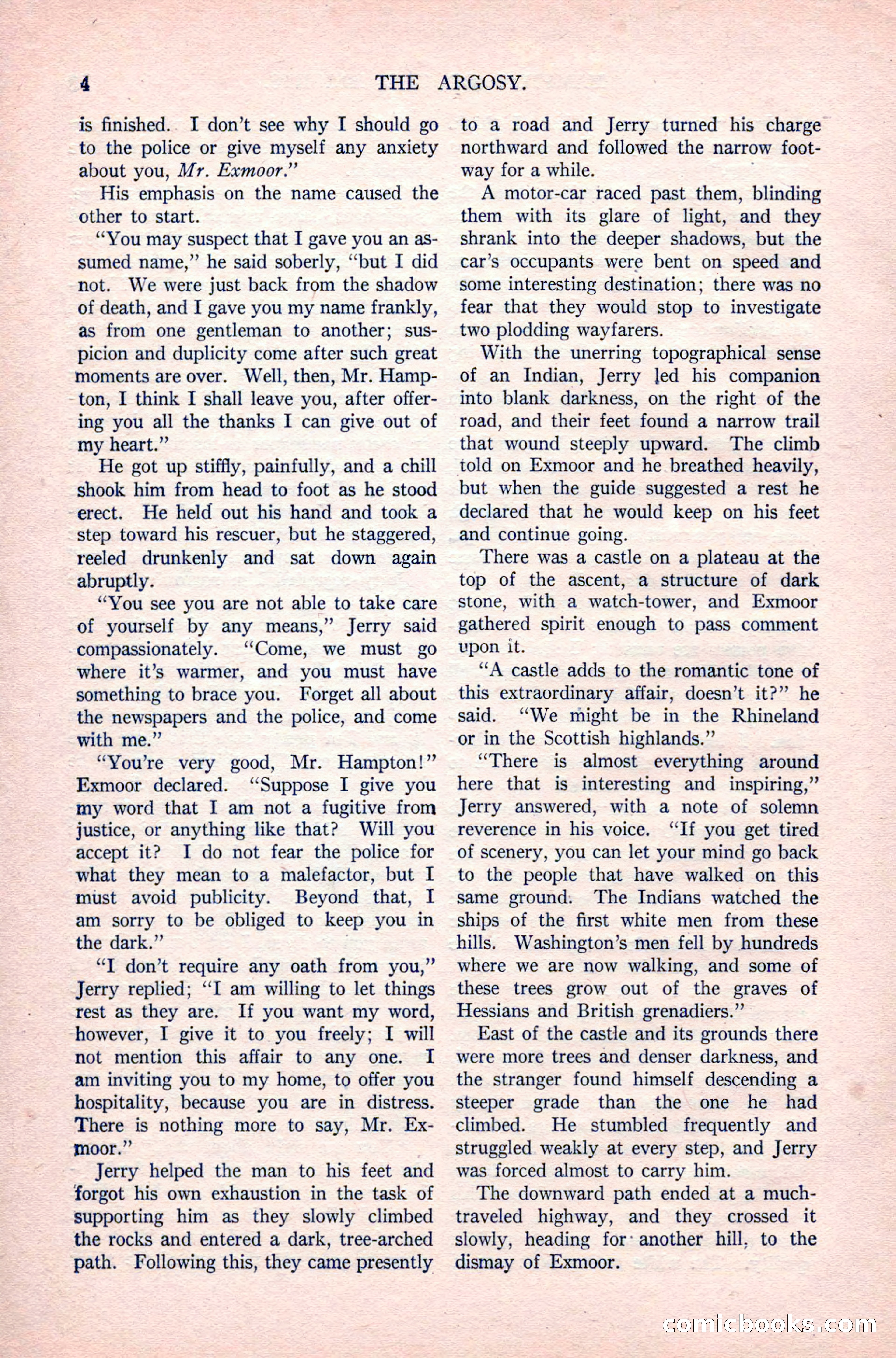
A restored page from Pulp Fiction, 1916. Page through the whole issue in the reader above.
📄 Transcribed text from this page (OCR, searchable)
Machine-transcribed from the original scan — historical spelling and the odd misread are preserved.
4 THE ARGOSY. is finished.. I don’t see why I should go to the police or give myself any anxiety about you, Mr. Exmoor.” His emphasis on the name caused the other to start. “Vou may suspect that I gave you an as- sumed name,” he said soberly, ‘‘but I did not. We were just back from the shadow of death, and I gave you my name frankly, as from one gentleman to another; sus- picion and duplicity come after such great moments are over. Well, then, Mr. Hamp- -ton, I think I shall leave you, after offer- ing you all the thanks I can give out of my heart.” He got up stiffly, painfully, and a chill shook him from head to foot as he stood erect. He held out his hand and took a step toward his rescuer, but he staggered, reeled drunkenly and sat down again abruptly. “Vou see you are not able to take care of yourself by any means,” Jerry said compassionately. “Come, we must go where it’s warmer, and you must have something to brace you. Forget all about the newspapers and the police, and come with me.” “You’re very good, Mr. Hampton!” Exmoor declared. ‘Suppose I give you my word that I am not a fugitive from justice, or anything like that? Will you accept it? I do not fear the police for what they mean to a malefactor, but I must avoid publicity. Beyond that, I am sorry to be obliged to keep you in the dark.”’ “T don’t require any oath from you,” Jerry replied; “I am willing to let things rest as they are. If you want my word, however, I give it to you freely; I will not mention this affair to any one. I am inviting you to my home, to offer you hospitality, because you are in distress. There is nothing more to say, Mr. Ex- moor.” Jerry helped the man to his feet and forgot his own exhaustion in the task of supporting him as they slowly climbed the rocks and entered a dark, tree-arched path. Following this, they came presently to a road and Jerry turned his charge northward and followed the narrow foot- way for a while. . A motor-car raced past them, blinding them with its glare of light, and they shrank into the deeper shadows, but the car’s occupants were bent on speed and some interesting destination; there was no fear that they would stop to investigate two plodding wayfarers. With the unerring topographical sense of an Indian, Jerry led his companion into blank darkness, on the right of the road, and their feet found a narrow trail that wound steeply upward. The climb told on Exmoor and he breathed heavily, but when the guide suggested a rest he declared that he would keep on his feet and continue going. There was a castle on a plateau at the top of the ascent, a structure of dark stone, with a watch-tower, and Exmoor gathered spirit enough to pass comment upon it. ‘“‘A castle adds to the romantic tone of this extraordinary affair, doesn’t it?” he said. ‘We might be in the Rhineland or in the Scottish highlands.” “There is almost everything around here that is interesting and inspiring,” Jerry answered, with a note of solemn reverence in his voice. “If you get tired of scenery, you can let your mind go back to the people that have walked on this same ground: The Indians watched the ships of the first white men from these hills. Washington’s men fell by hundreds where we are now walking, and some of these trees grow out of the graves of Hessians and British grenadiers.” East of the castle and its grounds there were more trees and denser darkness, and the stranger found himself descending a steeper grade than the one he had climbed. He stumbled frequently and struggled weakly at every step, and Jerry was forced almost to carry him. The downward path ended at a much- traveled highway, and they crossed it slowly, heading for: another hill, to the dismay of Exmoor. EOPMICLOOOLK< (C@)