
Pulp Fiction, 1916 · page 135 of 204
The Argosy, Vol. 83 No. 1 — page 135: what you’re looking at
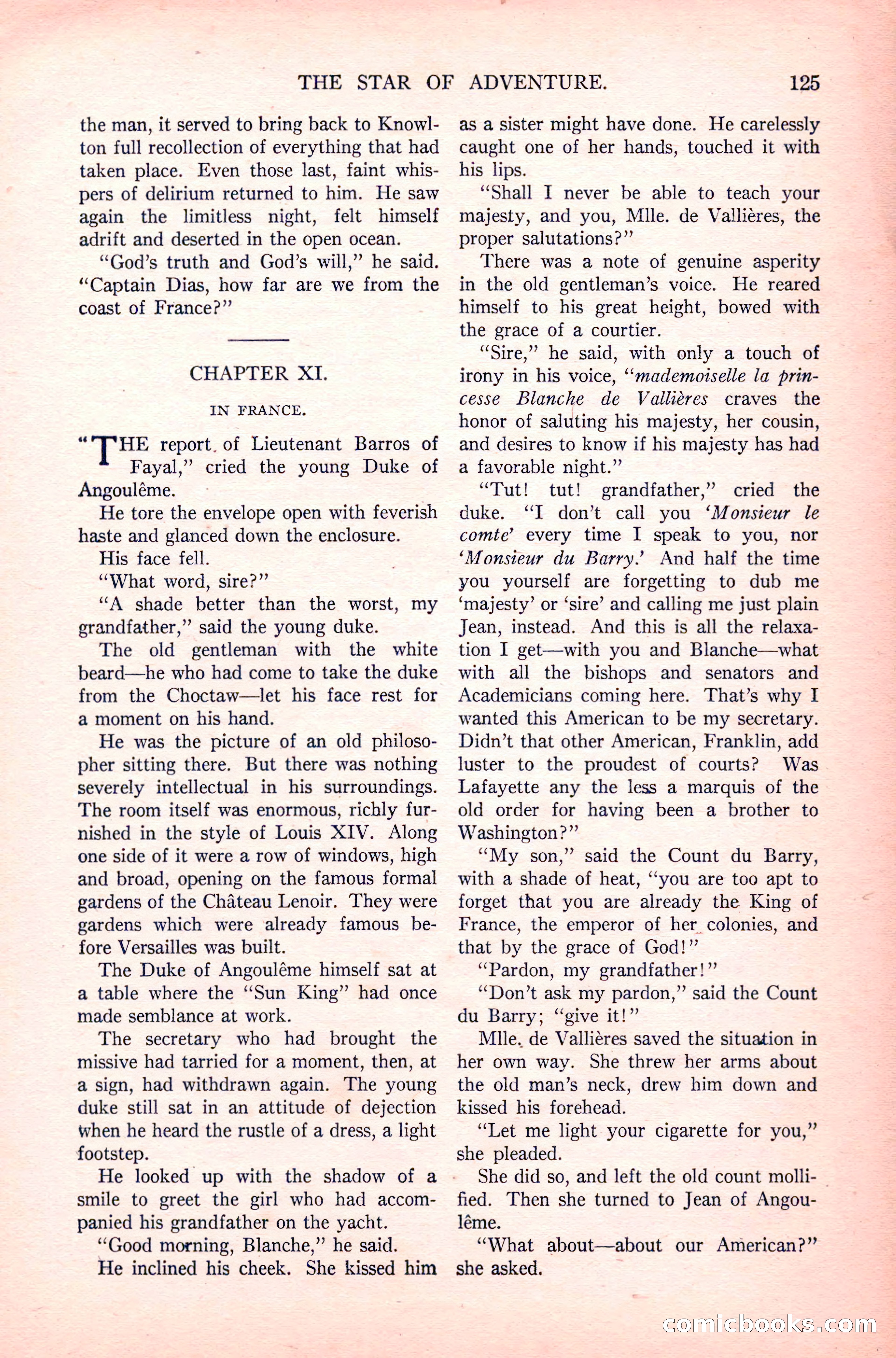
A restored page from Pulp Fiction, 1916. Page through the whole issue in the reader above.
📄 Transcribed text from this page (OCR, searchable)
Machine-transcribed from the original scan — historical spelling and the odd misread are preserved.
THE STAR OF ADVENTURE. the man, it served to bring back to Knowl- ton full recollection of everything that had taken place. Even those last, faint whis- pers of delirium returned to him. He saw again the limitless night, felt himself adrift and deserted in the open ocean. “God’s truth and God’s will,” he said. “Captain Dias, how far are we from the coast of France?” CHAPTER XI. IN FRANCE. “THE report. of Lieutenant Barros of Fayal,” cried the young Duke of Angouléme. He tore the envelope open with feverish haste and glanced down the enclosure. His face fell. “What word, sire?” ‘“A shade better than the worst, my grandfather,” said the young duke. The old gentleman with the white beard—he who had come to take the duke from the Choctaw—let his face rest for a moment on his hand. He was the picture of an old philoso- pher sitting there. But there was nothing severely intellectual in his surroundings. The room itself was enormous, richly fur- nished in the style of Louis XIV. Along one side of it were a row of windows, high and broad, opening on the famous formal gardens of the Chateau Lenoir. They were gardens which were already famous be- fore Versailles was built. The Duke of Angouléme himself sat at a table where the “Sun King” had once made semblance at work. The secretary who had brought the missive had tarried for a moment, then, at a sign, had withdrawn again. The young duke still sat in an attitude of dejection when he heard the rustle of a dress, a light footstep. He looked up with the shadow of a . smile to greet the girl who had accom- panied his grandfather on the yacht. “Good morning, Blanche,” he said. He inclined his cheek. She kissed him 125 as a sister might have done. He carelessly caught one of her hands, touched it with his lips. “Shall I never be able to teach your majesty, and you, Mlle. de Valliéres, the proper salutations?” There was a note of genuine asperity in the old gentleman’s voice. He reared himself to his great height, bowed with the grace of a courtier. | “Sire,” he said, with only a touch of irony in his voice, ‘‘mademoiselle la prin- cesse Blanche de Valliéres craves the honor of saluting his majesty, her cousin, and desires to know if his majesty has had a favorable night.” “Tut! tut! grandfather,” cried the duke. ‘I don’t call you ‘Monsieur le comte’ every time I speak to you, nor ‘Monsieur du Barry. And half the time you yourself are forgetting to dub me ‘majesty’ or ‘sire’ and calling me just plain Jean, instead. And this is all the relaxa- tion I get—with you and Blanche—what with all the bishops and senators and Academicians coming here. That’s why I wanted this American to be my secretary. Didn’t that other American, Franklin, add luster to the proudest of courts? Was Lafayette any the less a marquis of the old order for having been a brother to Washington?” “My son,” said the Count du Barry, with a shade of heat, ‘“‘you are too apt to forget that you are already the King of France, the emperor of her colonies, and that by the grace of God!” “Pardon, my grandfather!”’ “Don’t ask my pardon,” said the Count du Barry; “give it!” Mlle. de Valliéres saved the situation in her own way. She threw her arms about the old man’s neck, drew him down and kissed his forehead. “Let me light your cigarette for you,” She pleaded. She did so, and left the old count molli- fied. Then she turned to Jean of Angou- léme. “What about—about our American?” she asked. Go ONOOLK = a (C@)