
Pulp Fiction, 1916 · page 132 of 204
The Argosy, Vol. 83 No. 1 — page 132: what you’re looking at
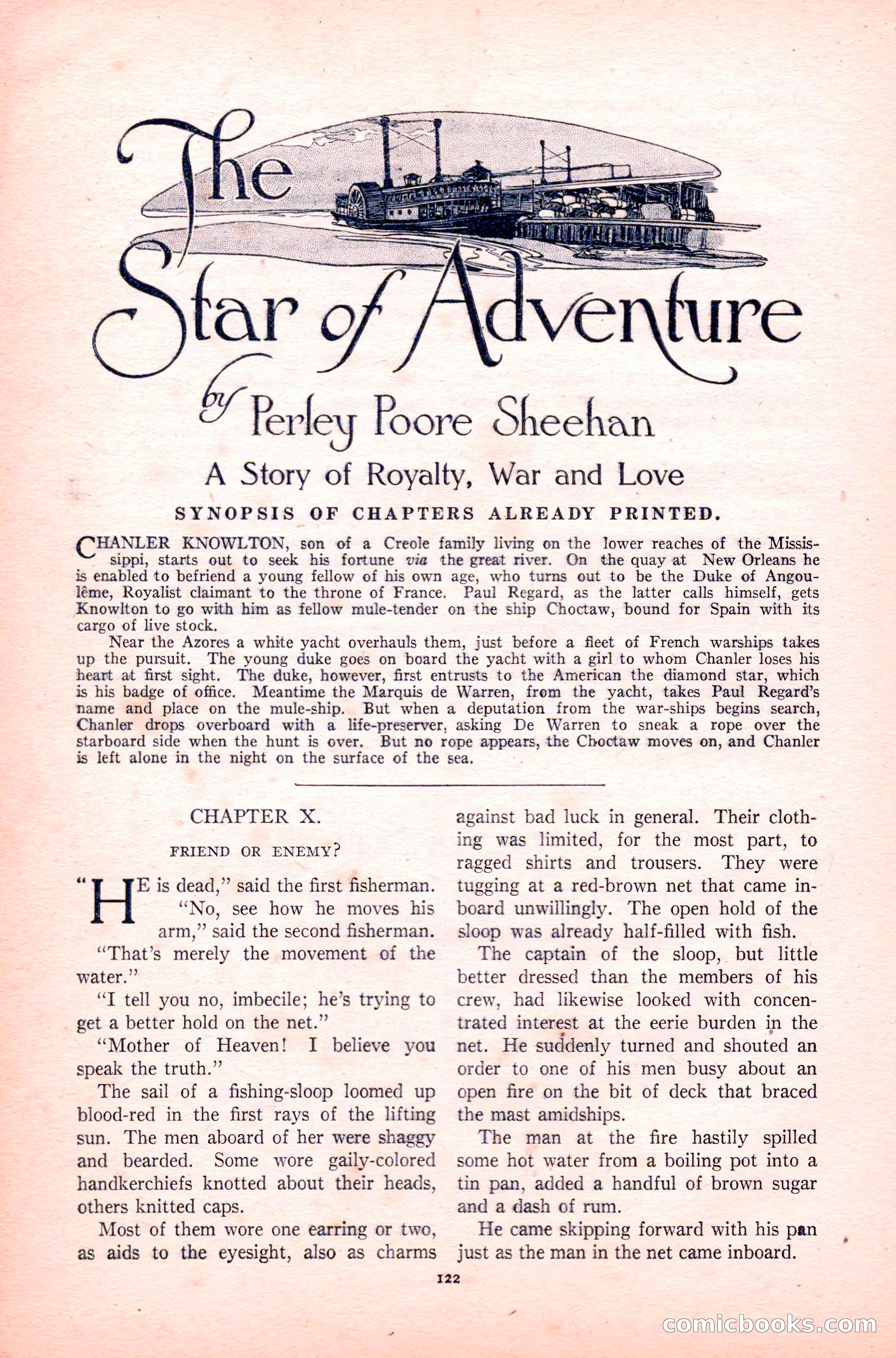
A restored page from Pulp Fiction, 1916. Page through the whole issue in the reader above.
📄 Transcribed text from this page (OCR, searchable)
Machine-transcribed from the original scan — historical spelling and the odd misread are preserved.
ait ai, Mea cA SSR B Parley fo Ore Sheehan A Story of Royalty, War and Love SYNOPSIS OF CHAPTERS ALREADY PRINTED. HANLER KNOWLTON, son of a Creole family living on the lower reaches of the Missis- sippi, starts out to seek his fortune via the great river. On the quay at New Orleans he is enabled to befriend a young fellow of his own age, who turns out to be the Duke of Angou- léme, Royalist claimant to the throne of France. Paul Regard, as the latter calls himself, gets Knowlton to go with him as fellow mule-tender on the ship Choctaw, bound for Spain with its cargo of live stock, Near the Azores a white yacht overhauls them, just before a fleet of French warships takes up the pursuit. heart at first sight. is his badge of office. The young duke goes on board the yacht with a girl to whom Chanler loses his The duke, however, first entrusts to the American the diamond star, which Meantime the Marquis de Warren, from the yacht, takes Paul Regard’s name and place on the mule-ship. But when a deputation from the war-ships begins search, Chanler drops overboard with a life-preserver, asking De Warren to sneak a rope over the starboard side when the hunt is over. But no rope appears, the Choctaw moves on, and Chanler is left alone in the night on the surface of the sea. CHAPTER xX. FRIEND OR ENEMY? = E is dead,” said the first fisherman. ‘‘No, see how he moves his arm,’ said the second fisherman. “That’s merely the movement of the water.” “T tell you no, imbecile; he’s trying to get a better hold on the net.” “Mother of Heaven! I believe you speak the truth.” The sail of a fishing-sloop loomed up blood-red in the first rays of the lifting sun. The men aboard of her were shaggy and bearded. Some wore gaily-colored handkerchiefs knotted about their heads, others knitted caps. Most of them wore one earring or two, as aids to the eyesight, also as charms against bad luck in general. Their cloth- ing was limited, for the most part, to ragged shirts and trousers. They were tugging at a red-brown net that came in- board unwillingly. The open hold of the sloop was already half-filled with fish. The captain of the sloop, but little better dressed than the members of his crew, had likewise looked with concen- trated interest at the eerie burden in the net. He suddenly turned and shouted an order to one of his men busy about an open fire on the bit of deck that braced the mast amidships. The man at the fire hastily spilled some hot water from a boiling pot into a tin pan, added a handful of brown sugar and a dash of rum. He came skipping forward with his pan just as the man in the net came inboard. 122 Go NOOK (C@