
Pulp Fiction, 1916 · page 117 of 204
The Argosy, Vol. 83 No. 1 — page 117: what you’re looking at
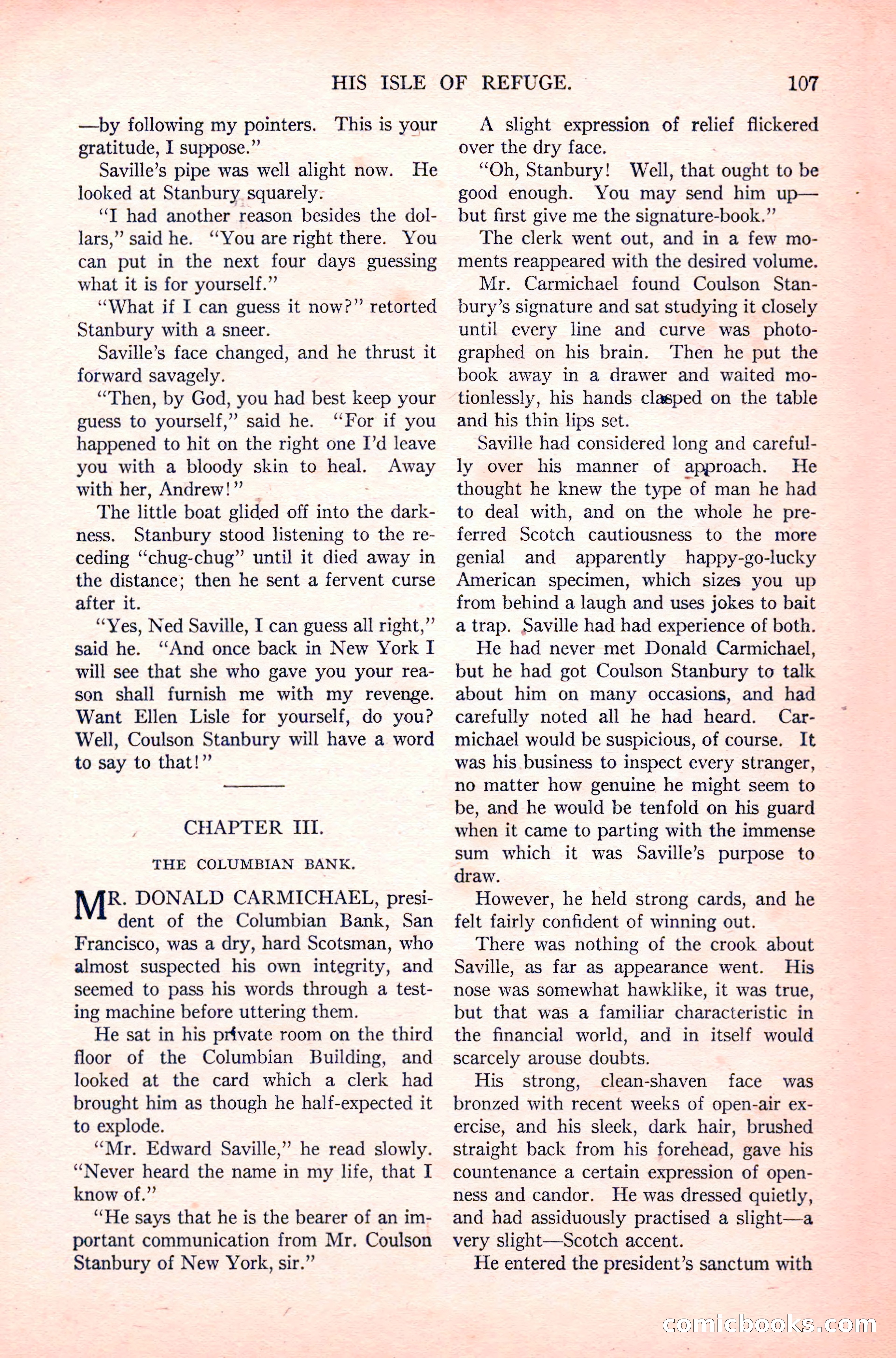
A restored page from Pulp Fiction, 1916. Page through the whole issue in the reader above.
📄 Transcribed text from this page (OCR, searchable)
Machine-transcribed from the original scan — historical spelling and the odd misread are preserved.
HIS ISLE OF REFUGE. —by following my pointers. This is your gratitude, I suppose.” Saville’s pipe was well alight now. He looked at Stanbury squarely. “T had another reason besides the dol- lars,” said he. “You are right there. You can put in the next four days guessing what it is for yourself.”’ ‘What if I can guess it now?” retorted Stanbury with a sneer. Saville’s face changed, and he thrust it forward savagely. “Then, by God, you had best keep your guess to yourself,” said he. ‘For if you happened to hit on the right one I’d leave you with a bloody skin to heal. Away with her, Andrew!” | The little boat glided off into the dark- ness. Stanbury stood listening to the re- ceding “chug-chug” until it died away in the distance; then he sent a fervent curse after it. “Ves, Ned Saville, I can guess all right,” said he. “And once back in New York I will see that she who gave you your rea- son shall furnish me with my revenge. Want Ellen Lisle for yourself, do you? Well, Coulson Stanbury will have a word to say to that!” oe oe CHAPTER III. THE COLUMBIAN BANK. ME: DONALD CARMICHAEL, presi- dent of the Columbian Bank, San Francisco, was a dry, hard Scotsman, who almost suspected his own integrity, and seemed to pass his words through a test- ing machine before uttering them. He sat in his private room on the third floor of the Columbian Building, and looked at the card which a clerk had brought him as though he half-expected it to explode. “Mr. Edward Saville,” he read slowly. “Never heard the name in my life, that I know of.” “He says that he is the bearer of an im- portant communication from Mr. Coulson Stanbury of New York, sir.” 107 A slight expression of relief flickered over the dry face. “Oh, Stanbury! Well, that ought to be good enough. You may send him up— but first give me the signature-book.”’ The clerk went out, and in a few mo- ments reappeared with the desired volume. Mr. Carmichael found Coulson Stan- bury’s signature and sat studying it closely until every line and curve was _ photo- graphed on his brain. Then he put the book away in a drawer and waited mo- tionlessly, his hands clasped on the table and his thin lips set. Saville had considered long and careful- ly over his manner of approach. He thought he knew the type of man he had to deal with, and on the whole he pre- ferred Scotch cautiousness to the more genial and apparently happy-go-lucky American specimen, which sizes you up from behind a laugh and uses jokes to bait a trap. Saville had had experience of both. He had never met Donald Carmichael, but he had got Coulson Stanbury to talk about him on many occasions, and had carefully noted all he had heard. Car- michael would be suspicious, of course. It was his business to inspect every stranger, no matter how genuine he might seem to be, and he would be tenfold on his guard when it came to parting with the immense sum which it was Saville’s purpose to draw. However, he held strong cards, and he felt fairly confident of winning out. There was nothing of the crook about Saville, as far as appearance went. His nose was somewhat hawklike, it was true, but that was a familiar characteristic in the financial world, and in itself would scarcely arouse doubts. His strong, clean-shaven face was bronzed with recent weeks of open-air ex- ercise, and his sleek, dark hair, brushed straight back from his forehead, gave his countenance a certain expression of open- ness and candor. He was dressed quietly, and had assiduously practised a slight—a very slight—Scotch accent. He entered the president’s sanctum with S COMMICLO® (C@)