
Pulp Fiction, 1916 · page 57 of 208
The Argosy, Vol. 82 No. 4 — page 57: what you’re looking at
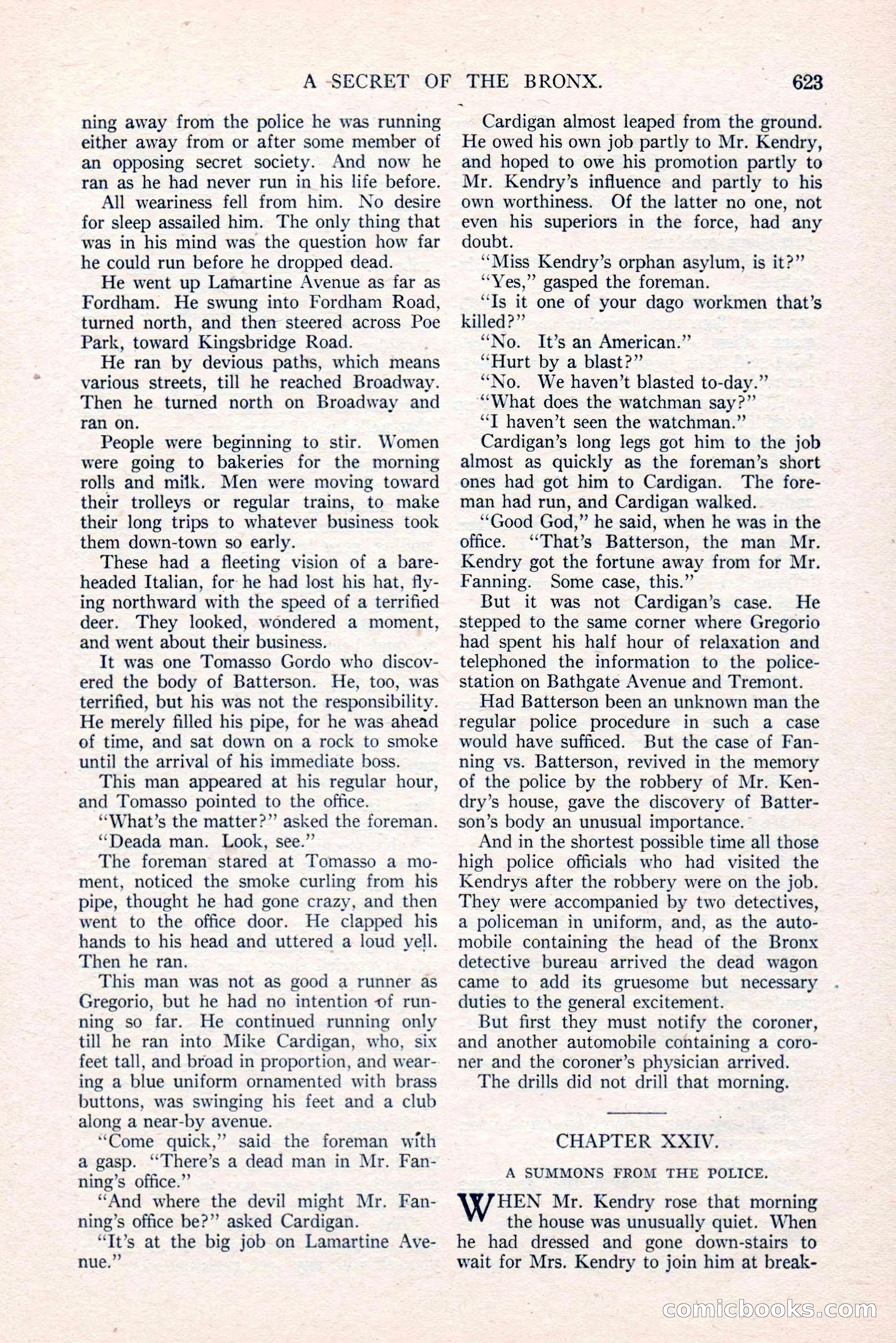
A restored page from Pulp Fiction, 1916. Page through the whole issue in the reader above.
📄 Transcribed text from this page (OCR, searchable)
Machine-transcribed from the original scan — historical spelling and the odd misread are preserved.
A SECRET OF THE BRONX. ning away from the police he was running either away from or after some member of an opposing secret society. And now he ran as he had never run in his life before. All weariness fell from him. No desire for sleep assailed him. The only thing that was in his mind was the question how far he could run before he dropped dead. He went up Lamartine Avenue as far as Fordham. He swung into Fordham Road, turned north, and then steered across Poe Park, toward Kingsbridge Road. He ran by devious paths, which means various streets, till he reached Broadway. Then he turned north on Broadway and ran on. People were beginning to stir. Women were going to bakeries for the morning rolls and milk. Men were moving toward their trolleys or regular trains, to make their long trips to whatever business took them down-town so early. These had a fleeting vision of a bare- headed Italian, for he had lost his hat, fly- ing northward with the speed of a terrified deer. They looked, wondered a moment, and went about their business. It was one Tomasso Gordo who discov- ered the body of Batterson. He, too, was terrified, but his was not the responsibility. He merely filled his pipe, for he was ahead of time, and sat down on a rock to smoke until the arrival of his immediate boss. This man appeared at his regular hour, and Tomasso pointed to the office. ‘““‘What’s the matter?” asked the foreman. ““Deada man. Look, see.” The foreman stared at Tomasso a mo- ment, noticed the smoke curling from his pipe, thought he had gone crazy, and then went to the office door. He clapped his hands to his head and uttered a loud yell. Then he ran. This man was not as good a runner as Gregorio, but he had no intention of run- ning so far. He continued running only till he ran into Mike Cardigan, who, six feet tall, and broad in proportion, and wear- ing a blue uniform ornamented with brass buttons, was swinging his feet and a club along a near-by avenue. “Come quick,” said the foreman with a gasp. “There’s a dead man in Mr. Fan- ning’s office.” “And where the devil might Mr. Fan- ning’s office be?” asked Cardigan. “It’s at the big job on Lamartine Ave- nue.” 623 Cardigan almost leaped from the ground. He owed his own job partly to Mr. Kendry, and hoped to owe his promotion partly to Mr. Kendry’s influence and partly to his own worthiness. Of the latter no one, not even his superiors in the force, had any doubt. ‘“Miss Kendry’s orphan asylum, is it?”’ “Yes,” gasped the foreman. “Is it one of your dago workmen that’s killed?” “No. It’s an American.” “Hurt by a blast?” “No. We haven’t blasted to- dae “What does the watchman say?”’ “T haven’t seen the watchman.”’ Cardigan’s long legs got him to the job almost as quickly as the foreman’s short ones had got him to Cardigan. The fore- man had run, and Cardigan walked. ‘““Good God,” he said, when he was in the office. ‘‘That’s Batterson, the man Mr. Kendry got the fortune away from for Mr. Fanning. Some case, this.” But it was not Cardigan’s case. He stepped to the same corner where Gregorio had spent his half hour of relaxation and telephoned the information to the police- station on Bathgate Avenue and Tremont. Had Batterson been an unknown man the regular police procedure in such a case would have sufficed. But the case of Fan- ning vs. Batterson, revived in the memory of the police by the robbery of Mr. Ken- dry’s house, gave the discovery of Batter- son’s body an unusual importance. And in the shortest possible time all those high police officials who had visited the Kendrys after the robbery were on the job. They were accompanied by two detectives, a policeman in uniform, and, as the auto- mobile containing the head of the Bronx detective bureau arrived the dead wagon came to add its gruesome but necessary duties to the general excitement. But first they must notify the coroner, and another automobile containing a coro- ner and the coroner’s physician arrived. The drills did not drill that morning. CHAPTER XXIV. A SUMMONS FROM THE POLICE. WHEN Mr. Kendry rose that morning the house was unusually quiet. When he had dressed and gone down-stairs to wait for Mrs. Kendry to join him at break- COMMICLOOOKS (C@