
Pulp Fiction, 1916 · page 45 of 208
The Argosy, Vol. 82 No. 4 — page 45: what you’re looking at
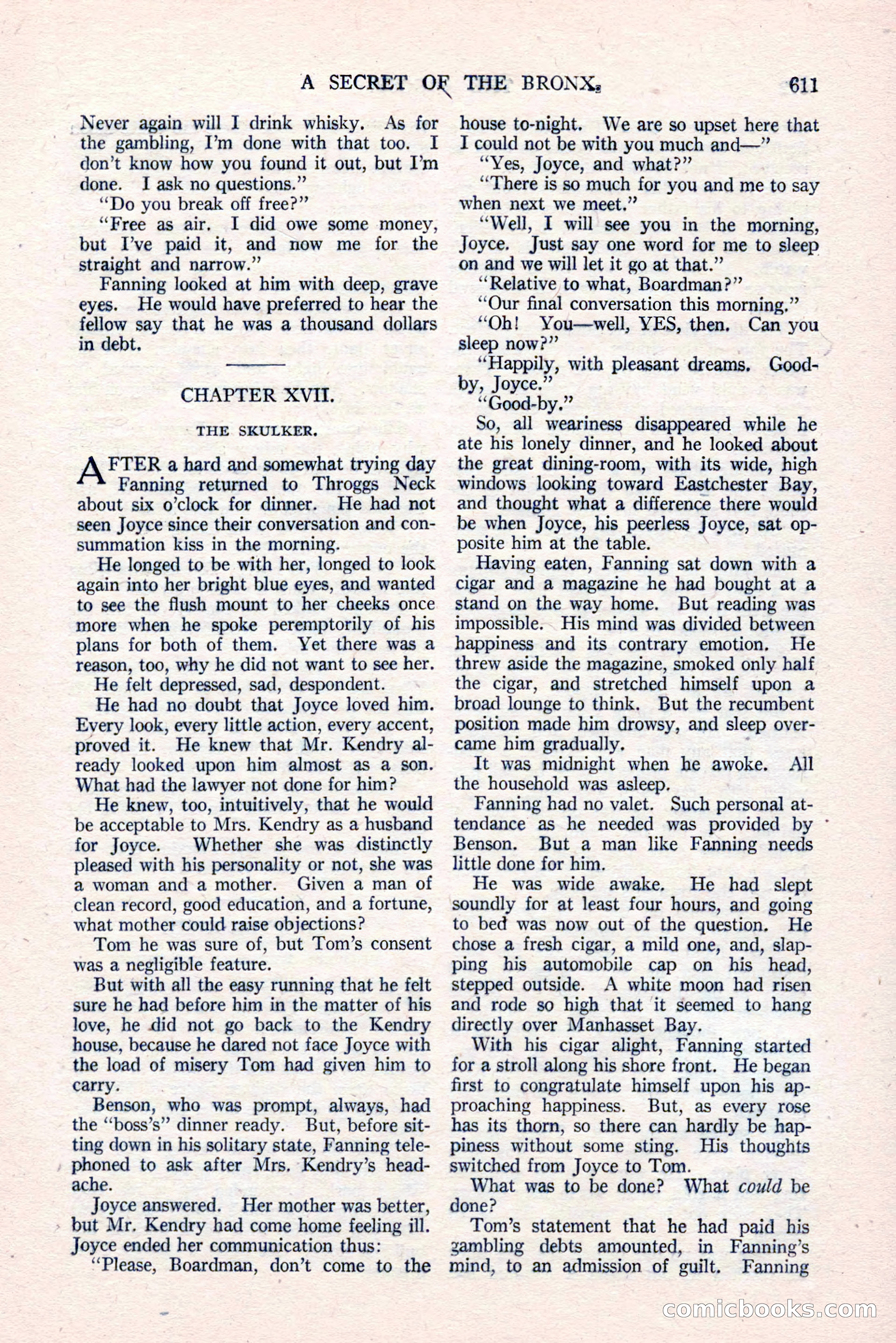
A restored page from Pulp Fiction, 1916. Page through the whole issue in the reader above.
📄 Transcribed text from this page (OCR, searchable)
Machine-transcribed from the original scan — historical spelling and the odd misread are preserved.
A SECRET OR THE BRONX, _Never again will I drink whisky. As for the gambling, I’m done with that too. I don’t know how you found it out, but I’m done. I ask no questions.” “Do you break off free?” “Free as air, I did owe some money, but I’ve paid it, and now me for the straight and narrow.” Fanning looked at him with deep, grave eyes. He would have preferred to hear the fellow say that he was a thousand dollars in debt. CHAPTER XVII. THE SKULKER, AFTER a hard and somewhat trying day Fanning returned to Throggs Neck about six o’clock for dinner. He had not seen Joyce since their conversation and con- summation kiss in the morning. He longed to be with her, longed to look again into her bright blue eyes, and wanted to see the flush mount to her cheeks once more when he spoke peremptorily of his plans for both of them. Yet there was a reason, too, why he did not want to see her. He felt depressed, sad, despondent. He had no doubt that Joyce loved him. Every look, every little action, every accent, proved it. He knew that Mr. Kendry al- ready looked upon him almost as a son. What had the lawyer not done for him? He knew, too, intuitively, that he would be acceptable to Mrs. Kendry as a husband for Joyce. Whether she was distinctly pleased with his personality or not, she was a woman and a mother. Given a man of clean record, good education, and a fortune, what mother could raise objections? Tom he was sure of, but Tom’s consent was a negligible feature. But with all the easy running that he felt sure he had before him in the matter of his love, he did not go back to the Kendry house, because he dared not face Joyce with the load of misery Tom had given him to carry. | Benson, who was prompt, always, had the “boss’s” dinner ready. But, before sit- ting down in his solitary state, Fanning tele- . phoned to ask after Mrs, Kendry’s head- ache. Joyce answered. Her mother was better, - but Mr. Kendry had come home feeling ill. Joyce ended her communication thus: “Please, Boardman, don’t come to the 611 house to-night. We are so upset here that I could not be with you much and—” “Yes, Joyce, and what?” ‘There is so much for you and me to say when next we meet,” “Well, I will see you in the morning, Joyce. Just say one word for me to sleep on and we will let it go at that.” “Relative to what, Boardman?” “Our final conversation this morning,” “Oh! You—well, YES, then, Can you sleep now?” “Happily, with pleasant dreams. Good- by, Joyce.” << Good-by.” 50, all weariness disappeared while he ate his lonely dinner, and he looked about the great dining-room, with its wide, high windows looking toward Eastchester Bay, and thought what a difference there would be when Joyce, his peerless Joyce, sat op- posite him at the table. Having eaten, Fanning sat down with a cigar and a magazine he had bought at a stand on the way home. But reading was impossible. His mind was divided between happiness and its contrary emotion, He threw aside the magazine, smoked only half the cigar, and stretched himself upon a broad lounge to think. But the recumbent position made him drowsy, and sleep over- came him gradually. It was midnight when he awoke. All the household was asleep. Fanning had no valet. Such personal at- tendance as he needed was provided by ° Benson. But a man like Fanning needs little done for him. He was wide awake. He had slept soundly for at least four hours, and going to bed was now out of the question. He chose a fresh cigar, a mild one, and, slap- ping his automobile cap on his head, stepped outside. A white moon had risen and rode so high that it seemed to hang directly over Manhasset Bay. With his cigar alight, Fanning started © for a stroll along his shore front. He began first to congratulate himself upon his ap- proaching happiness. But, as every rose has its thorn, so there can hardly be hap- piness without some sting. His thoughts switched from Joyce to Tom. What was to be done? What could be done? Tom’s statement that he had paid his gambling debts amounted, in Fanning’s mind, to an admission of guilt. Fanning GomiGcbdooks (C@