
Pulp Fiction, 1916 · page 43 of 208
The Argosy, Vol. 82 No. 4 — page 43: what you’re looking at
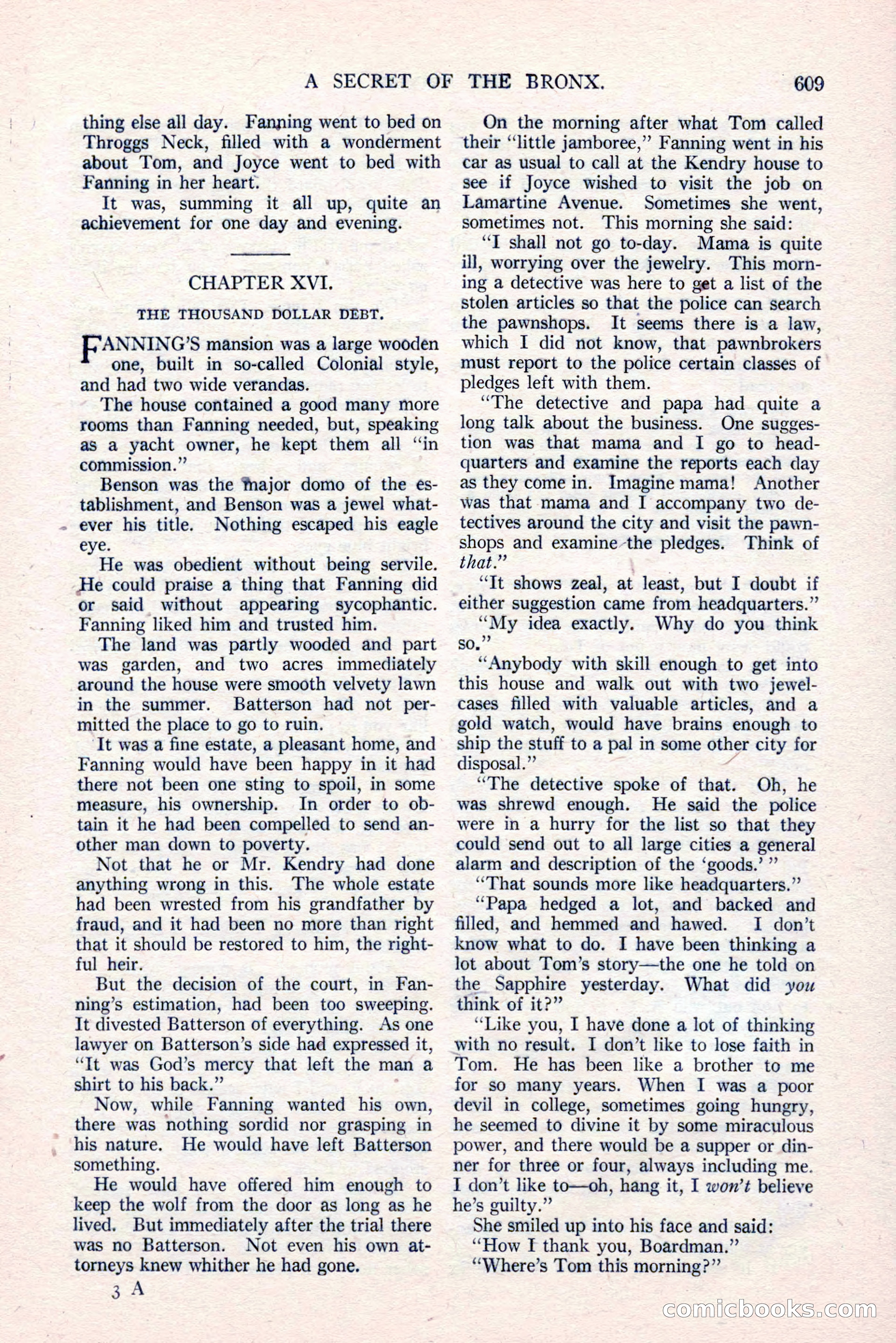
A restored page from Pulp Fiction, 1916. Page through the whole issue in the reader above.
📄 Transcribed text from this page (OCR, searchable)
Machine-transcribed from the original scan — historical spelling and the odd misread are preserved.
A SECRET OF THE BRONX. thing else all day. Fanning went to bed on Throggs Neck, filled with a wonderment about Tom, and Joyce went to bed with Fanning in her heart. It was, summing it all up, quite an achievement for one day and evening. CHAPTER XVI. THE THOUSAND DOLLAR DEBT. ANNING’S mansion was a large wooden one, built in so-called Colonial style, and had two wide verandas. The house contained a good many more rooms than Fanning needed, but, speaking as a yacht owner, he kept them all “in commission.” Benson was the fnajor domo of the és- tablishment, and Benson was a jewel what- . ever his title. Nothing escaped his eagle eye. He was obedient without being servile. He could praise a thing that Fanning did or said without appearing sycophantic. Fanning liked him and trusted him. The land was partly wooded and part was garden, and two acres immediately around the house were smooth velvety lawn in the summer. Batterson had not per- mitted the place to go to ruin. It was a fine estate, a pleasant home, and Fanning would have been happy in it had there not been one sting to spoil, in some measure, his ownership. In order to ob- tain it he had been compelled to send an- other man down to poverty. Not that he or Mr. Kendry had done anything wrong in this. The whole estate had been wrested from his grandfather by fraud, and it had been no more than right that it should be restored to him, the right- ful heir. But the decision of the court, in Fan- ning’s estimation, had been too sweeping. It divested Batterson of everything. As one lawyer on Batterson’s side had expressed it, “It was God’s mercy that left the man a shirt to his back.” Now, while Fanning wanted his own, there was nothing sordid nor grasping in his nature. He would have left Batterson something. He would have offered him enough to keep the wolf from the door as long as he lived. But immediately after the trial there was no Batterson. Not even his own at- torneys knew whither he had gone. 3 A 609 On the morning after what Tom called their “‘little jamboree,” Fanning went in his car as usual to call at the Kendry house to see if Joyce wished to visit the job on Lamartine Avenue. Sometimes she went, sometimes not. This morning she said: ‘‘T shall not go to-day. Mama is quite ill, worrying over the jewelry. This morn- ing a detective was here to get a list of the stolen articles so that the police can search the pawnshops. It seems there is a law, which I did not know, that pawnbrokers must report to the police certain classes of pledges left with them. ‘The detective and papa had quite a long talk about the business. One sugges- tion was that mama and I go to head- quarters and examine the reports each day as they come in. Imaginemama! Another was that mama and I accompany two de- tectives around the city and visit the pawn- shops and examine-the pledges. Think of that.” “Tt shows zeal, at least, but I doubt if either suggestion came from headquarters.” “My idea exactly. Why do you think so.” “Anybody with skill enough to get into this house and walk out with two jewel- cases filled with valuable articles, and a gold watch, would have brains enough to ship the stuff to a pal in some other city for disposal.” “The detective spoke of that. Oh, he was shrewd enough. He said the police were in a hurry for the list so that they could send out to all large cities a general alarm and description of the ‘goods.’ ” ‘That sounds more like headquarters.” “Papa hedged a lot, and backed and filled, and hemmed and hawed. I don’t know what to do. I have been thinking a lot about Tom’s story—the one he told on the Sapphire yesterday. What did you think of it?” “Like you, I have done a lot of thinking with no result. I don’t like to lose faith in Tom. He has been like a brother to me for so many years. When I was a poor devil in college, sometimes going hungry, he seemed to divine it by some miraculous power, and there would be a supper or din- ner for three or four, always including me. I don’t like to—oh, hang it, I won’t believe he’s guilty.” She smiled up into his face and said: “How I thank you, Boardman.” “Where’s Tom this morning?” COmMICLOOoks (C@