
Pulp Fiction, 1916 · page 22 of 208
The Argosy, Vol. 82 No. 4 — page 22: what you’re looking at
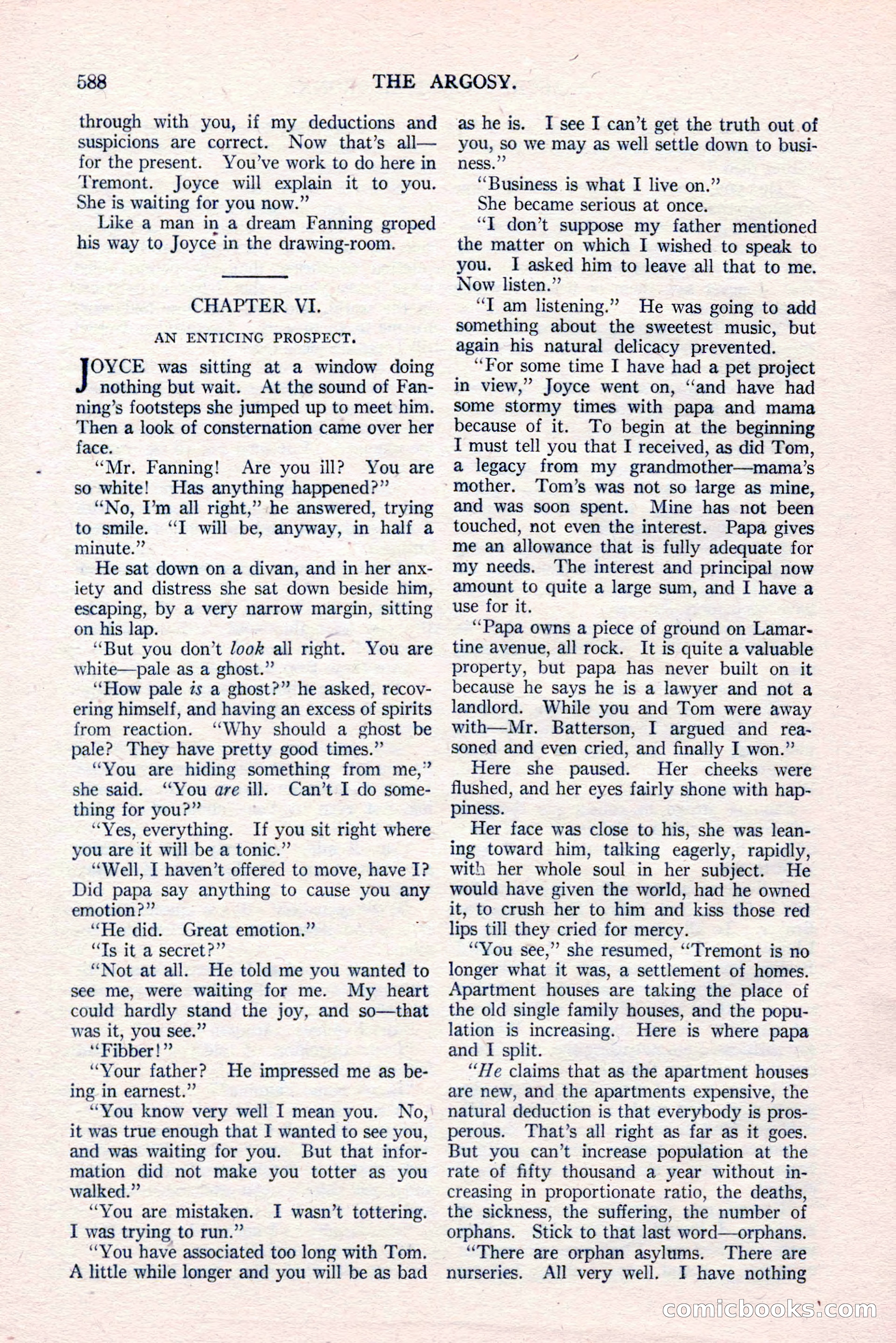
A restored page from Pulp Fiction, 1916. Page through the whole issue in the reader above.
📄 Transcribed text from this page (OCR, searchable)
Machine-transcribed from the original scan — historical spelling and the odd misread are preserved.
588 through with you, if my deductions and suspicions are correct. Now that’s all— for the present. You’ve work to do here in Tremont. Joyce will explain it to you. She is waiting for you now.” Like a man in a dream Fanning groped his way to Joyce in the drawing-room. CHAPTER VI. AN ENTICING PROSPECT. OYCE was sitting at a window doing nothing but wait. At the sound of Fan- ning’s footsteps she jumped up to meet him. Then a look of consternation came over her face. “Mr. Fanning! Are you ill? You are so white! Has anything happened?” “No, I’m all right,” he answered, trying to smile. “I will be, anyway, in half a minute.” He sat down on a divan, and in her anx- iety and distress she sat down beside him, escaping, by a very narrow margin, sitting on his lap. “But you don’t Jook all right. white—pale as a ghost.” ‘‘How pale zs a ghost?” he asked, recov- ering himself, and having an excess of spirits from reaction. ‘‘Why should a ghost be pale? They have pretty good times.” “You are hiding something from me,” she said. ‘You are ill. Can’t I do some- thing for you?” “Ves, everything. If you sit right where you are it will be a tonic.” “Well, I haven’t offered to move, have I? Did papa say anything to cause you any emotion?” “He did. Great emotion.” “Ts it a secret?” “Not at all. He told me you wanted to see me, were waiting for me. My heart could hardly stand the joy, and so—that was it, you see.” “Fibber!” “Your father? He impressed me as be- ing in earnest.” “You know very well I mean you. No, it was true enough that I wanted to see you, and was waiting for you. But that infor- mation did not make you totter as you walked.” “You are mistaken. I was trying to run.” “You have associated too long with Tom. A little while longer and you will be as bad You are I wasn’t tottering. THE ARGOSY. as he is. I see I can’t get the truth out of you, sO we may as well settle down to busi- ness.”’ ‘Business is what I live on.” She became serious at once. “I don’t suppose my father mentioned the matter on which I wished to speak to you. I asked him to leave all that to me. Now listen.” ‘“T am listening.” He was going to add something about the sweetest music, but again his natural delicacy prevented. ‘For some time I have had a pet project in view,” Joyce went on, ‘and have had some stormy times with papa and mama because of it. To begin at the beginning I must tell you that I received, as did Tom, a legacy from my grandmother—mama’s mother. Tom’s was not so large as mine, and was soon spent. Mine has not been touched, not even the interest. Papa gives me an allowance that is fully adequate for my needs. The interest and principal now amount to quite a large sum, and I have a use for it. ‘Papa owns a piece of ground on Lamar- tine avenue, all rock. It is quite a valuable property, but papa has never built on it because he says he is a lawyer and not a landlord. While you and Tom were away with—Mr. Batterson, I argued and rea- soned and even cried, and finally I won.” Here she paused. Her cheeks were flushed, and her eyes fairly shone with hap- piness. Her face was close to his, she was lean- ing toward him, talking eagerly, rapidly, with her whole soul in her subject. He would have given the world, had he owned it, to crush her to him and kiss those red lips till they cried for mercy. “You see,” she resumed, ‘“Tremont is no longer what it was, a settlement of homes. Apartment houses are taking the place of the old single family houses, and the popu- lation is increasing. Here is where papa and I split. “He claims that as the apartment houses are new, and the apartments expensive, the natural deduction is that everybody is pros- perous. That’s all right as far as it goes. But you can’t increase population at the rate of fifty thousand a year without in- creasing in proportionate ratio, the deaths, the sickness, the suffering, the number of orphans. Stick to that last word—orphans. “There are orphan asylums. There are nurseries. All very well. I have nothing CORNICOOOKS: (C@)