
Pulp Fiction, 1916 · page 18 of 208
The Argosy, Vol. 82 No. 4 — page 18: what you’re looking at
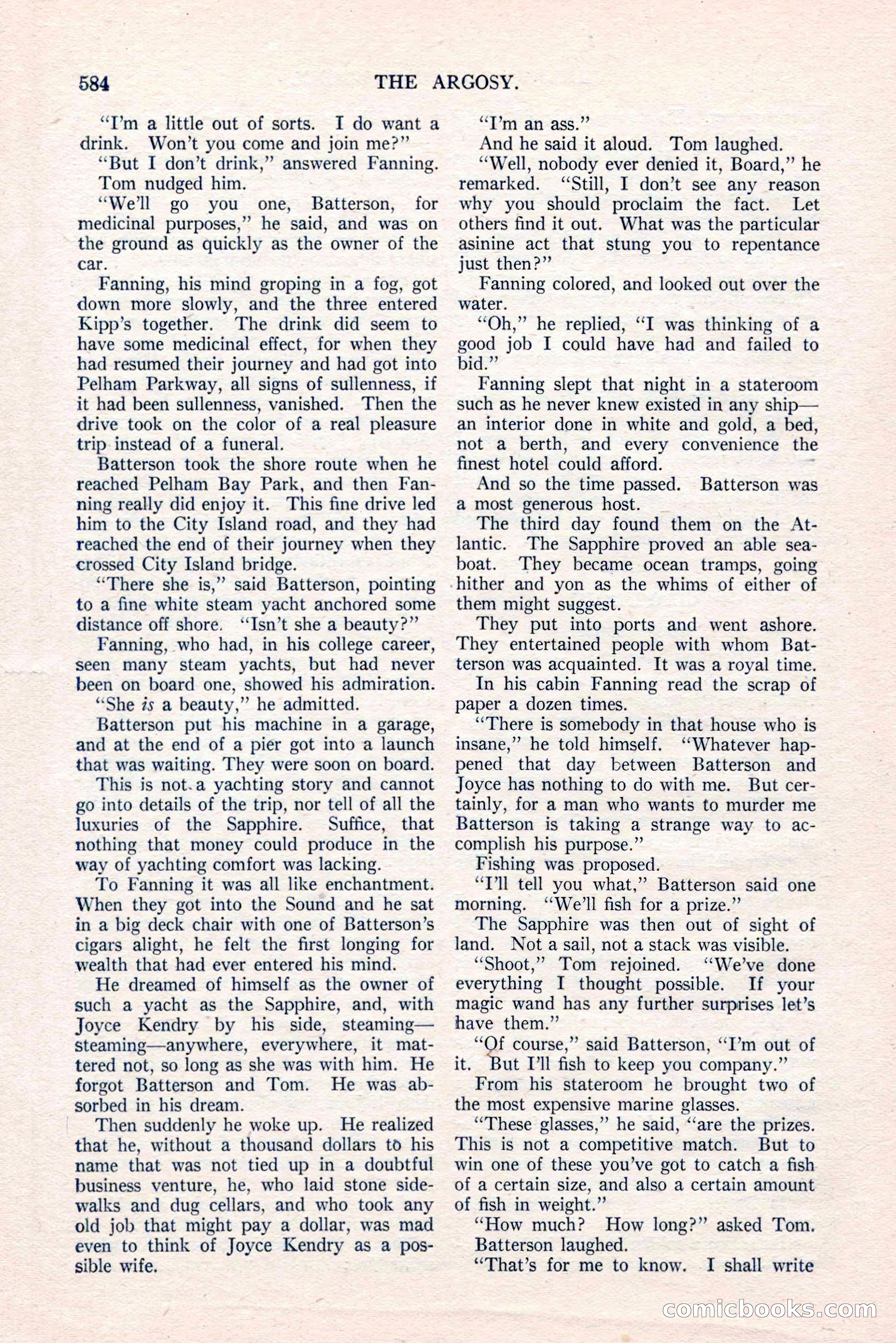
A restored page from Pulp Fiction, 1916. Page through the whole issue in the reader above.
📄 Transcribed text from this page (OCR, searchable)
Machine-transcribed from the original scan — historical spelling and the odd misread are preserved.
584 “I’m a little out of sorts. I do want a drink. Won’t you come and join me?” “But I don’t drink,” answered Fanning. Tom nudged him. “We'll go you one, Batterson, for medicinal purposes,” he said, and was on the ground as quickly as the owner of the car. Fanning, his mind groping in a fog, got down more slowly, and the three entered Kipp’s together. The drink did seem to have some medicinal effect, for when they had resumed their journey and had got into Pelham Parkway, all signs of sullenness, if it had been sullenness, vanished. Then the drive took on the color of a real pleasure trip instead of a funeral. Batterson took the shore route when he reached Pelham Bay Park, and then Fan- ning really did enjoy it. This fine drive led him to the City Island road, and they had reached the end of their journey when they crossed City Island bridge. “There she is,” said Batterson, pointing to a fine white steam yacht anchored some distance off shore. ‘“‘Isn’t she a beauty?” Fanning, who had, in his college career, seen many steam yachts, but had never been on board one, showed his admiration. “She is a beauty,” he admitted. Batterson put his machine in a garage, and at the end of a pier got into a launch that was waiting. They were soon on board. This is not.a yachting story and cannot go into details of the trip, nor tell of all the luxuries of the Sapphire. Suffice, that nothing that money could produce in the way of yachting comfort was lacking. To Fanning it was all like enchantment. When they got into the Sound and he sat in a big deck chair with one of Batterson’s cigars alight, he felt the first longing for wealth that had ever entered his mind. He dreamed of himself as the owner of such a yacht as the Sapphire, and, with Joyce Kendry by his side, steaming— steaming—anywhere, everywhere, it mat- tered not, so long as she was with him. He forgot Batterson and Tom. He was ab- sorbed in his dream. Then suddenly he woke up. He realized that he, without a thousand dollars to his name that was not tied up in a doubtful business venture, he, who laid stone side- walks and dug cellars, and who took any old job that might pay a dollar, was mad even to think of Joyce Kendry as a pos- sible wife. THE ARGOSY. “I’m an ass.” And he said it aloud. Tom laughed. ‘Well, nobody ever denied it, Board,” he remarked. “Still, I don’t see any reason why you should proclaim the fact. Let others find it out. What was the particular asinine act that stung you to repentance just then?” Fanning colored, and looked out over the water. “Oh,” he replied, “I was thinking of a good job I could have had and failed to bid.” Fanning slept that night in a stateroom such as he never knew existed in any ship— an interior done in white and gold, a bed, not a berth, and every convenience the finest hotel could afford. And so the time passed. Batterson was a most generous host. The third day found them on the At- lantic. The Sapphire proved an able sea- boat. They became ocean tramps, going -hither and yon as the whims of either of them might suggest. They put into ports and went ashore. They entertained people with whom Bat- terson was acquainted. It was a royal time. In his cabin Fanning read the scrap of paper a dozen times. “There is somebody in that house who is insane,” he told himself. ‘‘Whatever hap- pened that day between Batterson and Joyce has nothing to do with me. But cer- tainly, for a man who wants to murder me Batterson is taking a strange way to ac- complish his purpose.”’ Fishing was proposed. “T’ll tell you what,” Batterson said one morning. ‘‘We’ll fish for a prize.” The Sapphire was then out of sight of land. Not a sail, not a stack was visible. “Shoot,” Tom rejoined. ‘“‘We’ve done everything I thought possible. If your magic wand has any further surprises let’s have them.” “Of course,” said Batterson, “I’m out of ut [ll fish to keep you company.” From his stateroom he brought two of the most expensive marine glasses. “These glasses,” he said, ‘‘are the prizes. This is not a competitive match. But to win one of these you’ve got to catch a fish of a certain size, and also a certain amount of fish in weight.” “How much? How long?” asked Tom. Batterson laughed. “That’s for me to know. it. I shall write COMMICLOOOKS (C@