
Pulp Fiction, 1916 · page 98 of 212
The Argosy, Vol. 82, No. 3 — page 98: what you’re looking at
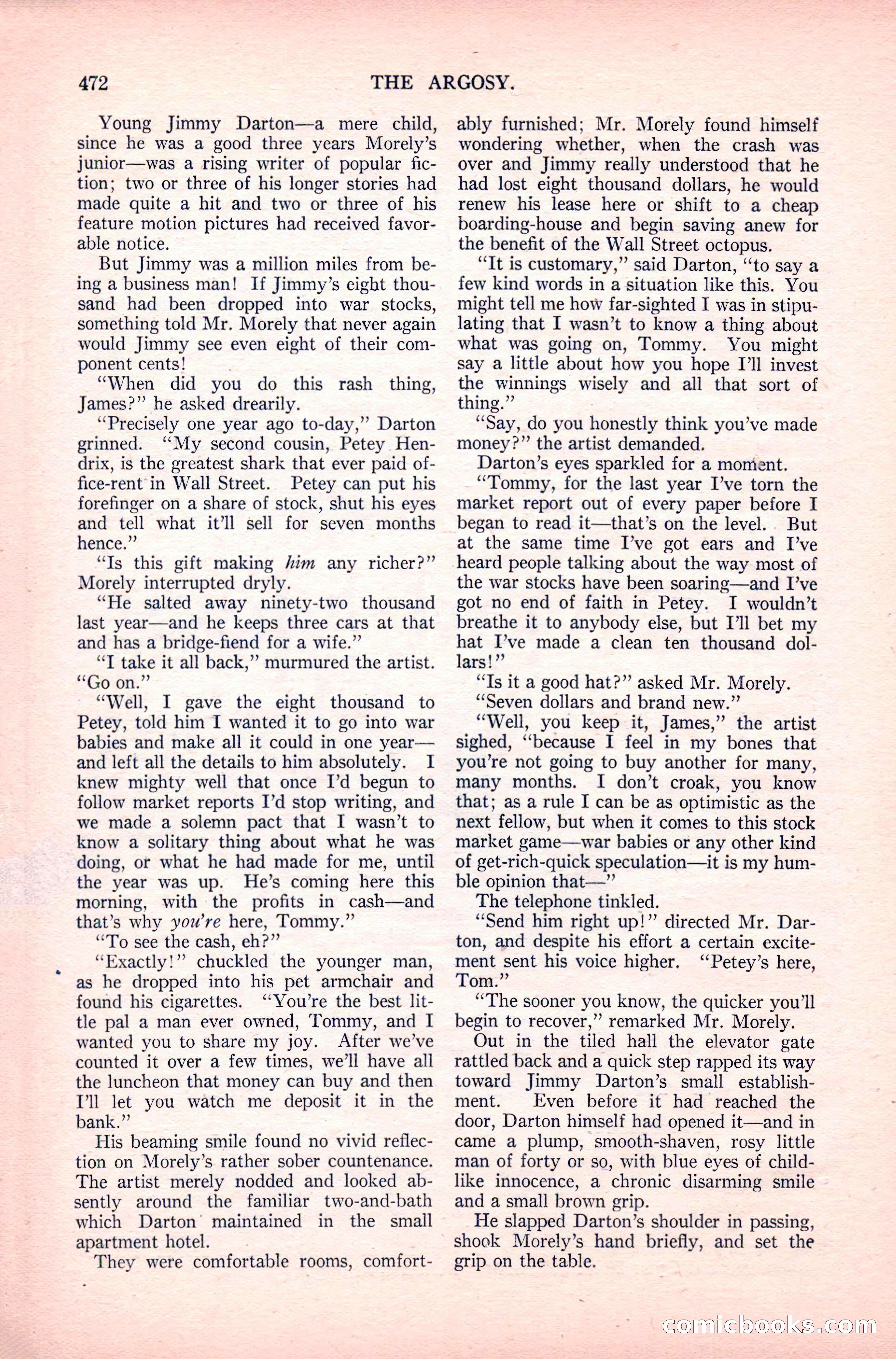
A restored page from Pulp Fiction, 1916. Page through the whole issue in the reader above.
📄 Transcribed text from this page (OCR, searchable)
Machine-transcribed from the original scan — historical spelling and the odd misread are preserved.
472 Young Jimmy Darton—a mere child, since he was a good three years Morely’s junior—was a rising writer of popular fic- tion; two or three of his longer stories had made quite a hit and two or three of his feature motion pictures had received favor- able notice. But Jimmy was a million miles from be- ing a business man! If Jimmy’s eight thou- sand had been dropped into war stocks, something told Mr. Morely that never again would Jimmy see even eight of their com- ponent cents! ‘When did you do this rash thing, James?” he asked drearily. “Precisely one year ago to-day,” Darton grinned. ‘“‘My second cousin, Petey Hen- drix, is the greatest shark that ever paid of- fice-rent in Wall Street. Petey can put his forefinger on a share of stock, shut his eyes and tell what it’ll sell for seven months hence.” “Is this gift making fim any richer?” Morely interrupted dryly. “He salted away ninety-two thousand last year—and he keeps three cars at that and has a bridge-fiend for a wife.” “T take it all back,” murmured the artist. “Go on.” “Well, I gave the eight thousand to Petey, told him I wanted it to go into war babies and make all it could in one year— and left all the details to him absolutely. I knew mighty well that once I’d begun to follow market reports I’d stop writing, and we made a solemn pact that I wasn’t to know a solitary thing about what he was doing, or what he had made for me, until the year was up. He’s coming here this morning, with the profits in cash—and that’s why you’re here, Tommy.” “To see the cash, eh?” “Exactly!” chuckled the younger man, as he dropped into his pet armchair and found his cigarettes. ‘‘You’re the best lit- tle pal a man ever owned, Tommy, and I wanted you to share my joy. After we’ve counted it over a few times, we’ll have all the luncheon that money can buy and then T’ll let you watch me deposit it in the bank.” His beaming smile found no vivid reflec- tion on Morely’s rather sober countenance. The artist merely nodded and looked ab- sently around the familiar two-and-bath which Darton’ maintained in the small apartment hotel. They were comfortable rooms, comfort- THE ARGOSY. ably furnished; Mr. Morely found himself wondering whether, when the crash was over and Jimmy really understood that he had lost eight thousand dollars, he would renew his lease here or shift to a cheap boarding-house and begin saving anew for the benefit of the Wall Street octopus. “It is customary,” said Darton, “‘to say a few kind words in a situation like this. You might tell me how far-sighted I was in stipu- lating that I wasn’t to know a thing about what was going on, Tommy. You might say a little about how you hope I’ll invest the winnings wisely and all that sort of thing.” ‘Say, do you honestly think you’ve made money?” the artist demanded. Darton’s eyes sparkled for a moment. “Tommy, for the last year I’ve torn the market report out of every paper before I began to read it—that’s on the level. But at the same time I’ve got ears and I’ve heard people talking about the way most of the war stocks have been soaring—and I’ve got no end of faith in Petey. I wouldn’t breathe it to anybody else, but I’ll bet my hat I’ve made a clean ten thousand dol- lars!” ‘Is it a good hat?” asked Mr. Morely. “Seven dollars and brand new.”’ “Well, you keep it, James,” the artist sighed, “‘because I feel in my bones that you're not going to buy another for many, many months. I don’t croak, you know that; as a rule I can be as optimistic as the next fellow, but when it comes to this stock market game—war babies or any other kind of get-rich-quick speculation—it is my hum- ble opinion that—” The telephone tinkled. “Send him right up!” directed Mr. Dar- ton, and despite his effort a certain excite- ment sent his voice higher. ‘Petey’s here, Tom.” “The sooner you know, the quicker you’ll begin to recover,” remarked Mr. Morely. Out in the tiled hall the elevator gate rattled back and a quick step rapped its way toward Jimmy Darton’s small establish- ment. Even before it had reached the door, Darton himself had opened it—and in came a plump, smooth-shaven, rosy little man of forty or so, with blue eyes of child- like innocence, a chronic disarming smile and a small brown grip. He slapped Darton’s shoulder in passing, shook Morely’s hand briefly, and set the grip on the table. Gomichbook (C@