
Pulp Fiction, 1916 · page 44 of 212
The Argosy, Vol. 82, No. 3 — page 44: what you’re looking at
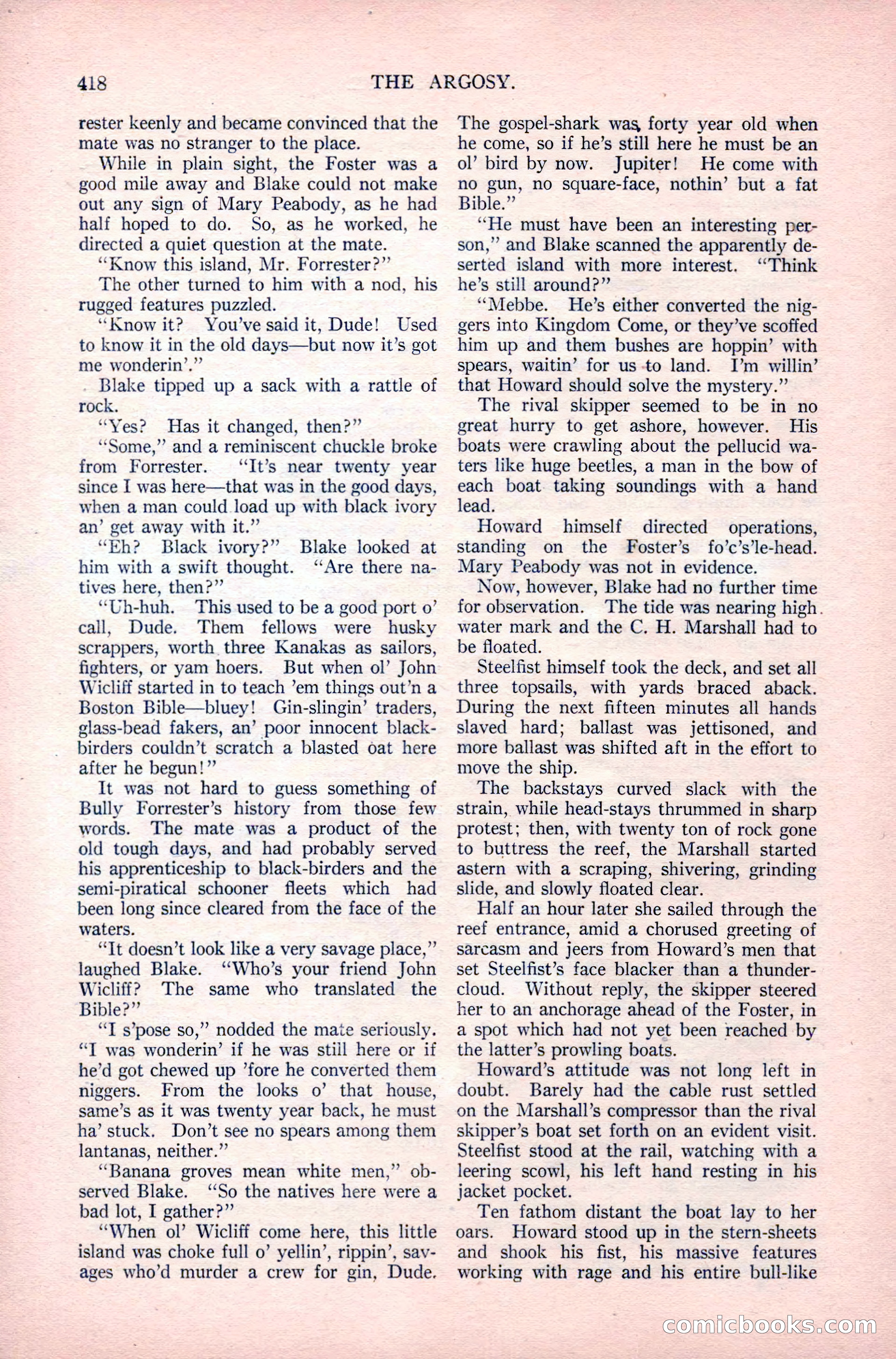
A restored page from Pulp Fiction, 1916. Page through the whole issue in the reader above.
📄 Transcribed text from this page (OCR, searchable)
Machine-transcribed from the original scan — historical spelling and the odd misread are preserved.
418 rester keenly and became convinced that the mate was no stranger to the place. While in plain sight, the Foster was a good mile away and Blake could not make out any sign of Mary Peabody, as he had half hoped to do. So, as he worked, he directed a quiet question at the mate. ‘“‘Know this island, Mr. Forrester?”’ The other turned to him with a nod, his rugged features puzzled. “Know it? You’ve said it, Dude! Used to know it in the old days—but now it’s got me wonderin’.” Blake tipped up a sack with a rattle of rock. “Yes? Has it changed, then?”’ “Some,’’ and a reminiscent chuckle broke from Forrester. “It’s near twenty year since | was here—that was in the good days, when a man could load up with black ivory an’ get away with it.” “Eh? Black ivory?” him with a swift thought. tives here, then?” “Uh-huh. This used to be a good port o’ call, Dude. Them fellows were husky scrappers, worth three Kanakas as sailors, fighters, or yam hoers. But when ol’ John Wicliff started in to teach ’em things out’n a Boston Bible—bluey! Gin-slingin’ traders, glass-bead fakers, an’ poor innocent black- birders couldn’t scratch a blasted oat here after he begun!” It was not hard to guess something of Bully Forrester’s history from those few words. The mate was a product of the old tough days, and had probably served his apprenticeship to black-birders and the semi-piratical schooner fleets which had been long since cleared from the face of the waters. “Tt doesn’t look like a very savage place,”’ laughed Blake. ‘“Who’s your friend John Wicliff? ‘The same who translated the Bible?” “TI s’pose so,”’ nodded the maie seriously. “T was wonderin’ if he was still here or if he’d got chewed up ’fore he converted them niggers. From the looks o’ that house, same’s as it was twenty year back, he must ha’ stuck. Don’t see no spears among them lantanas, neither.” “Banana groves mean white men,’ ob- served Blake. ‘So the natives here were a bad lot, I gather?” “When ol’ Wicliff come here, this little island was choke full 0’ yellin’, rippin’, sav- ages who’d murder a crew for gin, Dude. Blake looked at ‘‘Are there na- THE ARGOSY. The gospel-shark was forty year old when he come, so if he’s still here he must be an ol’ bird by now. Jupiter! He come with no gun, no square-face, nothin’ but a fat Bible.” ‘‘He must have been an interesting per- son,’ and Blake scanned the apparently de- serted island with more interest. ‘Think he’s still around?” ‘‘Mebbe. He’s either converted the nig- gers into Kingdom Come, or they’ve scoffed him up and them bushes are hoppin’ with spears, waitin’ for us-to land. J’m willin’ that Howard should solve the mystery.” The rival skipper seemed to be in no great hurry to get ashore, however. His boats were crawling about the pellucid wa- ters like huge beetles, a man in the bow of each boat taking soundings with a hand lead. Howard himself directed operations, standing on the Foster’s fo’c’s’le-head. Mary Peabody was not in evidence. Now, however, Blake had no further time for observation. water mark and the C. H. Marshall had to be floated. Steelfist himself took the deck, and set all three topsails, with yards braced aback. During the next fifteen minutes all hands slaved hard; ballast was jettisoned, and more ballast was shifted aft in the effort to move the ship. The backstays curved slack with the strain, while head-stays thrummed in sharp protest; then, with twenty ton of rock gone to buttress the reef, the Marshall started astern with a scraping, shivering, grinding slide, and slowly floated clear. Half an hour later she sailed through the reef entrance, amid a chorused greeting of sarcasm and jeers from Howard’s men that set Steelfist’s face blacker than a thunder- cloud. Without reply, the skipper steered her to an anchorage ahead of the Foster, in a spot which had not yet been reached by the latter’s prowling boats. Howard’s attitude was not long left in doubt. Barely had the cable rust settled on the Marshall’s compressor than the rival skipper’s boat set forth on an evident visit. Steelfist stood at the rail, watching with a leering scowl, his left hand resting in his jacket pocket. Ten fathom distant the boat lay to her oars. Howard stood up in the stern-sheets and shook his fist, his massive features working with rage and his entire bull-like (e(0) VOOLKS AMUNG The tide was nearing high. (C@)