
Pulp Fiction, 1916 · page 30 of 212
The Argosy, Vol. 82, No. 3 — page 30: what you’re looking at
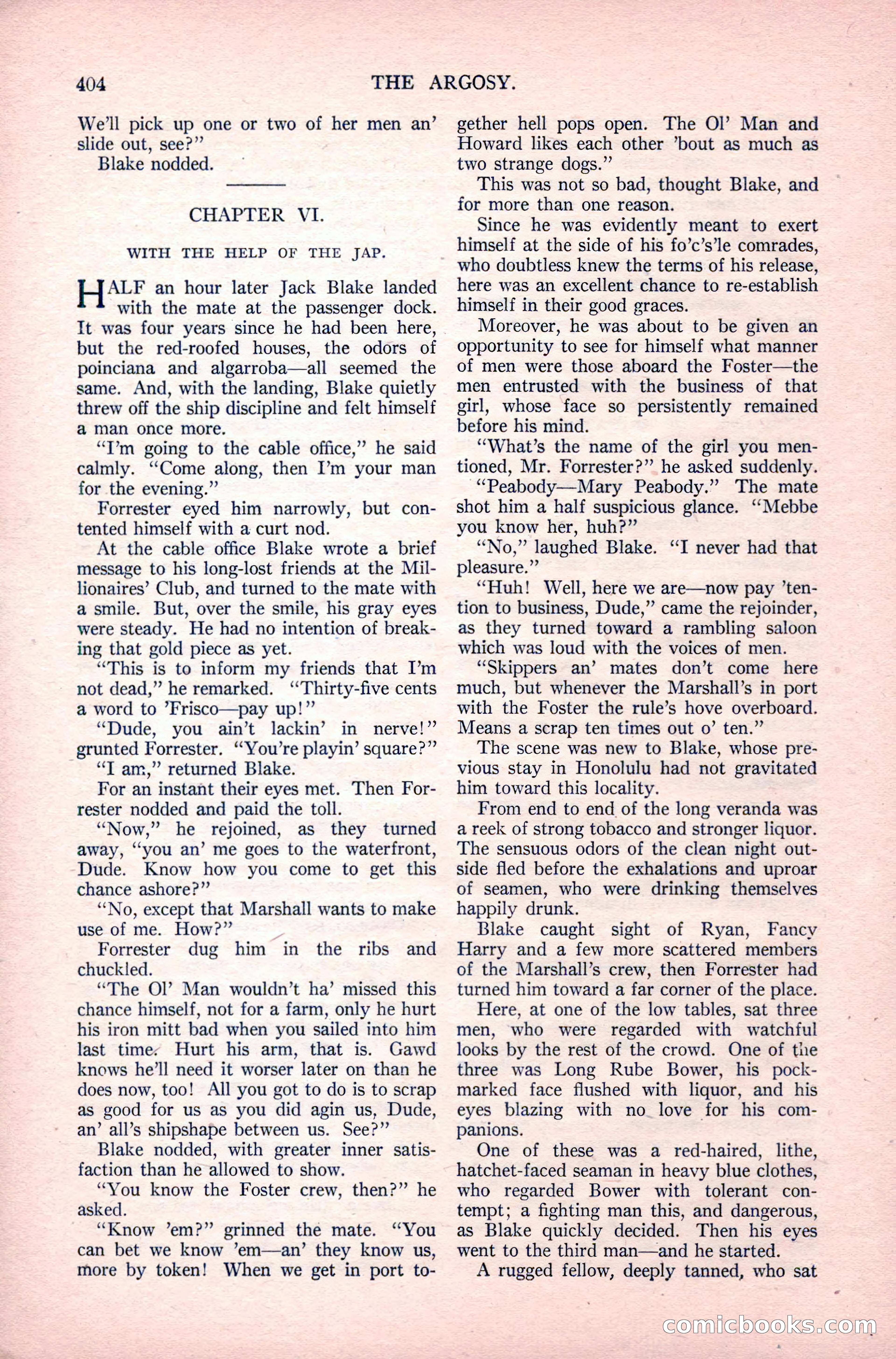
A restored page from Pulp Fiction, 1916. Page through the whole issue in the reader above.
📄 Transcribed text from this page (OCR, searchable)
Machine-transcribed from the original scan — historical spelling and the odd misread are preserved.
404 THE We'll pick up one or two of her men an’ slide out, see?” Blake nodded. CHAPTER VI. WITH THE HELP OF THE JAP. HALF an hour later Jack Blake landed with the mate at the passenger dock. It was four years since he had been here, but the red-roofed houses, the odors of poinciana and algarroba—all seemed the same. And, with the landing, Blake quietly threw off the ship discipline and felt himself a man once more. “T’m going to the cable office,” he said calmly. “Come along, then I’m your man for the evening.” Forrester eyed him narrowly, but con- tented himself with a curt nod. At the cable office Blake wrote a brief message to his long-lost friends at the Mil- lionaires’ Club, and turned to the mate with a smile. But, over the smile, his gray eyes were steady. He had no intention of break- ing that gold piece as yet. “This is to inform my friends that I’m not dead,” he remarked. ‘‘Thirty-five cents a word to ’Frisco—pay up!” “Dude, you ain’t lackin’ in nerve grunted Forrester. “You’re playin’ square?” “T am,” returned Blake. For an instant their eyes met. Then For- rester nodded and paid the toll. “Now,” he rejoined, as they turned away, “you an’ me goes to the waterfront, Dude. Know how you come to get this chance ashore?” “No, except that Marshall wants to make use of me. How?” Forrester dug him chuckled. “The Ol’ Man wouldn’t ha’ missed this chance himself, not for a farm, only he hurt his iron mitt bad when you sailed into him last times Hurt his arm, that is. Gawd knows he’ll need it worser later on than he does now, too! All you got to do is to scrap as good for us as you did agin us, Dude, an’ all’s shipshape between us. See?” Blake nodded, with greater inner satis- faction than he allowed to show. “You know the Foster crew, then?” he asked. “Know ’em?” grinned the mate. ‘You can bet we know ’em—an’ they know us, more by token! When we get in port to- !? in the ribs and ARGOSY. gether hell pops open. The Ol’ Man and Howard likes each other ’bout as much as two strange dogs.” This was not so bad, thought Blake, and for more than one reason. Since he was evidently meant to exert himself at the side of his fo’c’s’le comrades, who doubtless knew the terms of his release, here was an excellent chance to re-establish himself in their good graces. Moreover, he was about to be given an opportunity to see for himself what manner of men were those aboard the Foster—the men entrusted with the business of that girl, whose face so persistently remained before his mind. ‘““‘What’s the name of the girl you men- tioned, Mr. Forrester?’”’ he asked suddenly. ““‘Peabody—-Mary Peabody.” ‘The mate shot him a half suspicious glance. “Mebbe you know her, huh?” “No,” laughed Blake. ‘I never had that pleasure.” “Huh! Well, here we are—now pay ’ten- tion to business, Dude,” came the rejoinder, as they turned toward a rambling saloon which was loud with the voices of men. “Skippers an’ mates don’t come here much, but whenever the Marshall’s in port with the Foster the rule’s hove overboard. Means a scrap ten times out o’ ten.” The scene was new to Blake, whose pre- vious stay in Honolulu had not gravitated him toward this locality. From end to end of the long veranda was a reek of strong tobacco and stronger liquor. The sensuous odors of the clean night out- side fled before the exhalations and uproar of seamen, who were drinking themselves happily drunk. Blake caught sight of Ryan, Fancy Harry and a few more scattered members of the Marshall’s crew, then Forrester had turned him toward a far corner of the place. Here, at one of the low tables, sat three men, who were regarded with watchful looks by the rest of the crowd. One of the three was Long Rube Bower, his pock- marked face flushed with liquor, and his eyes blazing with no_love for his com- panions. One of these was a red-haired, lithe, hatchet-faced seaman in heavy blue clothes, who regarded Bower with tolerant con- tempt; a fighting man this, and dangerous, as Blake quickly decided. Then his eyes went to the third man—and he started. A rugged fellow, deeply tanned, who sat COLMUC NOOLKS (C@)