
Pulp Fiction, 1916 · page 200 of 212
The Argosy, Vol. 82, No. 3 — page 200: what you’re looking at
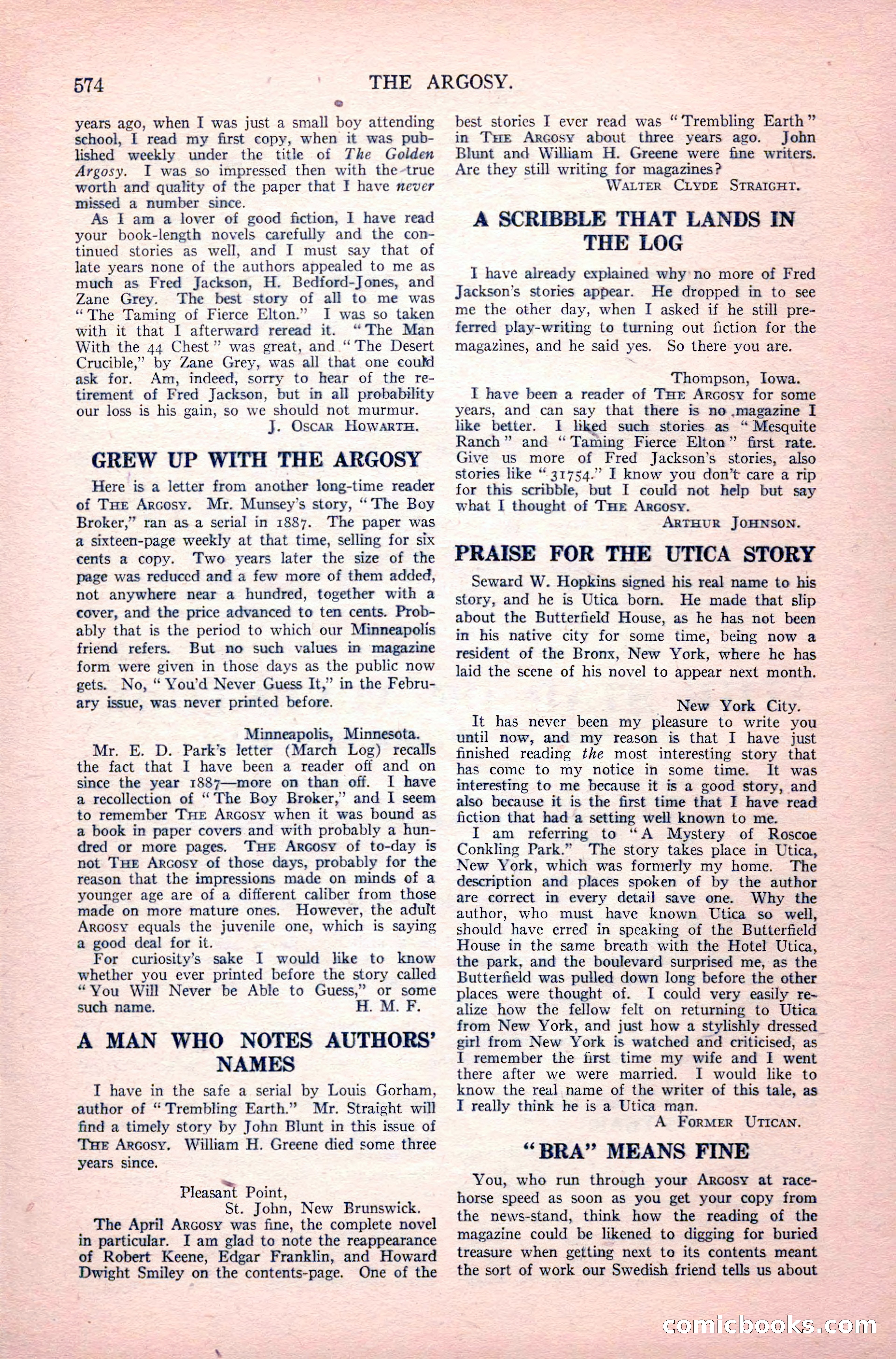
A restored page from Pulp Fiction, 1916. Page through the whole issue in the reader above.
📄 Transcribed text from this page (OCR, searchable)
Machine-transcribed from the original scan — historical spelling and the odd misread are preserved.
574 co years ago, when I was just a small boy attending school, I read my first copy, when it was pub- lished weekly under the title of The Golden Argosy. I was so impressed then with the-true worth and quality of the paper that I have never missed a number since. As I am a lover of good fiction, I have read your book-length novels carefully and the con- tinued stories as well, and I must say that of late years none of the authors appealed to me as much as Fred Jackson, H. Bedford-Jones, and Zane Grey. ‘The best story of all to me was “The Taming of Fierce Elton.” I was so taken with it that I afterward reread it. “The Man With the 44 Chest” was great, and “ The Desert Crucible,” by Zane Grey, was all that one could ask for. Am, indeed, sorry to hear of the re- tirement of Fred Jackson, but in all probability our loss is his gain, so we should not murmur. J. Oscak HowarTH. GREW UP WITH THE ARGOSY Here is a letter from another long-time reader of Tur Arcosy. Mr. Munsey’s story, “ The Boy Broker,” ran as a serial in 1887. The paper was a sixteen-page weekly at that time, selling for six cents a copy. ‘Two years later the size of the page was reduced and a few more of them added, not anywhere near a hundred, together with a cover, and the price advanced to ten cents. Prob- ably that is the period to which our Minneapolis friend refers. But no such values in magazine form were given in those days as the public now gets. No, “ You’d Never Guess It,” in the Febru- ary issue, was never printed before. Minneapolis, Minnesota. Mr. E. D. Park’s letter (March Log) recalls the fact that I have been a reader off and on since the year 1887—more on than off. I have a recollection of “The Boy Broker,’ and I seem to remember THE Arcosy when it was bound as a book in paper covers and with probably a hun- dred or more pages. THE Arcosy of to-day is not THe Arcosy of those days, probably for the reason that the impressions made on minds of a younger age are of a different caliber from those made on more mature ones. However, the adult Arcosy equals the juvenile one, which is saying a good deal for it. For curiosity’s sake I would like to know whether you ever printed before the story called “You Will Never be Able to Guess,” or some such name. H. M. F. A MAN WHO NOTES AUTHORS’ NAMES IT have in the safe a serial by Louis Gorham, author of “ Trembling Earth.” Mr. Straight will find a timely story by John Blunt in this issue of Tue Arcosy, William H. Greene died some three years since. Pleasant Point, St. John, New Brunswick. The April Arcosy was fine, the complete novel in particular. I am glad to note the reappearance of Robert Keene, Edgar Franklin, and Howard Dwight Smiley on the contents-page. One of the THE ARGOSY. best stories J ever read was ‘ Trembling Earth” in THe Arcosy about three years ago. John Blunt and William H. Greene were fine writers. Are they still writing for magazines? WALTER CLYDE STRAIGHT. A SCRIBBLE THAT LANDS IN THE LOG I have already explained why no more of Fred Jackson’s stories appear. He dropped in to see me the other day, when I asked if he still pre- ferred play-writing to turning out fiction for the magazines, and he said yes. So there you are. Thompson, lowa. I have been a reader of THe Arcosy for some years, and can say that there is no .magazine I like better. I ltked such stories as “ Mesquite Ranch” and “ Taming Fierce Elton” first rate. Give us more of Fred Jackson’s stories, also stories like “31754.” I know you don’t care a rip for this scribble, but I could not help but say what I thought of THe Arcosy. ARTHUR JOHNSON. PRAISE FOR THE UTICA STORY Seward W. Hopkins signed his real name to his story, and he is Utica born. He made that slip about the Butterfield House, as he has not been in his native city for some time, being now a resident of the Bronx, New York, where he has laid the scene of his novel to appear next month. _ New York City. It has never been my pleasure to write you until now, and my reason is that I have just finished reading the most interesting story that has come to my notice in some time. It was interesting to me because it is a good story, and also because it is the first time that I have read fiction that had a setting well known to me. I am referring to “A Mystery of Roscoe Conkling Park.” The story takes place in Utica, New York, which was formerly my home. The description and places spoken of by the author are correct in every detail save one. Why the author, who must have known Utica so well, should have erred in speaking of the Butterfield House in the same breath with the Hotel Utica, the park, and the boulevard surprised me, as the Butterfield was pulled down long before the other places were thought of. I could very easily re~ alize how the fellow felt on returning to Utica from New York, and just how a stylishly dressed girl from New York is watched and criticised, as I remember the first time my wife and I went there after we were married. I would like to know the real name of the writer of this tale, as I really think he is a Utica man. A ForMER UTICAN. “BRA” MEANS FINE You, who run through your Arcosy at race- horse speed as soon as you get your copy from the news-stand, think how the reading of the magazine could be likened to digging for buried treasure when getting next te its contents meant the sort of work our Swedish friend tells us about (e(0) .OO AAI cS (E©)