
Pulp Fiction, 1916 · page 173 of 212
The Argosy, Vol. 82, No. 3 — page 173: what you’re looking at
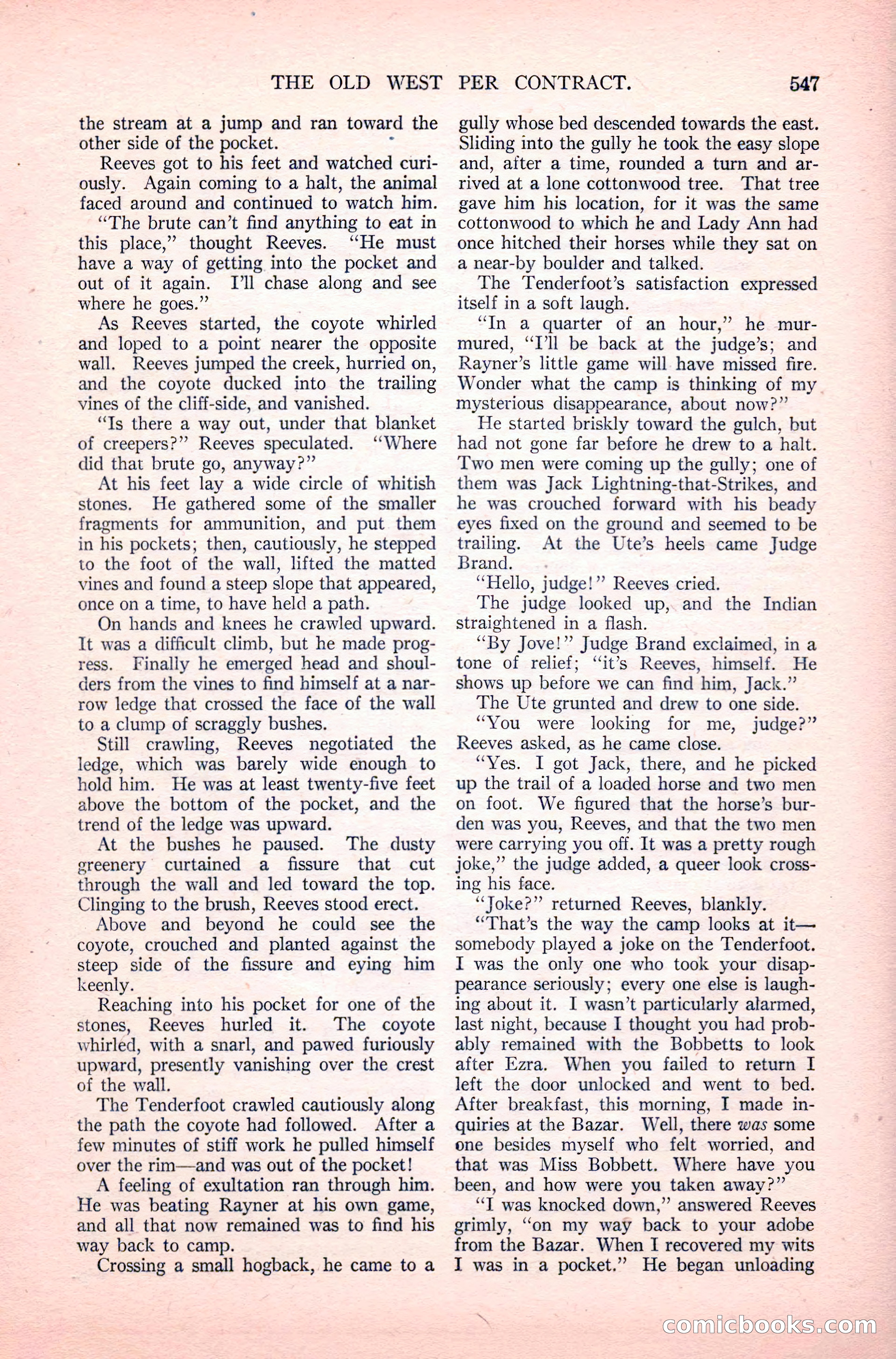
A restored page from Pulp Fiction, 1916. Page through the whole issue in the reader above.
📄 Transcribed text from this page (OCR, searchable)
Machine-transcribed from the original scan — historical spelling and the odd misread are preserved.
THE OLD WEST the stream at a jump and ran toward the other side of the pocket. Reeves got to his feet and watched curi- ously. Again coming to a halt, the animal faced around and continued to watch him. “The brute can’t find anything to eat in this place,” thought Reeves. ‘He must have a way of getting into the pocket and out of it again. Ill chase along and see where he goes.’ As Reeves started, the coyote whirled and loped to a point nearer the opposite wall. Reeves jumped the creek, hurried on, and the coyote ducked into the trailing vines of the cliff-side, and vanished. “Ts there a way out, under that blanket of creepers?” Reeves speculated. ‘Where did that brute go, anyway?” At his feet lay a wide circle of whitish stones. He gathered some of the smaller fragments for ammunition, and put them in his pockets; then, cautiously, he stepped to the foot of the wall, lifted the matted vines and found a steep slope that appeared, once on a time, to have held a path. On hands and knees he crawled upward. It was a difficult climb, but he made prog- ress. Finally he emerged head and shoul- ders from the vines to find himself at a nar- row ledge that crossed the face of the wall toa clump of scragely bushes. Still crawling, Reeves negotiated the ledge, which was barely wide enough to hold him. He was at least twenty-five feet above the bottom of the pocket, and the trend of the ledge was upward. At the bushes he paused. The dusty greenery curtained a fissure that cut through the wall and led toward the top. Clinging to the brush, Reeves stood erect. Above and beyond he could see the coyote, crouched and planted against the steep side of the fissure and eying him keenly. Reaching into his pocket for one of the stones, Reeves hurled it. The coyote whirled, with a snarl, and pawed furiously upward, presently vanishing over the crest of the wall. The Tenderfoot crawled cautiously along the path the coyote had followed. After a few minutes of stiff work he pulled himself over the rim—and was out of the pocket! A feeling of exultation ran through him. He was beating Rayner at his own game, and all that now remained was to find his way back to camp. Crossing a small hogback, he came to a PER CONTRACT. 547 gully whose bed descended towards the east. Sliding into the gully he took the easy slope and, aiter a time, rounded a turn and ar- rived at a lone cottonwood tree. That tree gave him his location, for it was the same cottonwood to which he and Lady Ann had once hitched their horses while they sat on a near-by boulder and talked. The Tenderfoot’s satisfaction expressed itself in a soft laugh. “In a quarter of an hour,” he mur- mured, “I’ll be back at the judge’s; and Rayner’s little game will have missed fire. Wonder what the camp is thinking of my mysterious disappearance, about now?” He started briskly toward the gulch, but had not gone far before he drew to a halt. Two men were coming up the gully; one of them was Jack Lightning-that-Strikes, and he was crouched forward with his beady eyes fixed on the ground and seemed to be trailing. At the Ute’s heels came Judge Brand. ‘Hello, judge!” Reeves cried. The judge looked up, and the Indian straightened in a flash. “By Jove!” Judge Brand exclaimed, in a tone of relief; “it’s Reeves, himself. He shows up before we can find him, Jack.” The Ute grunted and drew to one side. “You were looking for me, judge?” Reeves asked, as he came close. “Yes. I got Jack, there, and he picked up the trail of a loaded horse and two men on foot. We figured that the horse’s bur- den was you, Reeves, and that the two men were carrying you off. It was a pretty rough joke,” the judge added, a queer look cross- ing his face. “Joke?” returned Reeves, blankly. ‘“That’s the way the camp looks at it— somebody played a joke on the Tenderfoot. I was the only one who took your disap- pearance seriously; every one else is laugh- ing about it. I wasn’t particularly alarmed, last night, because I thought you had prob- ably remained with the Bobbetts to look after Ezra. When you failed to return I left the door unlocked and went to bed. After breakfast, this morning, I made in- quiries at the Bazar. Well, there was some one besides myself who felt worried, and that was Miss Bobbett. Where have you been, and how were you taken away?” ‘“T was knocked down,” answered Reeves grimly, “on my way back to your adobe from the Bazar. When I recovered my wits I was in a pocket.” He began unloading ECOPMICLOOOKS (S©)