
Pulp Fiction, 1916 · page 153 of 212
The Argosy, Vol. 82, No. 3 — page 153: what you’re looking at
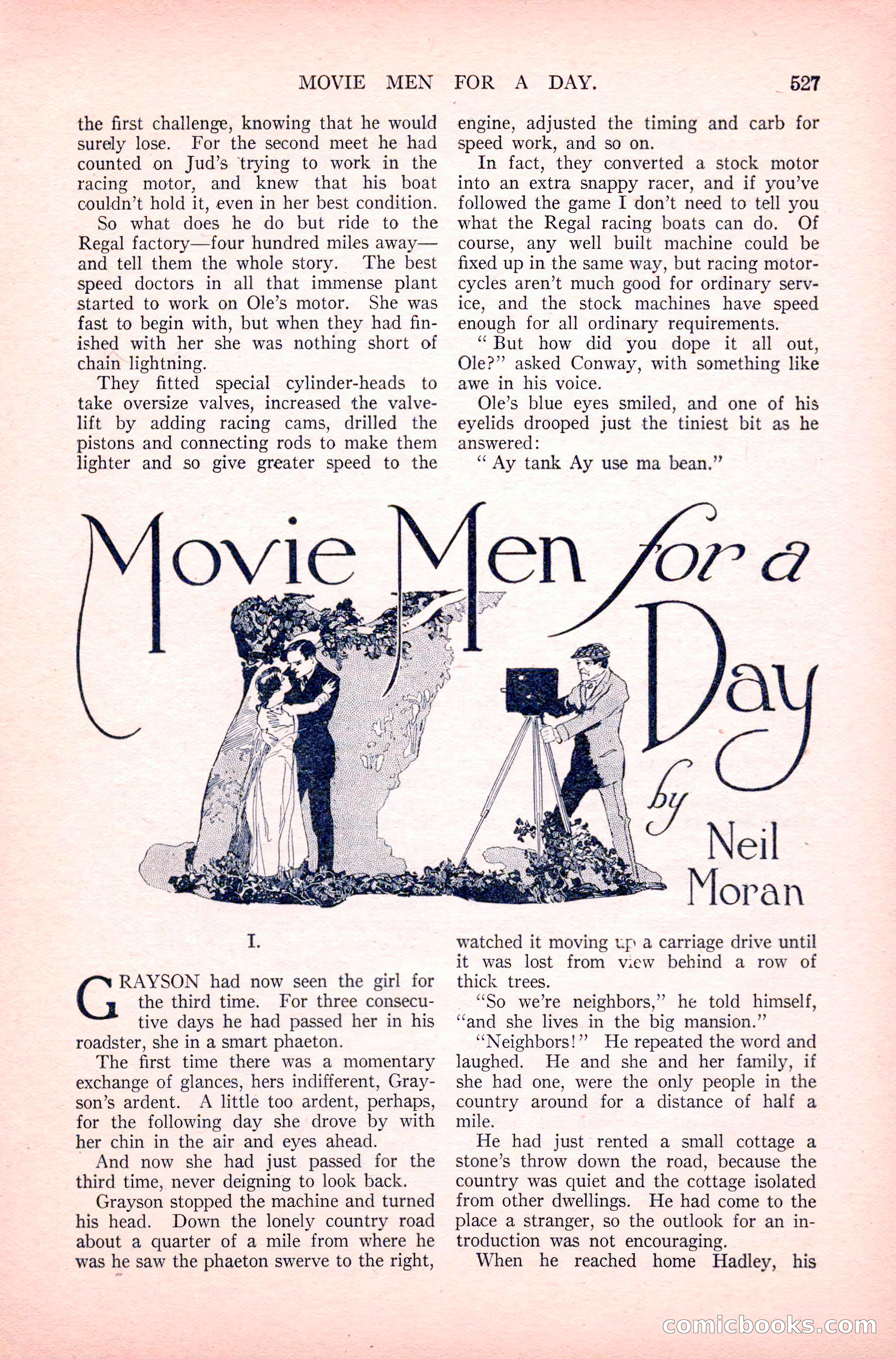
A restored page from Pulp Fiction, 1916. Page through the whole issue in the reader above.
📄 Transcribed text from this page (OCR, searchable)
Machine-transcribed from the original scan — historical spelling and the odd misread are preserved.
MOVIE MEN the first challenge, knowing that he would surely lose. For the second meet he had counted on Jud’s trying to work in the racing motor, and knew that his boat couldn’t hold it, even in her best condition. So what does he do but ride to the Regal factory—four hundred miles away— and tell them the whole story. The best speed doctors in all that immense plant started to work on Ole’s motor. She was fast to begin with, but when they had fin- ished with her she was nothing short of chain lightning. They fitted special cylinder-heads to take oversize valves, increased the valve- lift by adding racing cams, drilled the pistons and connecting rods to make them lighter and so give greater speed to the the third time. [or three consecu- tive days he had passed her in his roadster, she in a smart phaeton. The first time there was a momentary exchange of glances, hers indifferent, Gray- son’s ardent. A little too ardent, perhaps, for the following day she drove by with her chin in the air and eyes ahead. And now she had just passed for the third time, never deigning to look back. Grayson stopped the machine and turned his head. Down the lonely country road about a quarter of a mile from where he was he saw the phaeton swerve to the right, Cy ees had now seen the girl for FOR A _ DAY. _ 627 engine, adjusted the timing and carb for speed work, and so on. In fact, they converted a stock motor into an extra snappy racer, and if you’ve followed the game I don’t need to tell you what the Regal racing boats can do. Of course, any well built machine could be fixed up in the same way, but racing motor- cycles aren’t much good for ordinary serv- ice, and the stock machines have speed enough for all ordinary requirements. “But how did you dope it all out, Ole?” asked Conway, with something like awe in his voice. Ole’s blue eyes smiled, and one of his eyelids drooped just the tiniest bit as he answered: ‘““ Ay tank Ay use ma bean.” Neil Moran watched it moving up a carriage drive until it was lost from view behind a row of thick trees. “So we’re neighbors,” he told himself, “and she lives in the big mansion.” “Neighbors!” He repeated the word and laughed. He and she and her family, if she had one, were the only people in the country around for a distance of half a mile. He had just rented a small cottage a stone’s throw down the road, because the country was quiet and the cottage isolated from other dwellings. He had come to the place a stranger, so the outlook for an in- troduction was not encouraging. When he reached home Hadley, his CORMICGLOOOKS (C@)