
Pulp Fiction, 1916 · page 106 of 212
The Argosy, Vol. 82, No. 3 — page 106: what you’re looking at
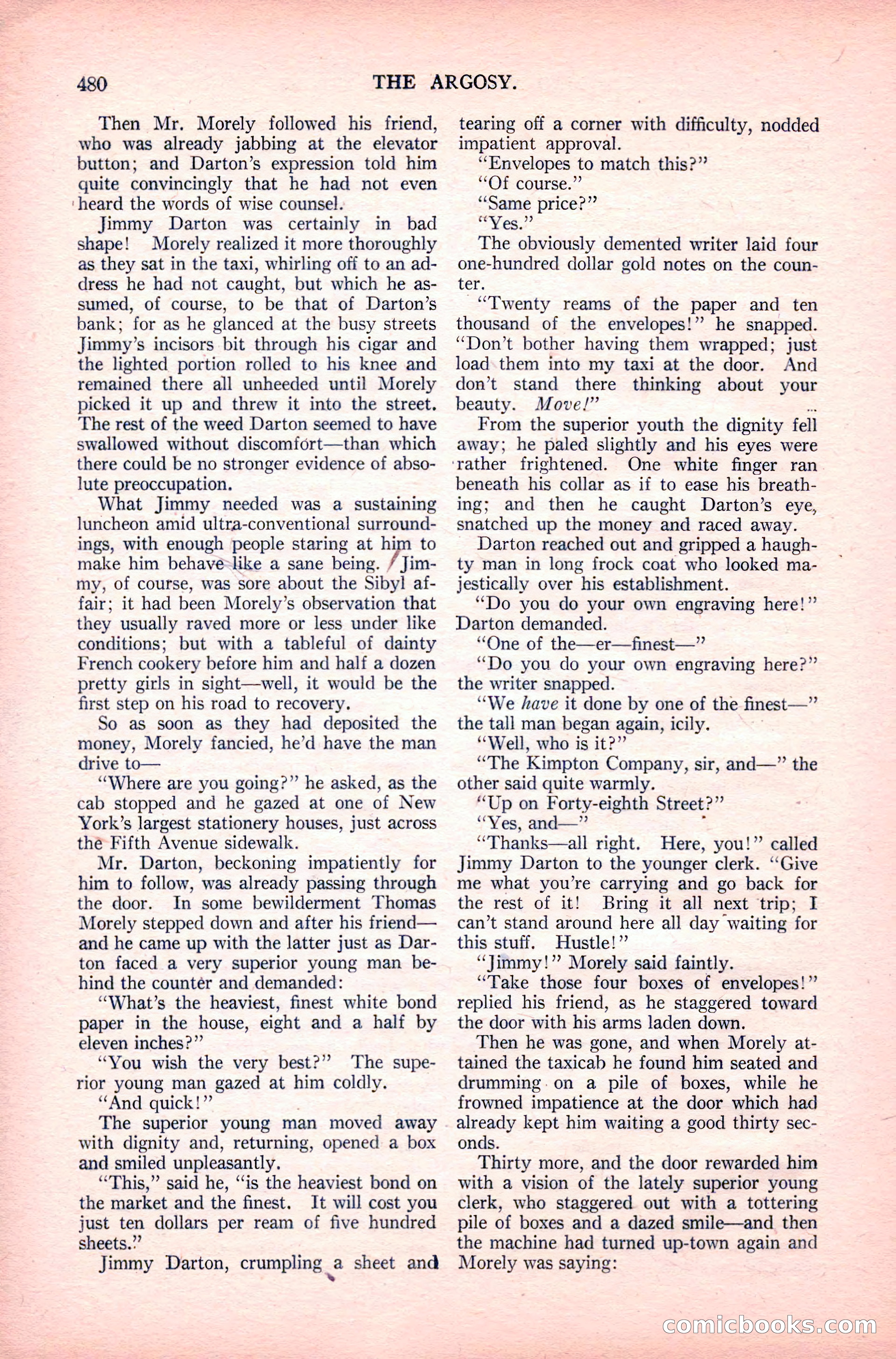
A restored page from Pulp Fiction, 1916. Page through the whole issue in the reader above.
📄 Transcribed text from this page (OCR, searchable)
Machine-transcribed from the original scan — historical spelling and the odd misread are preserved.
480 Then Mr. Morely followed his friend, who was already jabbing at the elevator button; and Darton’s expression told him quite convincingly that he had not even ‘heard the words of wise counsel. Jimmy Darton was certainly in bad shape! Morely realized it more thoroughly as they sat in the taxi, whirling off to an ad- dress he had not caught, but which he as- sumed, of course, to be that of Darton’s bank; for as he glanced at the busy streets Jimmy’s incisors bit through his cigar and the lighted portion rolled to his knee and remained there all unheeded until Morely picked it up and threw it into the street. The rest of the weed Darton seemed to have swallowed without discomfort—than which there could be no stronger evidence of abso- lute preoccupation. What Jimmy needed was a sustaining luncheon amid ultra-conventional surround- ings, with enough people staring at him to make him behave=like a sane being. / Jim- my, of course, was sore about the Sibyl! af- fair; it had been Morely’s observation that they usually raved more or less under like conditions; but with a tableful of dainty French cookery before him and half a dozen pretty girls in sight—vwell, it would be the first step on his road to recovery. So as soon as they had deposited the money, Morely fancied, he’d have the man drive to— ‘Where are you going?” he asked, as the cab stopped and he gazed at one of New York’s largest stationery houses, just across the Fifth Avenue sidewalk. Mr. Darton, beckoning impatiently for him to follow, was already passing through the door. In some bewilderment Thomas Morely stepped down and after his friend— and he came up with the latter just as Dar- ton faced a very superior young man be- hind the counter and demanded: ‘“What’s the heaviest, finest white bond paper in the house, eight and a half by eleven inches?” “Vou wish the very best?” The supe- rior young man gazed at him coldly. “And quick!” ; The superior young man moved away with dignity and, returning, opened a box and smiled unpleasantly. “This,” said he, “‘is the heaviest bond on the market and the finest. It will cost you just ten dollars per ream of five hundred sheets.” Jimmy Darton, crumpling a sheet and THE ARGOSY. tearing off a corner with difficulty, nodded impatient approval. “Envelopes to match this?” “Of course.” “Same price?” Ves,” The obviously demented writer laid four one-hundred dollar gold notes on the coun- ter. “Twenty reams of the paper and ten thousand of the envelopes!” he snapped. “Don’t bother having them wrapped; just load them into my taxi at the door. And don’t stand there thinking about your beauty. Move!” = From the superior youth the dignity fel away; he paled slightly and his eyes were ‘rather frightened. One white finger ran beneath his collar as if to ease his breath- ing; and then he caught Darton’s eye, snatched up the money and raced away. Darton reached out and gripped a haugh- ty man in long frock coat who looked ma- jestically over his establishment. “Do you do your own engraving here!” Darton demanded. “One of the—er—finest—” “Do you do your own engraving here?” the writer snapped. ‘““‘We dave it done by one of the finest—”’ the tall man began again, icily. “Well, who is it?”’ “The Kimpton Company, sir, and—” the other said quite warmly. “Up on Forty-eighth Street?” “Ves, and—” ; ‘“Thanks—all right. Here, you!” called Jimmy Darton to the younger clerk. ‘‘Give me what you’re carrying and go back for the rest of it! Bring it all next trip; I can’t stand around here all day waiting for this stuff. Hustle!” “Jimmy!” Morely said faintly. “Take those four boxes of envelopes!” replied his friend, as he staggered toward the door with his arms laden down. Then he was gone, and when Morely at- tained the taxicab he found him seated and drumming: on a pile of boxes, while he frowned impatience at the door which had already kept him waiting a good thirty sec- onds. Thirty more, and the door rewarded him with a vision of the lately superior young clerk, who staggered out with a tottering pile of boxes and a dazed smile—and then the machine had turned up-town again and Morely was saying: (EO) _DOOK (E@)