
Pulp Fiction, 1916 · page 97 of 216
The Argosy, Vol. 82 No. 2 — page 97: what you’re looking at
A restored page from Pulp Fiction, 1916. Page through the whole issue in the reader above.
📄 Transcribed text from this page (OCR, searchable)
Machine-transcribed from the original scan — historical spelling and the odd misread are preserved.
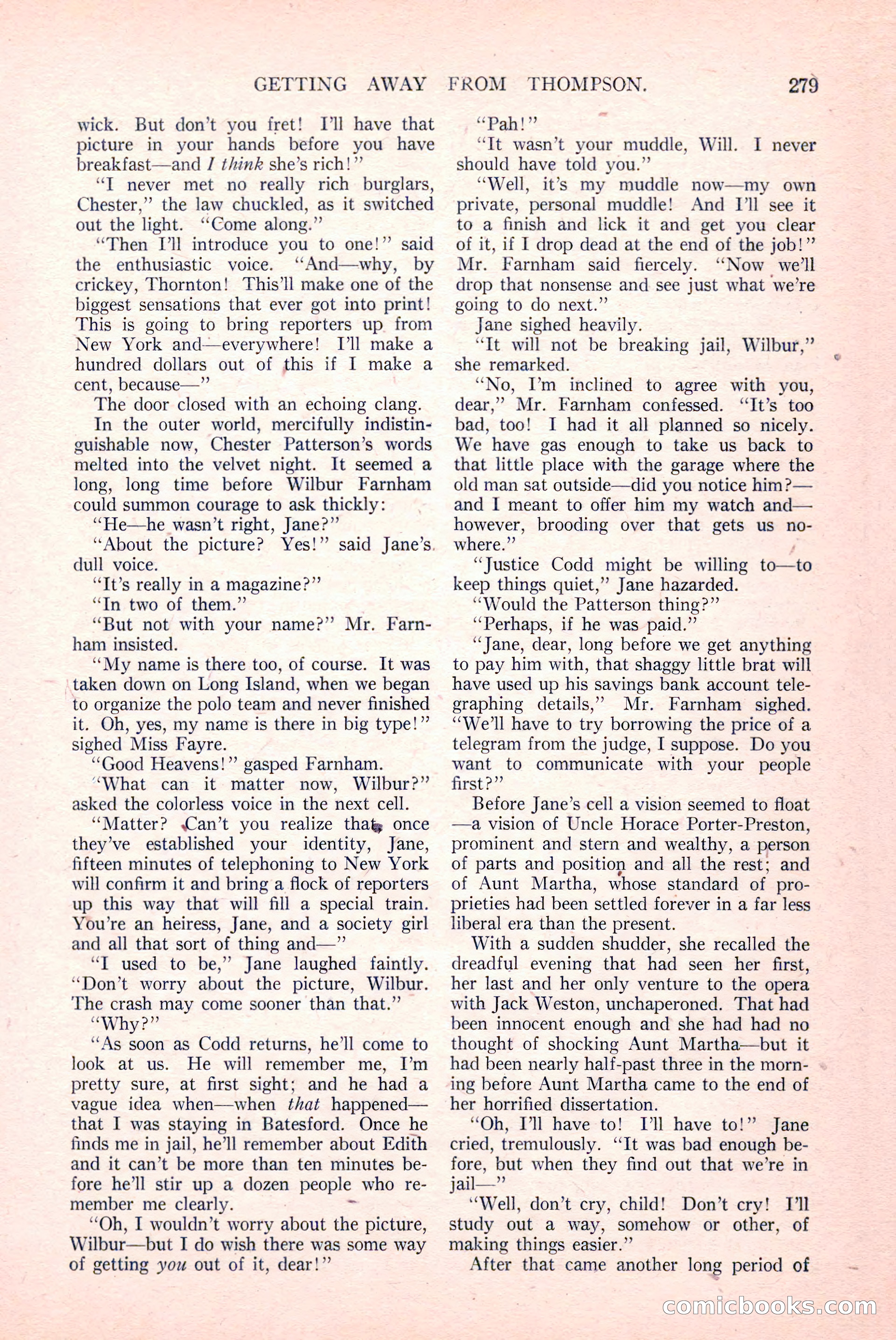
GETTING AWAY wick. But don’t you fret! Ill have that picture in your hands before you have breakfast—and J think she’s rich!” “T never met no really rich burglars, Chester,” the law chuckled, as it switched out the light. ‘Come along.” “Then I’ll introduce you to one!” said the enthusiastic voice. ‘‘And—why, by crickey, Thornton! This’ll make one of the biggest sensations that ever got into print! This is going to bring reporters up from New York and—everywhere! Ill make a hundred dollars out of this if I make a cent, because—”’ The door closed with an echoing clang. In the outer world, mercifully indistin- guishable now, Chester Patterson’s words melted into the velvet night. It seemed a long, long time before Wilbur Farnham could summon courage to ask thickly: ‘““He—he wasn’t right, Jane?” ‘About the picture? Yes!” said Jane’s. dull voice. “Tt’s really in a magazine?”’ “In two of them.” “But not with your name?” Mr. Farn- ham insisted. ‘“My name is there too, of course. It was taken down on Long Island, when we began to organize the polo team and never finished it. Oh, yes, my name is there in big type!” sighed Miss Fayre. “Good Heavens!” gasped Farnham. ‘What can it matter now, Wilbur?” asked the colorless voice in the next cell. “Matter? Can’t you realize that: once they’ve established your identity, Jane, fifteen minutes of telephoning to New York will confirm it and bring a flock of reporters up this way that will fill a special train. You’re an heiress, Jane, and a society girl and all that sort of thing and—”’ “T used to be,” Jane laughed faintly. ‘Don’t worry about the picture, Wilbur. ‘The crash may come sooner than that.” “Why?” ‘““As soon as Codd returns, he’ll come to look at us. He will remember me, I’m pretty sure, at first sight; and he had a vague idea when—when that happened— that I was staying in Batesford. Once he finds me in jail, he’ll remember about Edith and it can’t be more than ten minutes be- fore he’ll stir up a dozen people who re- member me clearly. = “Oh, I wouldn’t worry about the picture, Wilbur—but I do wish there was some way of getting you out of it, dear!” FROM THOMPSON. 279 “Tt wasn’t your muddle, Will. should have told you.” “Well, it’s my muddle now—my own private, personal muddle! And I'll see it to a finish and lick it and get you clear of it, if | drop dead at the end of the job!” Mr. Farnham said fiercely. ‘‘Now we'll drop that nonsense and see just what we’re going to do next.” Jane sighed heavily. “Tt will not be breaking jail, Wilbur,” she remarked. ‘No, I’m inclined to agree with you, dear,” Mr. Farnham confessed. ‘It’s too bad, too! I had it all planned so nicely. We have gas enough to take us back to that little place with the garage where the old man sat outside—did you notice him ?— and I meant to offer him my watch and— however, brooding over that gets us no- where.”’ “Justice Codd might be willing to—to keep things quiet,” Jane hazarded. ‘Would the Patterson thing?” ‘Perhaps, if he was paid.” ‘‘Jane, dear, long before we get anything to pay him with, that shaggy little brat will have used up his savings bank account tele- graphing details,’ Mr. Farnham sighed. ‘We'll have to try borrowing the price of a telegram from the judge, I suppose. Do you want to communicate with your people first?” Before Jane’s cell a vision seemed to float —a vision of Uncle Horace Porter-Preston, prominent and stern and wealthy, a person of parts and position and all the rest; and of Aunt Martha, whose standard of pro- prieties had been settled forever in a far less liberal era than the present. With a sudden shudder, she recalled the dreadful evening that had seen her first, her last and her only venture to the opera with Jack Weston, unchaperoned. That had been innocent enough and she had had no thought of shocking Aunt Martha—but it had been nearly half-past three in the morn- ing before Aunt Martha came to the end of her horrified dissertation. “Oh, ll have to! Ill have to!” Jane cried, tremulously. ‘It was bad enough be- fore, but when they find out that we’re in jail—” ‘Well, don’t cry, child! Don’t cry! ll study out a way, somehow or other, of making things easier.” After that came another long period of Il never COMMICLO® S (C@)